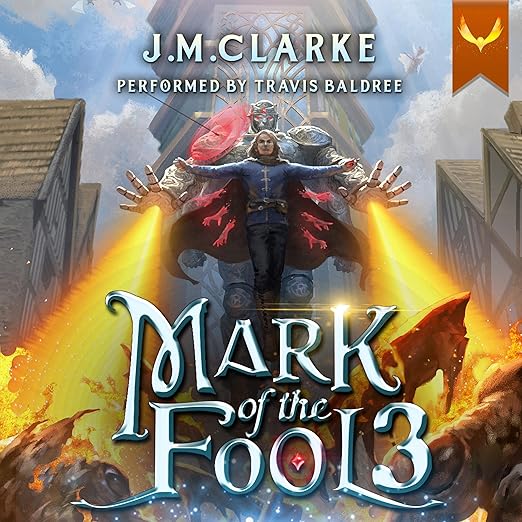
I came to Mark of the Fool 3 having already spent a significant number of hours with Alex Roth and the magic academy at Generasi, and that familiarity is the primary prerequisite for getting what this book offers. This is a series where the pleasure accumulates, where a character like Baelin the professor, who one reviewer lovingly called "the goat of all professors," becomes genuinely funny and touching the more time you spend with him, not immediately on introduction. By book three, the investment has been made, and J.M. Clarke is spending it wisely.
Travis Baldree's narration has been one of the series' defining features since the beginning, and his performance here, managing an ensemble that has grown to include Alex's new relationship, visiting family, and a city-wide Games of Roal competition, demonstrates why he was the right choice. Baldree has an instinct for comedic timing that serves this material particularly well, since Clarke regularly works with a light touch even when the underlying stakes are serious.
Games of Roal Hides a Demon Conspiracy
The book operates in two registers simultaneously. On the surface, it is a summer interlude: Alex completing his first year at the university, taking additional courses, building his relationships, and participating in the annual Games of Roal athletic competition. Below that surface, a conspiracy involving demonic attacks on the planned expedition to Thameland is building, and Alex's carefully guarded secrets are under increasing pressure.
One reviewer noted that this structure, a Games-focused volume rather than the Thameland expedition many readers were anticipating, initially felt like a detour. I understand the reaction, but Clarke earns the choice. The Games allow secondary characters like Tyris and Vesuvius to demonstrate abilities the narrative has been building toward, and the competitive structure creates natural tension that the more open-ended Thameland setup would not have provided. The demon summoner conspiracy running beneath the Games gives the lighter material an undertow that prevents the book from feeling like pure slice-of-life.
Baldree Balances Heavier Moments with Lighter Tone
The ensemble is the series' greatest asset, and this book gives more time to characters who have been present but less central in the first two volumes. The introduction of Alex's visiting family, Mr. and Mrs. Lu, brings a domesticity to the story that one reviewer found particularly affecting: "such an air of home." This is a series interested in what it means to build a life as well as gain power, and that interest distinguishes it from LitRPG and progression fantasy that focuses purely on capability escalation.
The philosophical and moral questioning that Clarke peppers through the narrative, what one reviewer called "moral dilemmas and philosophical ponderings seamlessly woven in", is more present in this volume than in the earlier books, as Alex grapples with his responsibilities and the implications of what he has discovered at the end of book two. Baldree delivers these heavier moments without letting them sink the lighter tone that defines the series.
Book Two's Discovery Still Waits Unresolved
This is book three in an ongoing series, and it functions entirely as such. The discovery Alex made at the end of book two, described in the synopsis as something that "could change his kingdom forever", is not resolved here. The book adds complications rather than removing them, and the final chapters set up a fourth volume with an unexpected visit that disrupts everything Alex has established during the summer.
Some readers who enjoyed the more externally focused conflict of the first two books found this volume's domestic and academic focus slightly slower. If you are in the series for the progression mechanics and the large-scale conflict, this book offers those elements more sparingly than the preceding volumes. If you are in the series for the ensemble and the world, this is the richest book so far.
Baldree's Narration Rewards Exclusively Returning Listeners
Exclusively for listeners who have completed books one and two. The character relationships, the ongoing secrets, and the specific significance of the Games of Roal competition all depend on established context. Travis Baldree's narration is the audiobook's primary draw and he continues to justify the format. Listeners new to the series should start at the beginning; the progression payoff of watching Alex develop his abilities from a position of apparent weakness is the foundation everything else rests on.
Common Questions
Why does book three focus on the Games of Roal rather than the Thameland expedition that book two seemed to set up?
Clarke made the deliberate choice to develop the ensemble and deepen Generasi as a location before sending the characters into the external conflict. Some readers found this a surprise; others felt it enriched the characters in ways that make the coming conflict more meaningful. The Thameland threads are still active, they inform the demonic conspiracy subplot, but the main narrative stays in the city.
Is Travis Baldree's narration performance consistent with his work in the earlier volumes?
Yes. Baldree has been the narrator for the full series and his character voices, comedic timing, and tonal range are consistent with what established listeners will expect. The introduction of new characters, including Alex's visiting family, is handled with the same character specificity he brought to the existing ensemble.
Does Mark of the Fool 3 have any meaningful progression for Alex's abilities, or is it primarily character-focused?
There is meaningful ability development, the summer courses and the Games both provide opportunities for Alex to extend his capabilities, but the book prioritizes community and character over power escalation more than the earlier volumes. Readers primarily interested in the progression mechanics will find it present but not the central focus.
What is the nature of the discovery Alex made at the end of book two, and how does it affect book three?
The synopsis describes it as something that could change his kingdom forever, and it creates the tension that underlies the book's apparently lighter summer framework. Without spoiling the specifics, the conspiracy subplot in book three is directly connected to the implications of that discovery, and it escalates toward the end of the volume.