The Short Version
- Voice: Tabitha Honeywood reads with a measured, non-judgmental calm that suits instructional content on an intimate subject.
- Big ideas: Consent and communication, kink education, keyholder responsibility
- Atmosphere: Frank, practical, unembarrassed
- Worth it?: A tasteful, genuinely useful primer for keyholders and curious partners, not erotica for casual listening.
A lockable chastity device and one consenting keyholder are the entire architecture of Lucy Fairbourne's guide, and this audiobook spends two hours and forty-six minutes explaining, patiently and without embarrassment, how that arrangement actually works in practice. Male Chastity: A Guide for Keyholders opens with definitions rather than scenes: what the practice means, and what a keyholder's role and consent actually require before anything else happens. That clinical starting point sets the tone for everything that follows.
Definitions Before Anything Else Happens
The approach here is informative rather than narrative, closer in spirit to a relationship-communication guide than to erotica, despite the catalog placement. Reviewer Greg M. described the writing as "insightful and wise," noting the author draws on real experience with the subject and writes thoughtfully about "navigating complex situations" and how to "safely adopt the lifestyle," language that signals a guide built around practice and consent rather than titillation for its own sake.
A third review, credited to a reviewer using the placeholder name "Placeholder," engages with the psychological complexity underneath the practice more directly: the way male chastity, like the cuckold dynamic it's sometimes compared to, depends on a male-orchestrated desire followed by willing submission to a female-led fantasy. That reviewer frames the book as informative specifically because it coaxes out, confidently, what a woman on the receiving end of that arrangement actually wants to hear, rather than assuming it.
Most kink-education writing tends to fall into one of two failure modes: overly clinical language that drains the subject of any emotional context, or breathless enthusiasm that skips past the practical questions a genuinely curious beginner needs answered first. Fairbourne's definitional opening, stating plainly what the practice is and what a keyholder's role requires before anything else, positions the book against both failure modes at once, and the reviews suggest that choice pays off for readers new to the subject.
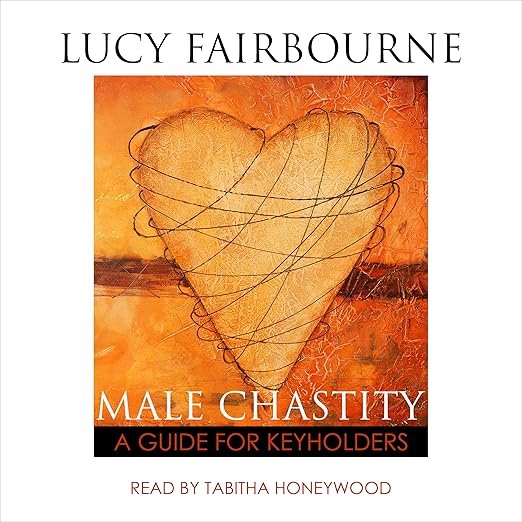
The title itself is worth noting as a trust-building choice: it states its subject plainly, "Male Chastity: A Guide for Keyholders," rather than reaching for a coy euphemism the way some adjacent titles in the category do. For a nervous first-time reader trying to figure out if a book is actually going to be useful, that directness upfront is itself a small, meaningful signal of the tone waiting inside.
Tabitha Honeywood's Calm, Unthreatening Register
Reviewer Beardo's use case is a genuinely useful way to think about this book's value: faced with three competing titles on the subject, they read all three specifically to figure out which one would be safe to hand to a partner unfamiliar with the topic, and this one won on tone, landing as clear and unthreatening rather than alarming. That's a real, practical recommendation from someone who did the comparative reading so a new listener doesn't have to.
Tabitha Honeywood narrates with what the material demands: a calm, measured register that avoids both clinical coldness and anything approaching salaciousness. I found no prior narration credits for this narrator to draw on, but the genre-fit case is straightforward, instructional content on an intimate subject needs exactly this kind of steady, non-judgmental delivery to keep a listener comfortable rather than either bored or embarrassed.
Audio carries a specific, practical advantage for a book like this one that print doesn't automatically offer: private listening, through headphones, on a commute or alone at home, without the visible cover art or the physical object itself ever needing to be seen by anyone else. For a subject many people are still working up the nerve to research openly, that discretion is a real, non-trivial reason to choose the audiobook specifically.
Two Dictionary Definitions Stand In for a Synopsis
The synopsis attached to this listing is genuinely minimal, essentially two dictionary-style definitions of "male chastity" and "keyholder" rather than descriptive marketing copy, so anyone judging the book by that alone is working with very little, closer to a product label than an actual synopsis in the usual sense. The reviews fill in real substance where the synopsis doesn't, and are worth reading closely before committing to the two hours and forty-six minute runtime.
This is nonfiction guidance on a real relationship practice, not fiction and not narrative erotica, despite sitting under the erotica genre tag with a Sex Instruction label. Listeners browsing by genre expecting a story with characters and a plot arc should recalibrate expectations before starting; what's here is closer to a short, focused instructional manual.
A 4.2 rating from 239 ratings is respectable for a niche instructional title, though it's worth noting the third review's denser, more theoretical language about consent and desire dynamics runs noticeably more academic than the other two; readers expecting uniformly simple, plainspoken guidance throughout should know the register shifts depending on which section, and which reviewer's frame of reference, they're leaning on.
At this length, the book sits toward the shorter end for kink-education audio, closer to a focused primer than a comprehensive reference someone might return to for years. That's worth knowing for anyone comparing it against longer, more exhaustive guides on the same broad subject: brevity here is a feature for a nervous first-time listener, not necessarily a substitute for a fuller resource down the line.
A real narration challenge is built into material like this, easy to overlook: a narrator has to earn a nervous listener's comfort before the actual content can land. That likely shows up as pacing rather than anything a listener would consciously notice, a slightly more deliberate, settling rhythm early on that eases into a more natural conversational cadence once the definitions are out of the way and the practical guidance begins.
Short Enough for Two Partners to Share Together
Couples already curious about the practice, or one partner trying to explain the concept clearly and respectfully to someone new to it, are the clearest audience. Anyone newer to kink education generally who wants a calm, non-judgmental starting resource rather than a deep dive into community jargon will also find the pacing and tone genuinely well suited to a first exposure. The short runtime also makes it a realistic option for partners to listen to together, in a car or at home, which a denser, more academic text might not invite in the same way.
Skip it if you're specifically looking for narrative erotica or fiction rather than an instructional guide, since it offers no plot or characters to speak of. Skip it too if you need material centered primarily on the wearer's own perspective and experience rather than the keyholder's role, since the title and structure make clear which side of the arrangement this book is written for.