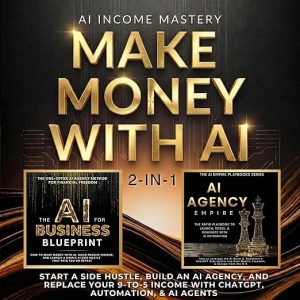
Business audiobooks about AI income have arrived in waves over the last two years, and the quality varies wildly from one to the next. Make Money with AI 2‑in‑1 by Austin Chen lands in a more useful position than most because it is structured as two complete playbooks rather than one inflated concept stretched across a full runtime. At 14 hours and 31 minutes narrated by Jamal West, this audiobook has the density of something that was genuinely planned as instruction rather than content filler.
Chen writes for a specific listener: someone who has watched the AI tool demonstrations, bookmarked the guides, and still has not converted that knowledge into a revenue stream. That framing is honest about the gap between enthusiasm and execution that most people are actually stuck in, and it is a better starting point than the usual claim that readers are about to discover a secret the gurus are hiding.
Built for Zero Portfolio and No Technical Skill
The two-book structure is the right architectural decision here. Book 1, AI Agency Empire, is built for listeners who want to launch an AI services business and move it toward significant recurring revenue, even starting from a position with no portfolio and no technical expertise. Book 2, The AI Business Blueprint, narrows the lens: choose one problem, build one AI-powered offer, land paying clients without ads or a personal brand. The two books are complementary rather than redundant. Agency Empire thinks in terms of scale. Business Blueprint thinks in terms of the single disciplined offer that makes scale possible.
Finding Underserved Ground Before Building Authority
Chen's S.I.M.P.L.E. Framework in Book 2 is the most structurally memorable piece of the collection. Six steps from problem identification to client acquisition, laid out with enough specificity that listeners can move through each stage with a concrete checklist. Whether or not every listener will complete that checklist is a different question, but the framework gives the audiobook a skeleton that holds up on a single listen.
The Strategic Battlefield Selection Method from Book 1 addresses something that genuinely derails early-stage service businesses: picking a niche where you are competing against established players with deeper proof of results. Chen's argument for finding underserved problem spaces before building authority is practical and backed by real business logic, not just motivational framing.
West Keeps the Pacing Alive, Never a Drone
Jamal West's narration is one of the more important variables in making this audiobook work. Framework-heavy business content has a natural tendency toward drone when read without variation, and West keeps the pacing alive across 14 hours. He brings an appropriate urgency to the sections about market windows and competitive timing without tipping into breathless sales-pitch energy. The result is something that functions as actual instruction rather than promotional audio.
The no-code emphasis in both books is significant for listeners who have been held back by the assumption that AI monetization requires programming ability. Chen is insistent that neither book's model requires technical background, and he designs both frameworks around tools and offer structures that operate within that constraint. For a large portion of the audience for this kind of business audiobook, that is not a minor point. It is the difference between a plan they can execute and one they will defer indefinitely.
The 7-Day Implementation System in AI Agency Empire is aimed at new service providers who need to demonstrate value before they have case studies to point to. Chen's approach to building client results quickly, which he frames as generating wow moments that justify premium pricing, is the kind of concrete early-stage tactic that generic business books avoid in favor of abstraction.
No Reviews Yet to Test the $50K Claim
The urgency language throughout both books is something listeners should notice. Phrases about windows closing and timing mattering carry an implicit claim that acting now is categorically different from acting later. That may be true in some specific niches. It is less reliable as a general rule about AI service markets, which have continued to open new opportunities even as they have closed others. Listeners who respond poorly to scarcity framing will find it woven into the motivational tissue of both books.
The absence of listener reviews at publication time is worth flagging honestly. This collection is part of The AI Business Architect Series by Austin Chen, and the frameworks are presented with confidence, but no external reader evidence yet exists to validate the $50K/month claim or the specific niche-selection methodology against real outcomes. Chen's framework design is coherent on its own terms. Whether it performs as described requires more data than exists in the audiobook itself.
Business audiobooks in the AI space also carry an inherent shelf-life problem. The specific tools named, the pricing benchmarks given, and the competitive landscape described reflect the moment of writing. Listeners accessing this audiobook a year or more after publication will need to update the tactical layer while retaining the structural logic, which is where the actual value lives.
Converting Curiosity Into a First Client
Listeners in the early stages of planning an AI services business, specifically those who have gathered knowledge but have not yet built a client base, will find the two-playbook structure well-suited to their position. Book 1 answers how to build a business. Book 2 answers how to focus it. The 14-hour runtime is appropriate for the amount of framework delivered.
Listeners who already run an established agency or who have significant AI business experience will find the material covers ground they already know. The audience here is people who are converting initial curiosity into their first clients or their first scalable offer, not people optimizing an existing operation.
Professionals who need case studies and third-party outcome data before committing to a business framework should note the current absence of listener reviews. The logical architecture of both playbooks is sound, but external validation is limited at this stage.
The Short Version
- Narrator: Jamal West reads Austin Chen's business prose with clean authority, keeping 14-plus hours of framework-heavy material from dragging into lecture territory.
- Subjects: AI monetization, service business building, no-code entrepreneurship
- Tone: Direct and action-oriented, with a time-pressure undercurrent throughout
- Bottom line: Chen's two-playbook format delivers a clear progression from service launch to agency scale, though listeners should calibrate for a market that moves faster than any audiobook can.
Good to Know
Do the two books in this audiobook collection need to be listened to in order?
They work in sequence by design. AI Agency Empire builds the service business model, and The AI Business Blueprint narrows that into a single-offer execution plan. Listening in order gives the full progression from broad strategy to focused launch, though each book can stand on its own.
Is any technical background required to apply the frameworks in this audiobook?
Chen is explicit that neither playbook requires programming ability. Both books are designed around no-code AI tools and offer structures that function without technical expertise, which is a core part of the argument for the business models he describes.
How does this audiobook differ from other AI business books available right now?
The two-playbook structure is more organized than most single-volume AI income books, giving listeners a service launch model and a focused single-offer model as two distinct frameworks. The S.I.M.P.L.E. Framework and Strategic Battlefield Selection Method are specific enough to use as actual checklists rather than abstract motivational content.