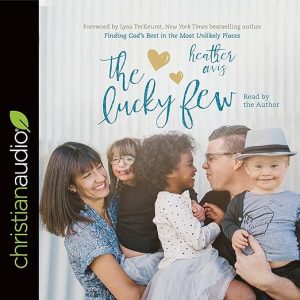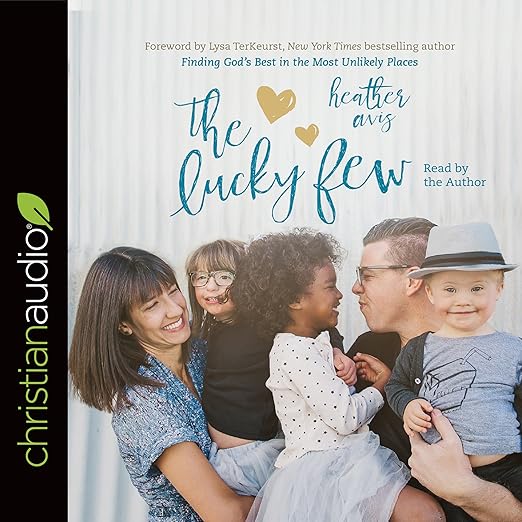
- Performance: Heather Avis narrates her own memoir, and the result is exactly what you want from a self-narrated audiobook: her voice carries the lived weight of the story in a way no hired narrator could replicate.
- What it covers: adoption and faith, parenting children with Down syndrome, redefining what a family looks like
- Feel: Emotionally open, warm, and occasionally raw
- Our call: Heather Avis's memoir about adopting three children, two with Down syndrome, is one of those audiobooks that shifts how you think about family, luck, and the stories we tell ourselves about the life we planned.
Macyn Hope's arrival in Heather Avis's life was not planned. Neither was Truly. Neither was August. Lucky Few is the audiobook of Avis's memoir about how a couple who began their parenthood journey with entirely conventional hopes found themselves moving toward something stranger, harder, and more beautiful than anything they had imagined, with three adopted children, two of whom have Down syndrome, as the living proof of what saying yes to the completely unplanned can look like over years of real life.
Avis narrates the book herself, and at five hours and thirteen minutes, that choice is a significant gift to the listener. Her voice carries the specific authority of someone describing their own children, their own doubts, their own moments of terror and unexpected grace. She holds a 4.8 rating across nearly eight hundred reviews, a number that speaks to how directly and consistently this memoir lands for the people who find it at precisely the moment they need it. Reviewer Tracie C Parker describes receiving a prenatal Down syndrome diagnosis at twelve weeks and reaching out to find stories that could help her understand what was ahead. Lucky Few was one of those stories, and that describes the kind of work this audiobook is doing in the world.
Found Herself in the Story Anyway
Avis is a skilled memoirist in the sense that matters most: she does not smooth out the hard parts or retrofit meaning onto experiences that were genuinely terrifying at the time. The path to Macyn involved watching a very sick child be placed with their family and choosing to believe they were capable of what that child needed, including open-heart surgeries and the particular challenges of raising a child whose developmental journey looks different from any standard parenting book's described arc. She is honest about how terrifying that felt, and she does not rush toward the comfort of retrospective certainty.
The faith dimension of Lucky Few is real and present throughout the narrative. Avis frames her story explicitly within her relationship with God, and that framing is not incidental or decorative. It is the structure within which she understands her own choices and finds meaning in outcomes she could not have anticipated. For listeners who share that context, the spiritual narrative adds considerable depth. For those who do not, the emotional truth of the story transcends the theological language in which Avis tells it. Reviewer Diane GP notes having come to the book without either having adopted a child or having a child with Down syndrome, and finding herself in the story anyway, in the infertility struggles, the adoption process, the particular tenderness of choosing a family that looks different from every expectation you carried into adulthood.
Avis's Warmth Doesn't Fully Translate to Text
The audiobook format serves this particular memoir unusually well. Avis's self-narration has a warmth and directness that does not fully translate to cold text. When she describes the first time she saw Macyn, or the particular fear of signing adoption papers for a child with an uncertain medical future, her voice carries something that a reader's own interior narration simply cannot supply. Holly, a reviewer who describes adopting three children with multiple special needs, says she devoured the book in a single sitting and was moved to tears by how accurately it reflected her own doubts and fears about saying yes to the unknown. That specific recognition is the power of memoir written and read by its author.
The book also serves a practical and informational purpose for families navigating Down syndrome diagnoses, adoption processes, or the intersection of both. Avis writes honestly about open-heart surgery recovery, about the public education system, about birth family relationships, about the administrative and emotional complexity of building a family through adoption. This is not a polished inspirational narrative that conveniently elides difficulty. It is a truthful account of what the path actually costs and what it gives back over time, and that balance of honesty and hope is what makes it genuinely useful rather than merely comforting.
The Title Waits Until the Final Sections
The title is doing specific, deliberate work. The phrase lucky few describes people who can recognize that the most beautiful things in life are often found precisely in differences, in the unplanned turns and the children and challenges you did not choose and would not have chosen in advance and cannot now imagine being without. That framing is developed gradually across the narrative rather than stated up front and moved past, and the audiobook earns it by the time it arrives with full weight in the final sections.
Listeners approaching this book without a Christian faith background should know that Avis's trust in God's plan is foundational to her narrative structure throughout. She does not argue for her faith as a theological position but simply lives it on the page across the memoir. The humility and genuine doubt she brings to that faith are as present as the conviction, and that honesty keeps the book from feeling like testimony in the promotional or prescriptive sense of the word. The spiritual content is woven into the story rather than imposed on it.
Still Living and Still Loving This Life
Parents of children with Down syndrome, people considering adoption, and anyone who has received an unexpected prenatal diagnosis will find this audiobook speaking directly and specifically to their situation. Reviewer Tracie C Parker's comment that she wished every expectant parent receiving a prenatal Down syndrome diagnosis could receive this book is the clearest statement of its primary audience and its most essential use.
It is equally powerful for readers interested simply in what honest memoir about unconventional family-building looks like at its best. Avis is not a celebrity or a professional author in the traditional sense. She is a parent writing from inside a life she is still living and still loving. That authenticity is audible throughout every one of the five hours, and it is the quality that makes Lucky Few one of the more memorable memoirs in the parenting and adoption space regardless of the specific circumstances a listener brings to it.
Does Heather Avis narrate the Lucky Few audiobook herself?
Yes. Avis narrates the entire memoir herself, and the self-narration is one of the audiobook's most significant strengths. Her voice carries the emotional authenticity of someone describing their own life, their own children, and their own faith journey in a way a hired narrator could not replicate.
Is this audiobook relevant for listeners who are not in the adoption process or parenting a child with Down syndrome?
Yes. Multiple reviewers with no direct connection to adoption or Down syndrome describe finding themselves in the story through experiences of infertility, unexpected life changes, or the universal question of how to embrace a life that does not match the one you planned. The memoir's emotional range is wider than its subject might suggest.