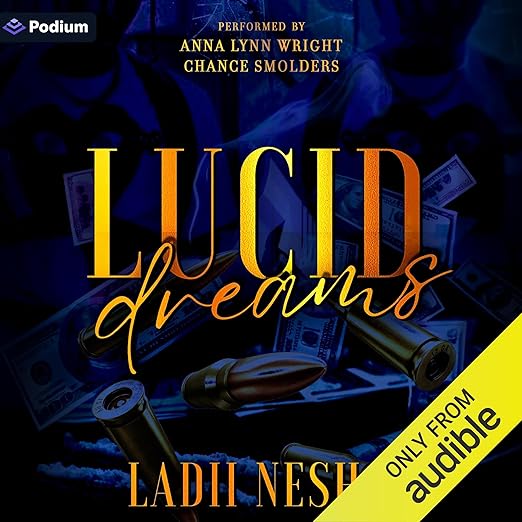
Key Details
- Voice: Chance Smolders handles the dual emotional register of the story, moving between sharp comedic moments and genuinely raw scenes without losing consistency.
- Big ideas: Childhood trauma and its long shadow, twin bonds under pressure, love as disruption of survival patterns
- Atmosphere: Emotionally intense with genuine humor as counterweight
- Worth it?: Lucid Dreams earns the emotional response it provokes, with characters whose damage is drawn honestly and whose growth feels like actual work rather than plot convenience.
I started Lucid Dreams on a slow weekday afternoon, expecting a breezy urban fiction listen, and ended up sitting in my car in the parking garage for an extra twenty minutes because I could not find a good stopping point. Ladii Nesha writes with a particular kind of momentum that does not let you settle. The story moves fast, the characters talk the way people actually talk when they are not performing for anyone, and the humor arrives in exactly the moments when the emotional weight has built to a point where you need it most.
The setup involves twins, Nite and Dai, who survived something terrible in childhood and have spent their adult years in what the synopsis describes as the fast lane: partying, substance use, getting money, and keeping emotion at a safe distance. Their coping mechanisms have calcified into personality. When Nite literally knocks Hunter off her feet, she is immediately put off by his rude demeanor, and she should be. The novel's central tension is whether these people, all of whom have excellent reasons for their defenses, can find enough trust in each other to lower them.
Is Lucid Dreams Worth Your Time?
Nesha's handling of childhood trauma is honest without being gratuitous. Hunter grew up with an alcoholic father and bore her child young, a circumstance that the novel presents not as background tragedy but as the thing that actually saved her, giving her a reason to build something better. Nite and Dai's abandonment by both parents shaped them into people who protect themselves by making it hard to care about them. The book understands this as a logic, not a character flaw, and that understanding is what keeps the romance from feeling like a simple redemption narrative.
The humor is worth dwelling on. Several reviewers highlighted it specifically, and one described laughing their butt off as a central part of the reading experience. This is not incidental. Nesha uses comedy strategically, deploying it at high-tension moments to keep the story from becoming suffocating. The twins' dynamic, in particular, generates a lot of this: their brother relationship is clearly established as the most stable relationship either of them has, and watching them navigate everything else through that lens creates both comedy and genuine poignancy.
Hunter herself is not a passive participant in her own story. She has built a life under difficult circumstances and knows exactly what it costs to let someone past the perimeter. Her resistance to Nite is not the romance-novel kind that exists only to be dissolved by a grand gesture. It is rooted in specific experience, and watching that resistance evolve is one of the more satisfying arcs in the book.
The Best Parts of Lucid Dreams
Chance Smolders brings consistent energy to an eleven-hour performance that demands a lot of emotional range. The narration handles both the comedic and the raw scenes without tipping into either mugging or melodrama, which is exactly right for material that depends on walking that line. At nearly twelve hours, the story earns its runtime. The character development does not feel rushed, which is what makes the eventual emotional payoffs land rather than feel manufactured.
Before You Commit to Lucid Dreams
One reviewer who gave the book four stars cited author errors in the physical edition, noting some proofreading issues. The audiobook experience may differ, but listeners who notice continuity details should be aware. The larger narrative involves the blurred line between past and future, loyalty and greed, which the title gestures toward, and the thriller elements in the back half of the book are more prominent than the premise might suggest. This is not a quiet character study. Events escalate.
The Podium Audio production from May 2025 is relatively recent, and the sound quality reflects contemporary production standards.
Should You Listen to Lucid Dreams?
Readers of urban fiction and African American romance who want emotional depth alongside the expected genre pleasures. Listeners who appreciate protagonists with genuine backstory rather than trauma as decoration. Anyone who enjoyed authors like Wahida Clark or similar voices in the contemporary street-lit space will find Nesha's style familiar but distinctive. If you need your romantic leads to be immediately likable, this one will require patience. The payoff comes, but these characters earn trust slowly, which is exactly the point.
Frequently Asked Questions
Is Lucid Dreams a standalone or the start of a series?
The audiobook listing does not indicate a series continuation, and the story delivers a complete arc for Nite, Dai, and Hunter. However, the world and character relationships are rich enough that readers frequently express wanting more, and whether Nesha revisits these characters appears to be an open question.
Does the story resolve Hunter and Nite's relationship or end on a cliffhanger?
Reviewers consistently describe feeling that the story reached a meaningful conclusion by the end, with one noting that the character growth felt honest and not rushed. There is no indication of a cliffhanger ending.