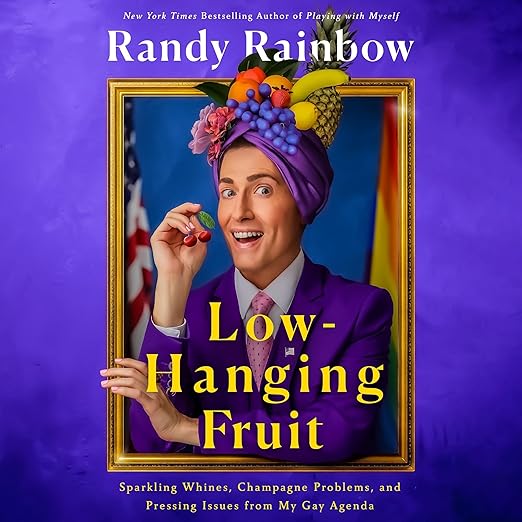
Quick Take
- Read by: Randy Rainbow narrating his own audiobook, with contributions from Pamela Adlon and his mother Gwen, is a fully produced audio experience rather than a simple read, complete with sound effects and music.
- At its heart: Political satire and social commentary, LGBTQ+ identity and dating, American absurdism
- Vibe: Tartly funny, occasionally tender, consistently irreverent
- Short version: An audiobook that functions as a comedy performance, a political dispatch, and a surprisingly personal confessional all at once, with production values that reward the audio format specifically.
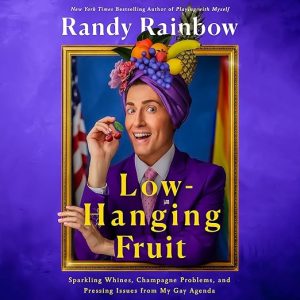
The scene that sets the tone for Low-Hanging Fruit is not one you read. It is one you hear. Randy Rainbow narrating his own essay collection, which is the only casting that makes sense for material this self-referential, comes equipped with sound effects, music, and contributions from Pamela Adlon and his mother Gwen Rainbow, the latter making what the synopsis describes as the most highly anticipated sequel since Top Gun: Maverick. The San Francisco Chronicle's description of the production as so rich with sound effects, additional voice actors and music is not hyperbole. This audiobook treats the format as an opportunity for full-scale comedy production rather than simply a way to deliver a print book to listeners who prefer audio. It is a distinct object with its own qualities and its own reasons to choose it over the written version.
Rainbow is best known for his viral political parody videos, and his first book, Playing With Myself, established him as a New York Times bestselling author with a clear voice and a specific audience. Low-Hanging Fruit is his second essay collection, and it arrives with the confidence of someone who knows exactly who he is writing for and does not particularly care who else is in the room. Kirkus Reviews described it as tart, sassy, and hilariously funny from start to finish, which is an accurate characterization but misses the thread of genuine personal disclosure that runs through the comedy and gives it weight beyond pure political entertainment.
Political Complaints That Turn Personal and Lonely
The central conceit is a good one: Rainbow positions himself as a privileged white male complaining about a bunch of shit, which is both self-aware and a pre-emptive disarmament of the obvious critique. The complaints in question range from Donald Jessica Trump and the GOP to TikTok dancing grandmas, Elon Musk, and the specifics of life on dating apps, including a story involving a fireman and goggles that is left, wisely, as a tease in the synopsis rather than fully described. The comedy works at multiple registers simultaneously: there is the political satire Rainbow has built his brand on, and then there is something more personal underneath it, a real account of loneliness and desire and the particular experience of navigating gay identity in America in the current political climate. Both registers are present throughout and neither one undermines the other.
Reviewer MrsCroz noted that the audiobook uses humor to share some very personal and often traumatic things and that someone may read this and realize none of us live a perfect life. This is the element that distinguishes Rainbow's work from pure political comedy. The personal disclosures, the sex talk, the honest account of what it is like to be a certain kind of gay man in a certain kind of America, are handled with the same sharp wit as the political material but carry a different emotional weight. Library Journal's description of it as providing laughter as a tonic for troubled times is accurate, but the tonic is more complex than that framing suggests: it also contains a genuine reckoning with what it means to be alive and publicly known and privately lonely at the same time.
Sound Effects and Adlon Elevate the Transitions
The production is the reason to choose this audiobook over the print version, and it is a substantial reason. Rainbow narrates with the same camp precision and comic timing that made his videos viral, and the added sound effects and music are not decorative but functional: they elevate certain essay transitions into genuinely theatrical moments. The contributions from Pamela Adlon and Gwen Rainbow add texture and vary the listening experience in ways that a solo narrator cannot. Adlon in particular brings a quality of real-person energy that grounds the more heightened comedic material and creates a sense of genuine conversation rather than solo performance.
The Chinchilla Silver Persian cat Tippi, who dishes about her life chez Randy, is a recurring bit that works better in audio than it would in print because Rainbow commits to the voice fully and the production supports it with appropriate sound. This is the kind of comedy that requires performance rather than just prose, and the audiobook format is its natural home. Reviewer Guy McLimore, writing in October 2024, captured something real: this is material that engages with its cultural moment directly and benefits from being heard in proximity to the events it describes. The specificity of the political targets makes the comedy more alive when the targets are still in the news cycle.
Gwen Rainbow Turns Political Talk into Warmth
The political satire sections are the most energetic and the most familiar to Rainbow's existing audience. The more personal material, particularly the sections about dating, desire, and the complications of being publicly known in ways that make ordinary intimacy strange, is where the audiobook reveals a register that his video work does not typically reach. These passages are worth listening to carefully because they are doing something different from the political comedy, and that difference is where Low-Hanging Fruit becomes more than its premise suggests from the outside.
The maternal interlude with Gwen Rainbow is a consistent source of genuine comedy that doubles as something warmer. The dynamic between a gay Jewish comedian and his Jewish mother discussing American politics and his personal life is a genre unto itself, and Rainbow handles it with an affection that never tips into sentimentality. For listeners who found the mother-son dynamic in Playing With Myself one of the highlights, this sequel delivers on that expectation fully and with additional production values behind it.
Six Hours for an Audience Already Self-Selected
This audiobook is for listeners who want their political satire warm, LGBTQ+-centered, and willing to be vulnerable in between the punchlines. Rainbow's audience is self-selected and he knows it: this is not a book designed to persuade anyone of anything they did not already believe about American politics. It is, as Library Journal suggests, a sharp, sassy dispatch from someone who has decided that comedy is his response to chaos and has gotten very good at it. Those who do not share Rainbow's general political orientation will find the content more irritating than entertaining, and the audiobook does not spend time trying to persuade them otherwise. For everyone else, the production values, the genuine personal disclosure, and the consistently precise comedic timing make this audiobook six hours and fifty-three minutes of real entertainment that the audio format serves better than any other.
Frequently Asked Questions
How does the audiobook production of Low-Hanging Fruit differ from a standard author-narrated audiobook?
Significantly. The San Francisco Chronicle specifically called out its sound effects, additional voice actors and music, and the production includes contributions from Pamela Adlon and Gwen Rainbow throughout. Some essay transitions have been elevated into theatrical audio moments that do not exist in the print version. This is a produced audio experience rather than a reading of the book.
Does this audiobook require familiarity with Randy Rainbow's viral video work?
No. The essays are self-contained, and Rainbow introduces his perspective and sensibility clearly within the audiobook itself. That said, listeners who know his political parody videos will find additional resonance in how the written voice relates to the performance voice they already know.
Is this audiobook primarily political satire, or does it include substantial personal material?
Both in roughly equal measure. The political targets, Trump, the GOP, Musk, are prominent, but reviewer MrsCroz correctly identified a significant personal thread involving dating, desire, LGBTQ+ experience, and genuine moments of vulnerability. The personal material is distributed throughout rather than confined to a single section.
Does the audiobook include the full conversation with Gwen Rainbow, and is it as entertaining as the synopsis suggests?
Yes, the mother-son dynamic is fully present and is one of the audiobook's consistent comedy highlights. The combination of Randy's deadpan and Gwen's genuine Jewish-mother energy is a real comedic partnership, and the sequel-framing the synopsis uses is earned: it delivers on what fans of the first book's maternal interlude will be hoping for.