In Brief
- Performance: Byron Katie reads her own book, which means one voice carries both halves of every transcribed session, including the participants she was questioning.
- What it covers: Four questions applied to one thought at a time, suffering located in thinking rather than circumstance, the turnaround, acceptance as practice.
- Feel: Plain, patient, and unexpectedly unmystical.
- Our call: A small method demonstrated at length, worth hearing if you have one specific thought you cannot put down.
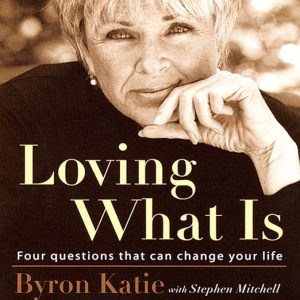
Byron Katie woke up one morning in a state of absolute joy, after ten years of sinking into depression, rage, despair, and thoughts of ending her life. That is the founding scene of Loving What Is, and everything the book teaches comes out of it: four questions she says ended her own suffering, handed to anyone willing to apply them to a specific problem. The audiobook runs nine hours and seven minutes, published by Random House Audio, and Katie reads it herself, which turns out to matter more here than it usually does.
Four questions, applied to one thought at a time, plus a step she calls the turnaround. That is the whole method, and its smallness is deliberate. Katie's claim is not that your problem is imaginary but that your thinking about the problem is the part doing the damage, and that trying to let go of a painful thought never works; what works is inquiring into it until the thought lets go of you. Whether that strikes you as profound or as a semantic dodge will depend on your temperament, and the book is refreshingly unbothered by the question. It is not arguing. It is demonstrating.
One five-star response set expectations correctly, and the warning bears repeating: if you want philosophy or a theory of truth, this is not that book. It is not complicated and it is not the least bit philosophical. What it offers instead is four short questions you can run by yourself against the endless stream of thoughts that overwhelm and obsess you. That reader could not remember buying the book at all and simply started using it on one particularly difficult day, which is a common enough route into something like this.
Demonstrations are the actual substance here, and the book's most distinctive feature. Rather than explaining the method and leaving you to it, Katie sets down transcripts of sessions with real people working through real problems: a wife ready to leave a husband who wants more sex, a Manhattan worker frozen by fear of terrorism, a woman suffering over a death in her family. You hear the four questions applied to circumstances that do not resolve neatly, and the range of that selection is the point. If the method only worked on trivial irritations it would not be worth nine hours.
Highlights
Consider how the book is actually built, because that is where the audio version earns its keep. The transcripts are dialogues. Katie asks, a participant answers, Katie asks again. In print those exchanges sit on the page as a script, names in front of the lines, and a reader processes them as a document. Read aloud by the person who conducted them, they become what they originally were: conversations. The questions arrive as questions rather than as headings, and material that was always speech is returned to speech.
Self-narration also settles a problem this book would otherwise have. The material is intensely first-person: her own collapse, her own recovery, her own certainty. An actor performing that certainty would sound like an actor performing certainty, and a listener would spend nine hours deciding whether to believe the voice. Hearing it from the person who lived the morning in question removes the question entirely. You may still reject the method. You will not be wondering who is talking.
Portability helps too. The four questions are short enough to carry away, which matters because practice books usually fail in audio by asking you to write things down. Loving What Is asks less: four questions and a turnaround, memorable after one pass, applicable while you are doing something else entirely. The transcripts do the teaching, the questions do the work, and neither part requires a pen.
What to Watch For in Loving What Is
Content first. The opening material covers a decade of worsening depression including thoughts of suicide, and the sessions that follow take on grief, a failing marriage, and paralyzing fear. None of it is sensationalized, but the book gives no warning either, and a listener going through a fragile stretch should know what the first hour contains before pressing play.
Strangest feature of this listing is its review column, which is odd in an instructive way. All five entries sit at five stars. One of them, filed from the United Kingdom, is written explicitly in reply to negative comments about the book, describing an urge to defend Katie's work against them before turning the four questions on that urge and concluding the critics had taught as much as the admirers had. That is the method being applied to the review page itself, which is either the best possible advertisement or a closed loop, depending on your view. It also establishes that critical responses exist somewhere, and that not one of them appears here.
The broader caution is the obvious one. A method that reframes suffering as a thinking problem can slide, in careless hands, into telling people their pain is their own fault. Katie does not say that, and the transcripts are careful about it: the wife considering leaving is not told her marriage is fine, and the woman grieving is not told her grief is a mistake. But four questions are portable, and portable ideas get used carelessly by people who are not being careful at all. If you have met The Work secondhand and disliked it, the book itself is gentler than its downstream users.
Who It's For
If you are stuck on one specific recurring thought, this will land. If you want a framework explaining why you feel the way you do, it will not. That is the cleanest way to split the audience. The book is not diagnostic and never pretends to be; it is a procedure for interrogating a single belief, and its best use is narrow and repeated rather than broad and once. Listeners who have found contemplative writers persuasive in theory and impossible in practice are an unusually good fit, and one response filed from Germany describes exactly that arc: years of reading Eckart Tolle without managing to practice any of it, then a method that finally made the reading usable. Anyone in acute distress should treat this as a supplement to real care rather than a substitute for it, and anyone allergic to the language of spiritual awakening should know the book speaks it, though considerably less than its reputation suggests.
Common Questions
Is this audiobook religious or spiritual in nature?
Neither, quite. It is filed under health and wellness with a psychology and mental health tag, and the description frames the method as practical inquiry rather than as a belief system. The vocabulary of awakening does appear, but the four questions themselves ask for no faith commitment.
Does the audiobook include worked examples or only theory?
Examples dominate. The description promises you will hear people working through The Work with Katie across a wide range of problems, from a marriage under strain to a fear of terrorism to a death in the family. The instruction is short; the demonstrations fill most of the runtime.