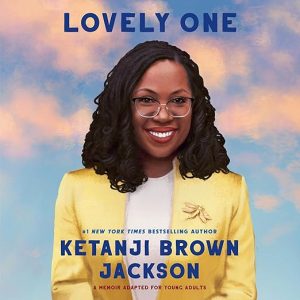
Justice Ketanji Brown Jackson's high school speech club is where this audiobook first comes alive with the specific texture that makes memoir worth listening to rather than simply reading. Her account of discovering oratory as a space where her voice mattered, delivered in her own voice nearly four decades later, creates a listening experience that the printed page cannot replicate in quite the same way. Lovely One (Adapted for Young Adults) is a memoir with a clear dual audience: young readers navigating questions of identity and ambition, and adult listeners who will find their own experiences of isolation and persistence reflected in a story that arrives from a very particular historical vantage point.
The Young Adult adaptation adds a preface and epilogue written specifically for this edition, as well as an exclusive high school prize-winning speech that functions as both a historical document and a demonstration of the speaker Jackson was already becoming. Her writing does not talk down to younger readers. The imposter syndrome she describes at Harvard, the loneliness of being one of very few Black students at her Florida high school, and the sustained difficulty of working in the legal field as a Black woman are rendered with the kind of specificity that resists easy consolation. The memoir does not promise that hard work solves everything. It acknowledges the institutional weight of systemic barriers while insisting, through the evidence of Jackson's own life, that persistence through those barriers is possible and worth attempting. That balance is difficult to achieve in memoir aimed at young readers, and it is the book's most significant accomplishment.
Jackson's parents gave her the nickname Lovely One, and the memoir spends real time examining what that name meant as both protection and expectation, a declaration of value made into her before the world had an opportunity to contradict it. That framing is not saccharine. The book is honest that parental belief and institutional reality can exist in painful tension, and that navigating between them requires more than confidence. It requires the kind of community Jackson found, eventually, in places she did not expect: speech club, musical theatre, the network of people who showed up during her confirmation hearings. The young adult adaptation does not sanitize the professional difficulties Jackson encountered as a Black woman in law. Listeners expecting a story of smooth ascent will find instead an honest account of incremental progress, setbacks, and the decision to keep going despite both.
The Best Parts of Lovely One (Adapted for Young Adults)
Ketanji Brown Jackson narrating her own story at nearly thirteen hours is a substantial commitment, but the decision to listen rather than read pays off throughout. Her pacing in passages about her Senate confirmation hearings is noticeably different from the warmth she brings to childhood memories, and that shift in vocal register communicates something about the emotional cost of those proceedings that no third-party narrator could interpret with equivalent accuracy. The Harvard section, in particular, benefits from her voice. When she describes homesickness and the disorienting experience of being surrounded by students who seemed to belong effortlessly while she felt like an imposter, the vulnerability is real and audible rather than described.
The audiobook format makes the speech excerpt extraordinarily effective. Hearing the same voice that would eventually be sworn in as a Supreme Court Justice delivering a high school competitive speech creates a retrospective that deepens the memoir's argument about who she was becoming and when. Reviewers who have read the book note its accessibility and its capacity to hold attention across many hours, and the narration amplifies both qualities. Readers who have engaged with similar memoirs from Michelle Obama's Becoming or Sonia Sotomayor's My Beloved World will recognize the genre but will find Jackson's legal career details and the specific context of the Supreme Court nomination give this book its own register entirely. The musical theatre group at Harvard is one of the memoir's more surprising throughlines. It is where Jackson found community when the academic environment felt isolating, and it becomes a structural metaphor for the kinds of belonging she was learning to build rather than wait for.
Before You Commit to Lovely One (Adapted for Young Adults)
Watch for how Jackson handles the tension between her parents' belief in her possibilities and the external world's resistance to those possibilities. The memoir is structured to show how specific moments of connection, a debate coach, a professor, a friend who recognized what Jackson was going through, accumulated into a network of support that made the harder stretches survivable. These connections are not presented as luck or as evidence that if you are good enough the right people will find you. They are presented as relationships Jackson worked to build and maintain, often at personal cost. That emphasis on chosen community as a survival strategy is one of the memoir's most useful arguments for the young adult audience the adaptation addresses.
The confirmation hearing section arrives late in the narrative, but its emotional weight depends entirely on everything that came before it. Jackson's account of sitting before the Senate Judiciary Committee, the specific quality of the scrutiny she was subjected to, the endurance that sequence required, reads differently once the listener has been with her through the preceding twelve-plus hours. The exclusive high school speech included in this edition is worth the listen on its own terms. It is the earliest surviving public record of the voice that would eventually become one of the most consequential in American legal history, and hearing it within the memoir's arc gives it a meaning the original occasion could not have predicted.
Who Should Pick Up Lovely One (Adapted for Young Adults)
Young listeners aged twelve and up will find this audiobook genuinely accessible and emotionally honest about the experience of feeling different, working hard, and not always knowing whether that hard work will be enough. Adult listeners who enjoyed the original memoir will find the Young Adult adaptation adds meaningful new material without reducing the substance of the original. This is a strong choice for school library collections and family listening. Skip it if you are looking for a political biography focused on legal argument rather than personal narrative. The book is a memoir first and an institutional history second, and listeners who want deep analysis of Supreme Court jurisprudence will need to supplement with other sources.