Before You Press Play
- Read by: Gary John Bishop narrates with the direct Scottish brogue that made Unfu*k Yourself compelling; the voice suits the no-nonsense content exactly.
- At its heart: personal responsibility in relationships, self-sabotage patterns, commitment versus performance of commitment
- Vibe: Blunt and energizing, with occasional moments of unexpected gentleness
- Short version: A compact, confrontational examination of why relationships fail that points at the listener rather than the partner, delivered with the conviction of someone who has had the conversation many times.
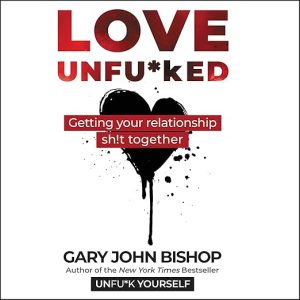
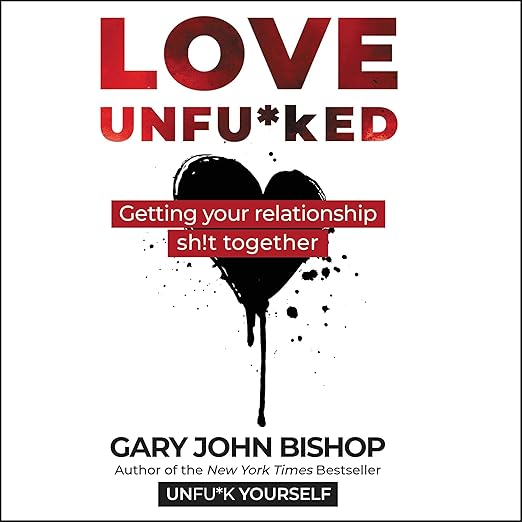
I listened to Love Unfu*ked on a Sunday morning, which was either a terrible or a perfect choice depending on what kind of Sunday I was having. Gary John Bishop's approach to relationships is the same as his approach to self-improvement generally: he is not here to make you feel better about your current situation, and he is not interested in techniques or strategies or communication frameworks. He is interested in getting you to look at yourself with the same honesty you probably apply to everyone else in your life, and then do something about what you find.
Bishop is the bestselling author of Unfu*k Yourself, and Love Unfu*ked occupies the same emotional and rhetorical territory: direct, Scottish, occasionally profane, and structured around the idea that most of your problems are caused by the gap between who you actually are and who you think you are. In the relationship context, this translates to a central argument that runs through every chapter: you are the common factor in every relationship you have been in. If there is a pattern of things not working, the pattern is probably you. That is not a comfortable premise, and Bishop does not try to make it one.
The Review
The phrase tough love appears in the book's marketing, and it is an accurate description of the tone. Bishop is not cruel, but he is relentless in returning the lens to the listener. He distinguishes clearly between the performance of working on your stuff, which can consume enormous amounts of time and emotional energy while producing no actual change, and genuine self-examination, which is shorter and considerably more uncomfortable. One reviewer who is a licensed clinical therapist with twenty-two years of practice described Bishop's work as provoking deeper personal reflection than anything else she had encountered in her career. That response is notable coming from a professional whose job is to provoke exactly that kind of reflection.
The content addresses anyone in any relationship state: currently partnered, wanting to be partnered, ending something, married, divorced, or simply overwhelmed by the whole subject. This wide address is both a strength and a slight structural limitation. The book is specific enough in its observations to feel personal, but the inclusivity of the address means that the advice does not always have the surgical precision it might if Bishop had narrowed to a single relationship situation. The breadth serves the argument, though, because Bishop's core point is about the listener's relationship to relationships in general, not to any specific partner.
Bishop narrates his own work, and the choice is essential to the experience. The Scottish accent and the directness of his delivery are not incidental to the content; they are part of the argument. He sounds like someone who is telling you something important because it is true, not because it is going to make you feel good. That tone is difficult to perform convincingly, and the fact that it is not being performed at all is part of why his books find their audience. One reviewer noted that he delivers coaching in a way that provokes deep thought and includes valid research from philosophers and psychologists, which captures the book's intellectual range beneath the plain-spoken surface. The references to philosophical work are integrated naturally rather than dropped as credibility signals.
At three hours and forty-six minutes, Love Unfu*ked is notably short. This is its most significant structural characteristic. Bishop is not interested in filling pages; he is interested in making the central argument clearly and then letting you sit with it. The brevity is a feature of the approach: a book that argues against substituting activity for actual change should not be padded with supplementary content that dilutes the core message. That said, listeners coming from other relationship books may find the runtime unexpectedly brief, and the book does not attempt to be comprehensive in the way that a longer relationship guide would be.
Before You Commit to Love Unfu*ked
One reviewer identified with the book's core argument immediately, noting that she had always thought she was the problem in her relationships and found the book confirmed and deepened that suspicion while moving toward what to actually do about it. That trajectory, from identification of the problem to some practical direction, is the book's structure in miniature. But it is worth being clear that this is not a communication handbook, not an argument clinic, and not a guide to understanding your partner better. It is a guide to understanding yourself in relation to your partner, which is a different and narrower project.
Bishop also does not promise that applying his framework will save any particular relationship. That honesty is present in the tone and occasionally in the text. Some relationships end not because two people were not willing to do the work but because the work revealed incompatibility rather than solvable problems. Bishop is realistic about this without dwelling on it, which is the mature position and the rare one in this genre.
Who It's For
Listeners who have tried therapy, relationship podcasts, and communication frameworks and found themselves circling the same problems will likely find this book the most direct statement of what they have been avoiding. Listeners who are already doing well in their relationships will find it less necessary. The three-and-a-half-hour runtime makes it an easy commitment for a skeptic who wants to test whether Bishop's approach actually lands before investing more time in his work. If it resonates, Unfu*k Yourself offers the same approach applied to self-development more broadly.
At under four hours, is the book substantial enough to be worth the listen?
Bishop's brevity is intentional and reflects the book's philosophy: a book arguing against substituting activity for change should not be padded. Multiple reviewers described it as an easy read they would recommend again and again. The short runtime is a feature, not a limitation, though listeners expecting a comprehensive relationship guide with chapters for every scenario will need to adjust expectations.
Does the book offer practical techniques or is it primarily about mindset and self-examination?
Primarily the latter. Bishop is explicit about not offering flowery strategies or woo-woo techniques. The book is built around self-examination and the assumption that understanding your actual patterns honestly is the precondition for any technique to work. A licensed therapist reviewer noted that it provoked deeper reflection than technique-focused approaches in her clinical practice.
Is Love Unfu*ked addressed specifically to people in troubled relationships, or is it relevant to anyone?
Bishop explicitly addresses the book to anyone regardless of relationship status: currently partnered, wanting to be partnered, half in or half out, married, single, separated, or divorced. The core argument is about the listener's relationship to relationships in general rather than to any specific partner, which makes it broadly applicable.