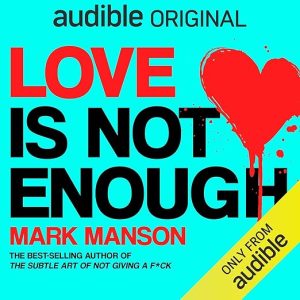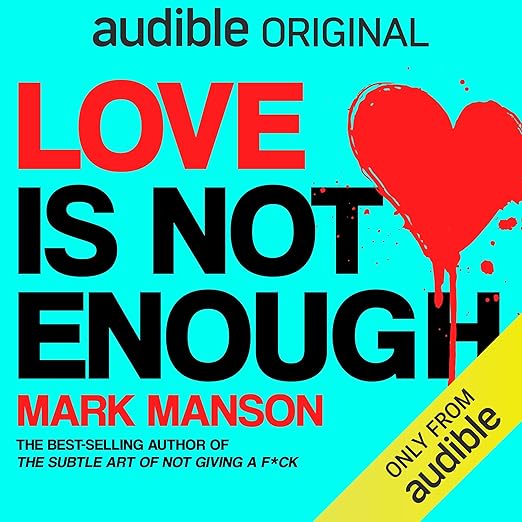
I have always been a little skeptical of audiobooks that blur the line between self-help and audio drama, partly because the format can become an excuse to pad thin ideas with other people's stories. But I was curious about Love Is Not Enough partly because of how explicitly Audible-native its structure is. Mark Manson's first Audible Original, released in 2020, uses a format that has almost no print equivalent: five real people followed over six months as they work through genuinely difficult romantic situations, checking in with Manson at intervals while he offers analysis. I put it on during a long flight and found myself more absorbed than I expected.
The honest frame from the outset is important: Manson is not a licensed therapist, and he says so. One reviewer described the format as like a multi-episode podcast, with multiple interviews intercut with insights and reflections on relationship themes. That is accurate, and it is also a more useful description of what this actually is than anything the marketing language offers. It is less a traditional audiobook and more a produced audio experience that happens to carry Manson's signature voice and perspective. The book even acknowledges at one point that specific issues merit professional therapeutic support rather than a self-help audio format.
Five Messy Situations, No Tidy Resolutions
The five people Manson follows are facing a range of relationship failures: dating app dependency, marital infidelity, fantasy-driven avoidance of real connection, and the accumulated patterns of people who have been in dysfunctional relationships long enough that dysfunction feels normal. What makes the case studies work is that they are not presented as solved problems with clear moral lessons. The situations evolve messily, as real situations do. A reviewer who described the book as basically therapy sessions where you hear what both the client and the analyst say pointed to something genuinely useful about the format: the breadth of cases is wide enough that most listeners will find at least one situation that maps onto their own experience.
Manson's central argument that the feeling of love is not sufficient to sustain a relationship, and that what we typically call love is often just intensity or familiarity, is not original. Writers from Erich Fromm to Esther Perel have developed versions of this thesis. What Manson brings that is distinctive is his willingness to be blunt about the self-deceptions involved, and his format allows him to ground the abstractions in specific behavior rather than keeping everything theoretical.
Manson's Voice Holds Uneven Stories Together
The documentary structure succeeds when the case studies are revealing and falters slightly when the editing choices make one participant's narrative feel thin compared to another's. At seven and a half hours, the overall runtime is generous for Audible Original material, and occasionally you can feel the editorial seams, a thread that needed more development or a resolution that arrives too quickly. But Manson himself narrates the connective tissue between case studies with the same direct, occasionally self-deprecating voice he uses in his writing, and that consistency gives the piece a coherent perspective even when the individual stories have different weights. One reviewer described it as unique in format but helpful though not for everyone, which is an honest summary of the trade-offs involved.
More Compassionate, Less Contrarian Than Expected
If you come to Love Is Not Enough expecting a structured argument delivered in chapters with research citations and actionable frameworks, you will be disappointed. This is not that kind of book. If you come to it the way you would come to a good documentary, interested in specific human situations and willing to let the observations accumulate toward something rather than being stated upfront, it rewards the approach. The 4.2 rating with 38 reviews reflects a somewhat niche audience for this format, but those who connected with it did so with real conviction. This is an audiobook that requires you to meet it on its own terms, and listeners who do so will find Manson operating with more genuine compassion and less performative contrarianism than his more famous titles suggest.
Real Pauses That a Book Would Lose
It is worth stepping back and acknowledging what the Audible Original designation actually means for a project like this. Manson was given access to a production apparatus that allowed him to record extended conversations, follow real people over six months, and shape the result into something that sits between a podcast, a documentary, and a book. The format has real advantages: you hear the actual voices of the people involved, you register the pauses and the moments when someone is working to answer an honest question, and the texture of that authenticity carries information that a written account of the same conversations would lose. The 4.2 rating with 38 reviews is a small sample, but the listeners who found it valuable described it in terms that suggest genuine engagement rather than satisfied passive consumption. One reviewer who called it wise and therapy-like and noted the way the broad variety of relationship challenges allowed personal resonance was describing a piece of work that succeeds on its own terms rather than being evaluated against the wrong standard.
Before You Listen
Is Love Is Not Enough structured as a traditional audiobook or is the format genuinely different?
It is genuinely different. This is an Audible Original in documentary format: five real people followed over six months, checking in with Manson at intervals. There are no traditional chapters. It is closer to a produced podcast or audio documentary than a standard self-help audiobook.
Is this a free audiobook, and is it available outside of Audible?
Yes, this is currently listed as a free audiobook on Audible at $0.00. Because it is an Audible Original, it was produced specifically for the platform and may not be available through other audiobook services. Check the current Audible listing for availability details.
How does this compare to Manson's book The Subtle Art of Not Giving a F*ck?
Manson's core voice is the same, direct, anti-sentimental, focused on cutting through self-deception, but the format is completely different. Subtle Art is a structured argument in essay form covering life philosophy broadly. Love Is Not Enough is a documentary focused specifically on romantic relationships through case studies. They complement each other but operate very differently as listening experiences.