Quick Take
- Narration: Leanne Yau brings warmth and clarity to Labriola’s counselor voice, measured, unhurried, and genuinely suited to the material’s practical register.
- Themes: Jealousy management, polyamorous structures, BDSM and ethical non-monogamy intersections
- Mood: Grounded and practical, like a candid conversation with a very knowledgeable friend
- Verdict: A genuinely useful resource for anyone navigating non-monogamy, though its mid-2000s assumptions about hierarchy deserve a critical ear.
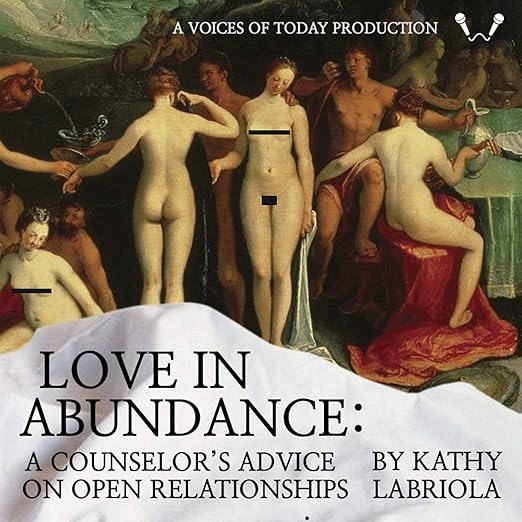
I came to Kathy Labriola’s Love in Abundance on a Tuesday afternoon when I was already deep in a reading project on relationship structures, and I remember thinking that what I needed wasn’t another philosophical argument for polyamory but something that dealt with the operational reality of it. The jealousy. The agreements that fall apart. The Sunday night when two people in the same house are both in love with the same third person and nobody knows what the protocol is. Labriola, a relationships counselor with decades of direct work with polyamorous clients, delivers exactly that kind of granular, functional help, and Leanne Yau’s warm, professional narration carries it well.
The audiobook runs just over seven hours and covers a genuinely wide scope: managing jealousy, building workable agreements, choosing compatible partners, the intersection of BDSM with open relationships, and the important distinction Labriola draws between sex addiction and polyamory. None of this is surface-level. You get the sense throughout that Labriola is drawing from real case histories, not assembled talking points.
The Jealousy Chapters That Earn the Book Its Reputation
If there’s a reason this book keeps showing up in poly reading lists and personal memoirs, reviewer rachelkrantz names it as central to her own published account of open relationships, it’s the jealousy section. Labriola doesn’t treat jealousy as a character flaw to overcome or a temporary emotional turbulence to endure. She treats it as information, something to examine closely for what it tells you about your own needs and fears. The practical exercises here are specific enough to actually use: she asks you to interrogate not just the presence of jealousy but its texture, its triggers, and what it’s protecting. This is counselor-level thinking applied to relationship self-help, and it shows.
For listeners who have tried and found the usual polyamory literature too idealistic or too focused on logistics at the expense of emotional depth, this section alone justifies the runtime.
The Age of the Material and Why It Matters
Reviewer Jes Irwin flags something real and worth taking seriously: this book was written around the turn of the millennium, and its assumptions about relationship hierarchy show their age. Couples privilege, the tendency to privilege established partnerships over newer connections, is treated as a structural given rather than something to interrogate. Amatonormativity, the cultural presumption that a romantic partnership is the primary goal of adult life, runs through the advice without being named or questioned.
For listeners who have spent time in contemporary polyamory communities shaped by newer voices and frameworks, some of this will feel dated, even quietly frustrating. The book doesn’t engage with solo polyamory as a serious option. It doesn’t much complicate the assumption that there is usually a central couple around which other relationships orbit. These are real gaps, and it’s honest to name them.
That said, Gus Allen’s reviewer note is also accurate: most polyamory books cover the same basics and stop there. Labriola goes further into the practical difficulties, and much of that practical material holds up regardless of the framework you’re working within.
The BDSM and Poly Intersection
One of the more distinctive sections of the book is Labriola’s treatment of combining BDSM with polyamorous structures. This is territory that a lot of relationship books either ignore entirely or treat with uncomfortable caution. Labriola handles it with the same matter-of-fact professionalism she brings to the rest of the book: here are the specific complications that arise, here are the conversations you need to have, here are the dynamics that tend to go wrong and why. It’s not extensive, but it’s more substantive than most comparable books attempt.
Yau’s narration doesn’t flinch from this material. She reads it with the same even tone as the jealousy chapters, direct, clear, and without the slight embarrassment that can creep into narrators reading content outside their personal register. That consistency matters when the content moves between emotionally charged territory and practical instruction.
Who Should Listen / Who Should Skip
Listen if you’re new to non-monogamy and want genuinely practical tools, if you’re working through jealousy in an existing open relationship, or if you need concrete language to navigate the agreements and negotiations that poly structures require. This book will give you frameworks you can actually apply in real time.
Approach with some critical distance if you’re coming from contemporary ethical non-monogamy communities where hierarchy-skepticism and solo poly are part of the conversation. Read Labriola alongside newer voices rather than instead of them. And if you’re already well-versed in the literature, be aware that the book may cover ground you know and apply assumptions you’ve long moved past.
Frequently Asked Questions
Does Love in Abundance cover solo polyamory or non-hierarchical structures?
Not in any meaningful way. The book was written around the turn of the millennium and treats relationship hierarchy and couples privilege as standard rather than interrogating them. Listeners who prioritize non-hierarchical or solo polyamory frameworks will find the underlying assumptions limiting, though the practical tools on jealousy and agreements remain useful across structures.
Is Leanne Yau’s narration a good fit for this material?
Yes. Yau reads with warmth and professional clarity that suits Labriola’s counselor voice well. The narration doesn’t editorialize or hesitate on frank content, which is exactly what you want for a practical relationship guide covering topics from BDSM to jealousy triggers.
How does this compare to other polyamory audiobooks like The Ethical Slut or More Than Two?
Love in Abundance is more practically focused and less philosophical than The Ethical Slut, and less comprehensive than More Than Two. Its greatest strength is the depth of the jealousy material and the specificity of its case-study-based advice. It works best as a complement to, not a replacement for, the broader texts.
Is the content appropriate for someone in a monogamous relationship who is curious but not committed to opening up?
Partly. The book is practical enough that someone doing serious research on non-monogamy would find it valuable. But it’s written for people actively navigating open relationships, not for the curious bystander stage. If you’re still deciding whether polyamory is right for you, you might get more from an introductory text first.