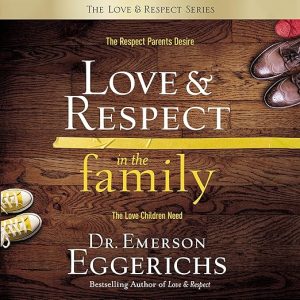
The Family Crazy Cycle is described early in the Love and Respect audiobook - read by the author's son Jonathan Eggerichs - and once you hear it explained, you start seeing it everywhere. Dr. Emerson Eggerichs, whose earlier Love and Respect applied his two-need framework to marriage, here applies the same insight to parent-child dynamics. His argument is precise: children need to feel loved, particularly during conflict. Parents need to feel respected, especially under pressure. When a child feels unloved, they respond in ways that register to the parent as disrespect. When a parent feels disrespected, they respond in ways that feel unloving to the child. That mutual reinforcement loop - neither party meaning to cause the harm they are causing - is the Family Crazy Cycle, and it is the central organizing structure of this six-hour audiobook. At just over six hours, it is compact for a parenting book of this ambition, which is one of its genuine virtues.
What Emerson Eggerichs Delivers
Eggerichs is explicitly working from a biblical framework, and listeners should know that upfront. His thirty years of study in child and family ecology are grounded in his reading of scripture, and the "six biblical ways" he outlines for parenting that energize children draw their authority from that foundation rather than from developmental psychology research. For readers who share that foundation, the book offers something that most secular parenting books do not: a framework where parenting is understood as a calling with moral weight, not merely a set of techniques to optimize outcomes. Eggerichs's insistence that "parenting is for adults only" - by which he means that the responsibility to be the mature party in parent-child conflict belongs unconditionally to the parent - is delivered with enough pastoral directness to land without feeling punitive. The distinction he draws between defiance and childishness is also genuinely useful. He argues that defiance requires discipline but childishness simply requires patience and differentiation, and he spends time helping readers distinguish between the two, which is a more practically useful exercise than most parenting books attempt. One reviewer who uses the book in grandparent and parent seminars noted that the Family Crazy Cycle concept is particularly effective in group settings because it is immediately recognizable to virtually every parent in the room.
What Emerson Eggerichs Gets Right
Jonathan Eggerichs narrating his father's book is a choice that carries real weight here. The audiobook's most distinctive feature is its transparency: Eggerichs senior writes openly about his own family - including what went wrong, what the Crazy Cycle looked like in their household, and how his wife and three adult children experienced his parenting. Jonathan, as one of those three adult children, is not a neutral party in that account. His narration of those passages carries an authenticity that no outside narrator could replicate. You can hear in his delivery that these are not case studies from other families; they are his own memories. That intimacy is unusual in a parenting book of this kind and gives the material a grounded quality that purely prescriptive parenting audiobooks rarely achieve. His reading on the more structured list-driven sections - the "six biblical ways," the diagnostic questions - is clean and clear but loses some of the warmth present in the narrative sections. That is a minor limitation in an otherwise well-suited casting choice. The six-hour runtime is appropriate for the depth of the framework being laid out, and the audiobook does not pad. Eggerichs moves from concept to case study to application with reasonable efficiency.
Where Emerson Eggerichs Loses Some Ground
The section distinguishing between an unloved child and a disrespected parent is worth close attention, particularly the part where Eggerichs demonstrates that neither party in the Crazy Cycle is typically trying to cause harm. The cycle is not driven by malice; it is driven by unmet need expressing itself as reactive behavior. Understanding that distinction changes the intervention logic entirely. Rather than trying to stop the negative behavior directly - which treats the symptom - Eggerichs argues for addressing the underlying unmet need, which requires the parent to act unilaterally and preemptively. He also spends meaningful time on the concept of becoming "a loving parent in God's eyes, regardless of a child's response," which he argues is a more stable foundation for parenting identity than parenting for specific outcomes. If the child's behavior is the measure of parenting success, every difficult period produces a crisis of parental identity. Eggerichs suggests that detaching parental faithfulness from child outcomes is not resignation; it is the mature structural move that allows consistent behavior across the inevitable difficulties of family life. For parents who have read his marriage-focused Love and Respect, the framework here will feel like a natural extension rather than a repetition.
Who Should Pick Up Love and Respect
This audiobook is most directly relevant to Christian parents who want a biblically grounded framework for family dynamics rather than secular developmental advice. The practical tools - the Family Crazy Cycle model, the distinction between defiance and childishness, the six parenting approaches - are accessible and specific enough to be immediately applicable. Listeners who have already engaged with the marital Love and Respect will find this a natural companion. Those without a Christian faith orientation may find the biblical grounding limiting, though the psychological mechanisms Eggerichs describes function regardless of the framework they are attached to. Parents of young children and those parenting through adolescence will find the most direct application, though the principles extend to adult family dynamics as well.
Is this the same Love and Respect as the marriage book, or a different audiobook?
Different book. Emerson Eggerichs's original Love and Respect applied his two-need framework to marriage. This audiobook applies the same core insight - that children need love and parents need respect - specifically to parent-child dynamics, with its own distinct material.
Does this audiobook require a Christian faith background to find it useful?
The framework is built explicitly on biblical principles, so listeners who share that foundation will get the most from it. That said, the psychological mechanisms - the Family Crazy Cycle, the distinction between defiance and childishness - describe real behavioral dynamics that operate regardless of faith background.
Why does Jonathan Eggerichs rather than the author himself narrate this audiobook?
Jonathan is the author's son and one of the three adult children whose family experiences Eggerichs describes transparently in the book. His narration of those personal passages carries an authenticity an outside narrator could not replicate - he is speaking about his own upbringing.
How practical is this audiobook - does it give concrete tools or mainly conceptual framing?
Both. The Family Crazy Cycle is an immediately usable diagnostic model. The six biblical parenting approaches are specific and action-oriented. Eggerichs also provides guidance on distinguishing defiance from childishness, which has direct practical implications for how parents respond to conflict.