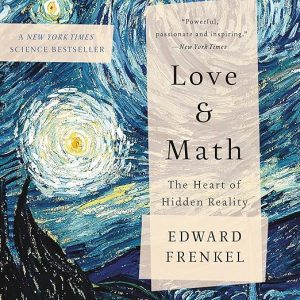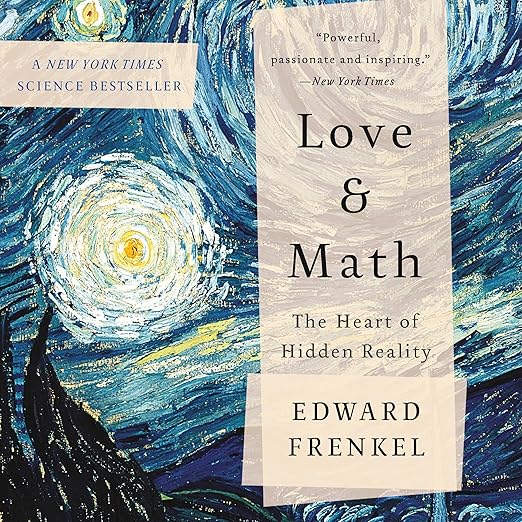
I studied literature, not mathematics, and I want to be upfront about that because Love and Math is, in part, a book about what happens when people like me are never shown what mathematics actually is. Edward Frenkel opens with an analogy I found disarming: what if art education consisted only of learning to paint a fence, and no one ever mentioned van Gogh or Picasso, let alone showed you their work? That is, he argues, what mathematics education typically does to students. It hands us the mechanical operations while keeping the actual ideas hidden. I listened to the opening chapters of this book on a Sunday evening and did not move for two hours.
The New York Times called it powerful, passionate, and inspiring. That is accurate as far as it goes, but it undersells what makes the book unusual. This is simultaneously a memoir of intellectual development under adversity and an ambitious attempt to explain some of the most difficult ideas in contemporary mathematics to readers who have no specialized background. The dual ambition is bold, and Frenkel pulls it off more often than any reasonable expectation would predict.
Our Take on Love and Math
Frenkel grew up in the Soviet Union, where admission to mathematics programs was restricted by antisemitic quota systems. He was rejected from Moscow State University, the premier institution for mathematics in the country, despite his evident gifts. The memoir thread of the book traces how he found his way into the discipline anyway, through informal instruction from established mathematicians who recognized his ability and worked with him outside the official channels. This is a story about intellectual passion persisting against institutional hostility, and it gives the mathematical content an emotional grounding that most popular mathematics books entirely lack.
One reviewer describes a parallel narrative structure: a boy near Moscow with questions that led him toward physics, then mathematics, with a professor who asked him about symmetry groups and changed the trajectory of his education. That kind of reader response tells you something important about Frenkel's skill as a storyteller. He makes his own path feel representative rather than exceptional, which is a difficult trick in a memoir.
Why Listen to Love and Math
Here is the honest accounting that Frenkel deserves. The back half of Love and Math covers the Langlands Program, a framework sometimes described as a Grand Unified Theory of mathematics that allows researchers to translate findings across different branches of the discipline. Frenkel is one of the leading researchers working on it. The explanations he provides are, by the standards of this material, remarkably accessible. A math teacher reviewing the book describes him as doing a decent job of keeping tension between the frustration and thrill of solving difficult problems. That framing is accurate, but some reviewers also note that the explanations require real effort from the reader's side.
A reviewer offering a candid assessment notes that the book is for those who do not already feel the love of math, but Frenkel's experience is at an extremely high level, which creates a gap between intended audience and actual difficulty. This is a real tension in Love and Math. It is not a flaw, exactly. It is the honest consequence of Frenkel caring deeply enough about mathematics to describe it as it actually is rather than in the simplified form that would make it more comfortable. But listeners who arrive expecting a gentle popular science experience may find the final third demanding.
What to Watch For in Love and Math
For a book this autobiographical, there is an inevitable question about whether an author narrator would have been preferable. Frenkel is a mathematician who has been known to appear in an independent film about mathematics, so he is not without public performance experience. Lenz is a capable professional narrator who handles the pacing and emotional range of the memoir passages well. The mathematical explanations require the kind of patient clarity that Lenz delivers reliably. What is absent is the sense that the person speaking has a stake in whether you understand, which is the particular quality an author brings to their own technical material.
That said, at over ten hours, this is not a short listen. Lenz keeps the pacing from becoming monotonous across a runtime that covers everything from Frenkel's childhood to the mathematical physics of quantum electrodynamics. That is a considerable achievement in itself.
Who Should Listen to Love and Math
Love and Math rewards curious generalists who are willing to work a little, people who have wondered why mathematics matters but never had a teacher patient enough to show them, and anyone whose interest in ideas spans disciplines. It is also surprisingly well-suited to people who work in fields adjacent to mathematics and want to understand what research mathematics is actually about rather than what they remember from school. Listeners who struggle with abstract concepts or who need concrete examples throughout may find the later chapters too demanding.