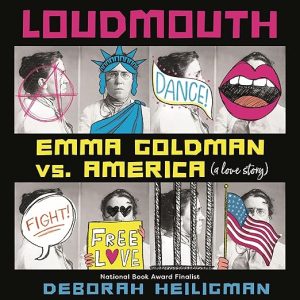
- Voice: Lipica Shah won an Earphones Award for this performance. Her modulation between Goldman's fiery oratory and the disapproving period newspaper voice is a master class in historical narration.
- Big ideas: Free speech and political radicalism in Gilded Age America, feminism and anarchism as intertwined liberation movements, the cost of living by principle in a hostile state
- Atmosphere: Propulsive and righteous, with real emotional stakes
- Worth it?: Deborah Heiligman's Goldman biography for young adults is one of the most sharply narrated audiobooks in YA nonfiction, and Shah's Earphones Award performance makes it essential in audio rather than in print.
Emma Goldman was arrested dozens of times, deported from the United States, surveilled for decades by J. Edgar Hoover's early intelligence apparatus, and called the most dangerous woman in America by a press that could not decide whether to fear or mock her. Loudmouth, Deborah Heiligman's biography for young adults narrated by Lipica Shah, brings Goldman's extraordinary life to audio in a production that Booklist and AudioFile both single out by name as among the best narrated YA nonfiction available. The AudioFile review notes Shah's mimicry of the period's disapproving newspaper tone alongside Goldman's own oratorical intensity, which gives a precise description of what makes this audiobook exceptional as a piece of audio craft.
How Loudmouth Holds Up
Heiligman is a National Book Award finalist, a YALSA Nonfiction Award winner, and a Printz Honor recipient, and the Goldman biography justifies that accumulation of recognition. She writes Goldman's story with the combination of biographical rigor and narrative propulsion that distinguishes literary nonfiction from dutiful chronology. Goldman's life provides genuinely extraordinary material: born in Lithuania in 1869 to a father who resented her existence from birth, immigrated to America as a young woman, became one of the most feared political voices of the early twentieth century, advocated for workers' rights, feminism, and what she called free love, was eventually deported during the post-World War I Red Scare, and continued agitating from exile until her death. Heiligman does not simplify any of this.
The Young Adult designation in the catalog does not diminish the book's intellectual demands. Heiligman engages with the tension at the core of Goldman's life: her genuine love of America's democratic ideals alongside her fury at the gap between those ideals and the exploitation she witnessed around her. That tension is not resolved in the book because it was not resolved in Goldman's life. The audiobook ends with Goldman still fighting, still loud, still insisting that the country she loved owed its most vulnerable people something it had not yet delivered. That open-ended quality gives the biography an honesty that more tidily resolved historical narratives lack.
Lipica Shah's Earphones Award narration is the definitive reason to choose audio over print for this title. The AudioFile review is unusually specific about what Shah does: when she reads Goldman's speeches, she exudes the intensity of Goldman's quest to elevate America's working class; when she reads the period newspaper coverage, she adopts their predominantly disapproving tone. The ability to hold two registers simultaneously, the voice of a woman who believed she was right and the voice of a society that found her intolerable, is a sophisticated performance choice that illuminates the book's central tension more efficiently than any analytical passage could.
Booklist's assessment, that Shah's voice pulls readers along and keeps the history interesting while remaining respectful to real historical figures, adds another dimension: the narration achieves what all historical biography narration should, making the past feel inhabited rather than merely described. Heiligman frames the book as both a love letter to America and a rallying cry for the country to live up to its ideals. Young adult readers encountering Goldman for the first time will find Shah's narration makes those arguments feel urgent rather than archived in the past. For adult listeners who want a rigorous introduction to Goldman's life and thought, the YA framing is not a limitation; Heiligman's research and analysis are thorough enough to reward readers who come with prior knowledge.
Weak Spots in Loudmouth
Goldman's politics are presented sympathetically throughout. Heiligman is not writing a balanced account of anarchism as one of several competing ideologies; she is writing a biography that takes Goldman's commitments seriously and finds them admirable. Readers who want a more critical examination of anarchist political philosophy or who want Goldman's critics to receive extended treatment will find the biographical advocacy framing a consistent factor across the entire ten-hour runtime. This is not a flaw in the book but a feature of its design: Heiligman is making a case for Goldman's significance, not adjudicating her legacy from a neutral position.
The book covers Goldman's romantic life with candor that the synopsis acknowledges directly: Goldman believed marriage was disempowering to women and practiced what she called free love, which in her era meant a series of committed but non-exclusive relationships with men who were often her political comrades. For younger readers or conservative households, these sections are not graphic but they are direct about Goldman's choices and values. Parents reading alongside younger teenagers should know this material is present and treated without apology as integral to understanding Goldman's full commitment to her principles.
The Macmillan Audio production attribution in the synopsis is a useful signal. Macmillan's audio division has a strong track record with literary nonfiction and biography, and the Earphones Award that Shah received reflects the production investment the publisher made in the casting and recording of this title. For listeners who weight production quality heavily in their audiobook selections, the combination of a National Book Award finalist author, an award-winning narrator, and a major publisher's audio imprint provides a strong baseline assurance of quality before you even begin the first chapter. The book earned its critical attention; the audio edition earned its separately.
Should You Listen to Loudmouth?
Young adult listeners drawn to political biography, feminist history, or figures who chose principle over comfort will find Goldman a compelling subject and Heiligman a reliable guide. Adult listeners interested in early twentieth century American radicalism, the labor movement, or the history of free speech will find the book substantive enough to satisfy beyond the YA designation. Anyone encountering the audiobook through Shah's narration is getting an Earphones Award-level performance, which is a meaningful marker of quality in the format. Listeners who prefer historically balanced accounts that give equal weight to Goldman's critics should approach knowing that the book is, as its framing suggests, a biography written with admiration for its subject.
Does narrator Lipica Shah's Earphones Award reflect the overall quality of this audiobook?
Yes. Both Booklist and AudioFile single Shah out by name for specific performance choices, including her ability to shift between Goldman's oratorical voice and the disapproving tone of period newspaper coverage. The award reflects a narration performance that materially enhances the book.
Is the Loudmouth audiobook suitable for adults as well as the young adult audience it targets?
Definitely. Heiligman's research is thorough and her treatment of Goldman's political philosophy is substantive. Adult listeners with existing interest in labor history, anarchism, or early feminist politics will find the book rewarding. The YA classification reflects the writing's accessibility, not a simplification of the subject.