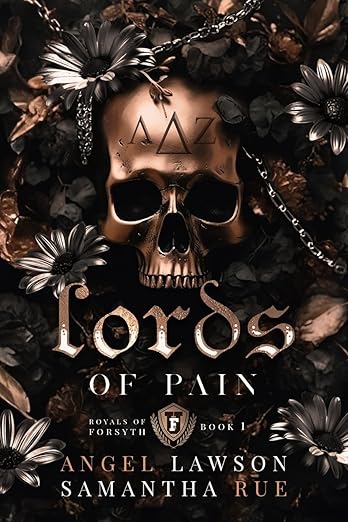
There is a strain of contemporary romance fiction that is entirely aware of how transgressive it is and leans into that transgression as its primary appeal. Lords of Pain by Angel Lawson belongs to that strain. It is a dark campus reverse harem novel, which is a specific genre with specific conventions and a specific readership, and evaluating it honestly requires understanding what it is and is not trying to do.
The setup: a heroine with a complicated past returns to Forsyth University three years after fleeing the three men who knew her secrets and used their power over her in ways that were brutal. Killian, Tristian, and Rath have risen to become Lords, the campus's power elite, and the heroine arrives back in their orbit not because she wants to but because the threat outside is worse than the threat inside. The book's central dynamic is control, protection, and compulsion operating simultaneously, which is the dark romance genre's defining tension.
Bridget Bordeaux narrates with the kind of controlled intensity that the genre demands. Dark romance in audio requires a narrator who can deliver morally complicated material without either sanitizing it or reveling in it to the point of parody, and Bordeaux navigates that line competently. The book's own content makes more demands than most, and at least one reviewer specifically called it ridiculous, depraved, and insane, adding that they loved every second of it, which is a fair description of the reader experience the book is designed to produce.
The prose, as one dismissive reviewer noted, reads like it was written quickly and without significant revision at the sentence level. That critique is not entirely unfair. Lawson is not doing anything technically ambitious with language. But the dark romance genre, at its best, derives its power from psychological intensity and the reader's engagement with forbidden dynamics rather than from literary craft, and on that dimension the book is considerably more effective than a surface reading of its sentences would suggest.
What Stands Out
The reverse harem structure, specifically three male leads rather than one, is what distinguishes this from a standard dark romance setup. The three Lords have distinct personalities and distinct relationships to the heroine, and Lawson differentiates between them clearly enough that the individual dynamics have texture. Killian, Tristian, and Rath each represent a different flavor of the controlling-but-compelling archetype that the genre deploys, and the heroine's navigation of those three different relationships simultaneously is where most of the book's genuine tension lives.
The external threat that forces the heroine back into the Lords' orbit also does real work in keeping the plot moving. Without that pressure, the book would be entirely confined to campus dynamics; the suggestion that someone more dangerous than the Lords is hunting her creates momentum that the romance alone might not sustain across twelve hours.
Before You Commit to Lords of Pain
The content warnings here are not decorative. A reviewer flagged that listeners sensitive to SA should check the trigger warnings before beginning, and that guidance is worth repeating. This is a book that depicts coercion and dark power dynamics as part of its romantic framework, not as antagonist behavior to be overcome. Readers who have not encountered dark romance before and who are not certain they are comfortable with that framing should approach carefully rather than blindly.
The prose is functional rather than strong throughout. Readers who prioritize writing quality alongside their genre pleasures will likely feel mild disappointment regardless of how they respond to the setup. The book rewards readers who engage primarily with character dynamics and plot momentum rather than sentence-level craft.
Best Suited For
Readers who are already embedded in the dark campus romance genre and who are specifically interested in the reverse harem subgenre will find this a competent and entertaining entry. One reviewer compared it directly to the Lords series by Shantel Tessier, and that comparison is useful: if you know that series and responded well to it, this is in directly comparable territory. Listeners new to dark romance or with sensitivity to coercive relationship dynamics in fiction should read the trigger warnings before committing.
- Narration: Bridget Bordeaux handles the dark romance genre's tonal requirements competently, though the material gives her more shock than substance to work with.
- Themes: Reverse harem and power dynamics, dark campus fiction, past trauma as romantic backstory
- Mood: Intense and provocative, with the deliberate discomfort that the dark romance genre courts
- Verdict: A competent entry in the dark campus reverse harem genre that delivers its intended provocations; not a book for readers outside that specific niche.
Questions Listeners Ask
Is Lords of Pain a standalone or the first in a series?
Based on the series name and the setup, Lords of Pain appears to be the beginning of an interconnected series featuring the Forsyth University Lords. The story introduces multiple characters and dynamics that suggest continuation, though the central romance arc has some resolution within this volume.
What are the content warnings for Lords of Pain?
The book contains dark romance dynamics including coercion, power imbalance, and content that reviewers have flagged with SA trigger warnings. Listeners should read the trigger warnings carefully before beginning if they are sensitive to these themes. This is explicitly a dark romance, not a light contemporary.
How does Lords of Pain compare to Shantel Tessier's Lords series?
One reviewer described it as similar to Tessier's Lords series but with a reverse harem structure, meaning multiple male leads rather than one. If you responded well to Tessier's work, this is likely to appeal. If you found Tessier's approach too dark, Lawson's book is in comparable territory.
Is there a genuine plot beyond the romance dynamic, or is the external threat minimal?
There is an external threat described in the synopsis as someone far more dangerous than the Lords who has been stalking the heroine since she left town. This element creates plot momentum and a rationale for the heroine returning. It is present enough to drive the action forward but secondary to the central relationship dynamics.