Quick Take
- Narration: No narrator is credited on this audiobook listing, a notable gap for a comedian whose entire appeal is rooted in his distinctive voice and delivery.
- Themes: Growing up different, finding a comedic identity, the long road from Northampton to national television
- Mood: Cheerful and self-deprecating, with the warmth of someone who has made peace with every awkward thing that ever happened to him
- Verdict: An enjoyable comedic memoir from one of Britain’s most likable entertainers, though the missing narrator credit warrants checking before purchase.
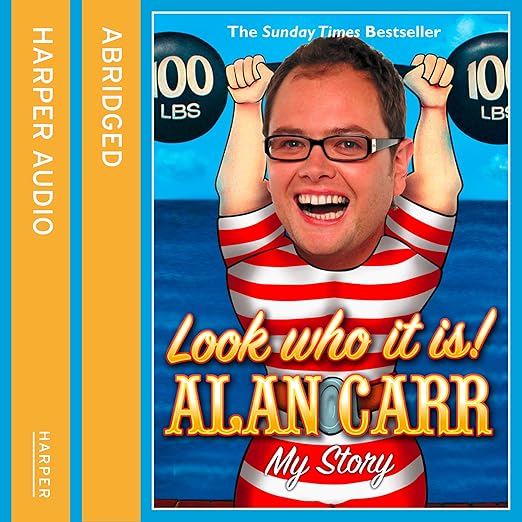
Let me flag something immediately: the audiobook listing for Look Who It Is carries no narrator credit. For a memoir by Alan Carr, a comedian whose entire public persona is constructed around a very specific voice, high, camp, immediately recognizable, the narrator question matters enormously. If Carr read this himself, that’s one audiobook. If someone else read it, that’s a substantially different proposition. I’ve been unable to confirm from the available metadata which is the case, so I’ll review the material while noting that you should verify narration before purchasing.
With that caveat entered: the book itself is exactly what it promises to be. Alan Carr grew up in Northampton as the son of a football manager, a situation designed by the universe specifically to maximize social awkwardness. He wore glasses, developed what the synopsis describes without excess modesty as a huge pair of knockers by fourteen, disliked PE, and had no interest whatsoever in football. The comic potential of this material is obvious. What Carr does with it is warmer and more self-aware than a simple outsider’s complaint.
Northampton and the Comedy of Irrelevance
Northampton features in this memoir less as a place than as a condition. Carr describes it as one of the most boring towns in England, famous primarily for shoes and Northampton Town FC, and he deploys this setting with the affectionate cruelty of someone who escaped it and can now appreciate how formative it was. The football club background is particularly productive material. His father’s local hero status amplified Carr’s own failure to conform to any recognizable version of regional masculinity. There’s a gentle sociological point buried in these sections about how strongly English working-class communities can enforce narrow definitions of acceptable boyhood, and Carr makes it through anecdote rather than argument.
The Poirot Problem and Carr’s Comedic Method
The excerpt in the synopsis, where Carr’s mother dismisses his memory of foiling a jewel theft as a Poirot episode he’d absorbed, is a good example of his particular comedic method. He mines his own tendency toward elaborate fantasy, his slight detachment from shared reality, and his habit of experiencing his own life through the filter of things he’d watched on television. It’s a technique with genuine literary precedent and it works in the context of memoir because it explains rather than merely illustrates. Carr is not just recounting funny things that happened; he’s showing you the mechanism that makes him see the world the way he does.
From Call Centre to Chatty Man: The Professional Rise
The later sections of the memoir cover Carr’s professional journey: working in a call centre, developing his comedy, and eventually arriving at the career that made him a household name. These sections are less consistently strong than the childhood material. The call centre passages are funny but feel polished for performance rather than preserved as experience. Reviews here describe the book as feeling like talking to a friend, which is both its appeal and its occasional limitation, there’s a studied naturalness to some of the later chapters that the early Northampton material doesn’t need.
Who Should Listen / Who Should Skip
Look Who It Is works best for existing Alan Carr fans who want context for the performer they know. At four hours and twenty minutes it’s a quick listen, and the comedic density is high enough that the short runtime doesn’t feel thin. If you’re coming to Carr cold, his television work is probably a better entry point, the memoir rewards pre-existing affection. And please confirm the narrator before purchasing.
Frequently Asked Questions
Who narrates the audiobook? The listing has no narrator credit.
The narrator credit is absent from the available metadata, which is worth investigating before purchase. Given that Carr’s voice is central to his comedy, whether he reads this himself or it’s performed by a third-party narrator will significantly affect the listening experience.
Is this primarily an autobiography about his childhood or does it cover his television career?
Both, though the book’s energy suggests the childhood material is stronger. The Northampton years, his relationship with his football-manager father, and the school years take up roughly the first half. The professional rise fills the second half.
How does this compare to other British comedian memoirs from that era?
Carr belongs to a generation of British stand-ups who came up through Edinburgh Fringe and television panel shows in the 2000s. The memoir sits alongside books by Lee Mack and Michael McIntyre from that cohort: warm, observational, and focused on the outsider-becoming-entertainer arc. It’s less dark than David Walliams and less literary than Frank Skinner.
At just over 4 hours, is this a satisfying listen or does it feel incomplete?
Four hours is on the short side for a memoir, and the later professional sections do feel more compressed than the early material warrants. But the Northampton childhood sections are dense enough that the listen feels substantive rather than thin. It’s a complete story told briskly rather than an incomplete one.