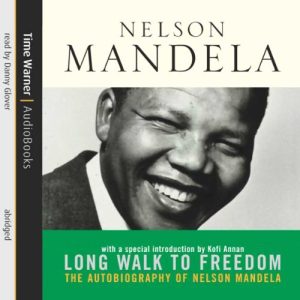
Hundreds of pages in print arrive here as six hours of audio, and that arithmetic is the first fact worth weighing about this audiobook. Publisher copy calls the memoir the exhilarating story of an epic life, told with the clarity and eloquence of a born leader. August 2023 brought an entry from Germany describing the same book as lengthy and comprehensive, covering numerous events in South African history. Little, Brown Audio's recording runs six hours. Whether that figure carries the complete text or a shortened one, the listing declines to say, and no field on the page settles it.
A Closer Look at Long Walk to Freedom
Genre filing is the second thing that does not sit right. This record is shelved under teen and young adult while its own tag reads Biographies, and no line of the description aims the book at a school-age listener. Mandela's memoir is a political autobiography by a head of state, and the copy sells it on moral authority rather than on accessibility. A young listener will get plenty from it, but the shelf placement looks like a cataloging accident rather than an editorial decision, and it matters, because the shelf is what decides who gets shown the record at all.
May 2015 produced the most useful summary anyone on the page has written. It walks through a birth in a small village in rural South Africa, a father who died while Mandela was a small child, an upbringing under an uncle who served as a tribal chief, schooling described as the best a black man could then attend, and a flight from home with a cousin to dodge a marriage he did not want. Alongside that, the same account notes how the book handles an education system shot through with white supremacy. What emerges is a life told in sequence rather than a thesis with illustrations, and six hours is a narrow vessel for a sequence that long.
Publisher copy repays a close reading for what it withholds. Emotive, compelling and uplifting are the three adjectives on offer, and the closing flourish credits the clarity and eloquence of a born leader. All three describe how the book was received rather than what happens inside it. No date appears. No place is named. No single event is named. A listener arriving without background will get the shape of a life from the recording itself, but the page does almost nothing to prepare them for it, and the six-hour figure remains the only concrete number in view.
What Makes Long Walk to Freedom Worth Hearing
August 2008 holds the oldest entry on the page, from someone partial to books that open your eyes to injustices otherwise swept under the rug, and who names this autobiography as a departure from a summer of lighter reading. The only comparison offered is Kite Runner, which is a revealing choice: not another political memoir but a novel, picked for how it landed rather than for what it covers. Mandela's own copy promises hardship, resilience and ultimate triumph, in that order, and the ordering is the point. Triumph gets earned across decades of the first two, and hearing that sequence in one continuous stretch compresses the arithmetic in a way a printed page does not.
Form matters here more than usual. Autobiography written in the first person carries an implied speaker, and putting it into a single voice that is not the author's creates a small, permanent distance: you are hearing an interpretation of a self-account. Some listeners find that distance clarifying, because it removes the temptation to listen for a famous man's cadence and lets the sentences carry themselves. Others want the original. Little, Brown Audio has cast one reader across the whole runtime, with no second voice, no archival material and no framing introduction announced in any field, so what you get is one performer and one continuous line of prose.
Things to Know Before Starting Long Walk to Freedom
Three stars arrived from Belgium in May 2024, and the grievance is that some pages carry no ink. A manufacturing fault in a physical copy has been filed against a page selling a recording, which tells you a great deal about how this column was assembled and how little of it concerns listening. October 2025 supplies a companion problem from Canada: eight words of approval, one of them a reading verb. Neither of those is a bad-faith entry. Both are simply attached to the wrong object, and a shopper scanning for guidance on the audio edition will find that part of the average was set by people holding paper.
Nothing in the five written responses assesses the narration. Danny Glover's name occupies the narrator field and no other element of the page supports it: no sample description, no award line, no listener remark, not even a passing note about pace. That is the second reason to treat this listing as under-documented on the thing you are actually buying. The first, and the larger one, is the runtime. Six hours against a life this long is a gap a buyer deserves to have explained in a field rather than inferred from a number.
Material is the final item to flag. The recording covers a childhood marriage escaped by running away, an education system described by its own subject as built on white supremacy, and a political struggle the copy summarizes as hardship before triumph. None of it is softened for a young audience, whatever the shelf says, and a parent buying from the teen category should know that going in.
Who Nelson Mandela Is Writing For
Readers who want a political life told from the inside, in sequence, and delivered in an evening's worth of listening rather than a week's, have a strong case here. Six hours is genuinely approachable, and approachability is not nothing for a book carrying this reputation. Students who need the arc of a South African century in a single pass, reading groups working to a deadline, and listeners who usually bounce off long-form nonfiction will all be served by the compression rather than defeated by it.
Hold off if completeness is the point. Anyone working toward an essay, a course or a serious argument should establish first whether this recording carries the full text, because the number on the page suggests otherwise and no field confirms it. Pass on it as well if you want to know how a performer handles the material before committing. The page gives you nothing on that front, and a name in a field is not a performance you have heard.
How long is the Long Walk to Freedom audiobook, and does it cover the whole memoir?
The listing gives a runtime of six hours flat. What it does not give is any marker saying whether the recording is complete or shortened, and no other field resolves it. For a memoir this size, treat completeness as unconfirmed until the publisher states it outright.
Who reads the Long Walk to Freedom audiobook, and is anyone else credited?
Danny Glover is the single name in the narrator field. Little, Brown Audio published the recording in February 2006, and no co-narrator, guest speaker or author-read introduction appears anywhere in the credits. One voice covers the entire runtime.
Why is a head of state's political memoir filed under teen and young adult?
The genre field reads teen and young adult while the record's own tag reads Biographies, and nothing in the publisher description targets a young readership. Read it as a cataloging quirk rather than a signal about the content, which is not adapted for younger listeners in any way.
Is six hours enough for a first pass at Mandela's life story?
For orientation, yes. The description promises childhood, hardship, resilience and triumph in sequence, and six hours delivers that arc without demanding a week of your attention. For citation or close study, the unexplained runtime makes this a starting point rather than a reference.