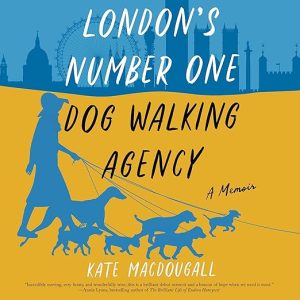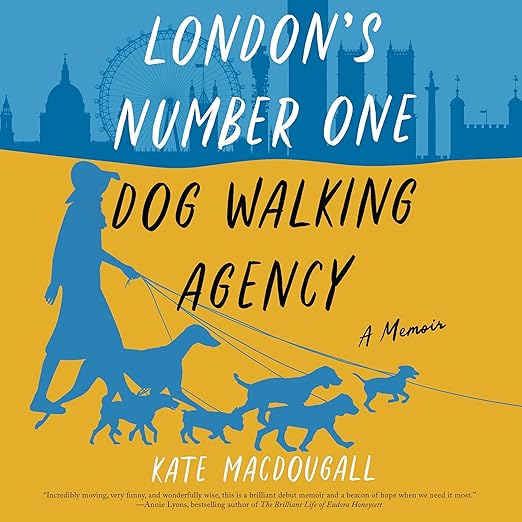
I picked up London's Number One Dog-Walking Agency on a recommendation from a colleague who described it as the book she read when she needed something that would not hurt her. That is a specific and useful category. I started it on a Sunday afternoon with no particular agenda, and I finished it that same evening. Not because it is a page-turner in the conventional sense but because Kate MacDougall has the particular gift of making domestic, particular detail feel genuinely interesting without inflating it into false significance. That is a harder skill than it looks, and MacDougall has it in abundance.
The premise is simple and very early-2000s London: in 2006, MacDougall was working at Sotheby's auction house in a role she describes as safe but dull. After an accident that nearly destroyed a valuable piece of art, she quit and started a dog-walking company with no relevant experience and a very bold name. The book follows the company's growth and her own simultaneous, somewhat chaotic coming-of-age over the years that follow. London is the third main character, rendered with the affection of someone who knows the city intimately and is documenting a version of it that she knows is changing around her as she writes.
Owners Over Dogs as the Real Comedy
The most interesting structural choice MacDougall makes is to acknowledge early that the dogs themselves, greedy Labradors, pampered pugs, the occasional bolter, the one dog who simply refused to walk, were the easy part of the job. The owners were the real territory. The book's comedy comes almost entirely from the human side of the transactions: the over-protective, the clueless, the eccentrics, the perfectionists. MacDougall writes about these people with affection rather than contempt, which is the right call and the more difficult one. It would be easy to write a sharp satire of wealthy Londoners and their relationship to their animals. MacDougall is after something more human, the way that people's attachment to their dogs reveals something genuine about them even when the attachment is also, undeniably, somewhat absurd.
One reviewer raised a legitimate concern: a particular episode in which a client named Elephant Dave kicked a dog in the care of one of MacDougall's employees, and MacDougall's account of how she handled it, left them troubled about where the book's priorities lay. This is worth naming because it is a real moment in the memoir and readers who care deeply about animal welfare will have a reaction to it. MacDougall does not flinch from including it, but she also does not dwell on it in the way some readers might want.
Popplewell's Light Touch Crosses the Atlantic
Anna Popplewell's narration is very well suited to this material. She has the light precision that British comic writing at its best requires, knowing when to let a sentence land without pressing it, understanding that the humor in MacDougall's observations comes from understatement rather than performance. The nine-and-a-half-hour runtime is paced naturally, and Popplewell's voice carries the texture of different London neighborhoods and client types without caricature. A reviewer who owns their own pet-sitting and dog-walking business in the United States described the pleasure of recognition, the specific rhythms of this kind of work translate across contexts even when the specific social landscape does not. That cross-cultural resonance speaks to MacDougall writing about something universal through very particular circumstances.
Human Stories Dominate a Dog-Themed Memoir
One reviewer went in expecting a book primarily about dogs and their personalities, and came away frustrated that the human stories dominated. That is an honest account of the book's actual structure. MacDougall uses the dogs as a lens for examining London and the people who inhabit it, but the animals themselves are more backdrop than subject. The memoir is really about what service work teaches you about the people being served, and about how you build something from nothing when you have no qualifications and no script. The 4.2 rating across 461 reviews reflects a somewhat divided audience on this point, but those who came with the right expectations found it thoroughly satisfying. Readers who want those questions explored through a specific and affectionately rendered London will find this very rewarding. Those who came for extended character studies of individual dogs will need to recalibrate their expectations before starting.
London Itself Is a Love Letter Here
What MacDougall does particularly well, and what separates this memoir from the kind of entrepreneurship story that uses setting as pure backdrop, is the way she renders specific London neighborhoods as participants in the narrative. The streets she walks, the gardens she cuts through, the mansion blocks and townhouses where her clients live, these are drawn with the precision of someone who knows that place shapes behavior and that behavior reveals character. A reviewer who described the book as a love letter to London and dogs and growing up was identifying something real about the memoir's emotional architecture: it is a book about a relationship with a city as much as it is about a business or a coming-of-age. That love letter framing also means the book has a specific temporal relationship with the London it depicts. The 2006 London MacDougall is walking through is already significantly different from the city that exists now, and part of what makes the memoir worth reading is the way it captures a particular social and economic moment in a city that has changed substantially around the spaces and communities she describes.
Before You Press Play
- Read by: Anna Popplewell brings warmth and light comedic timing to Kate MacDougall's memoir, her voice suits the affectionate, observational tone without pushing the humor harder than the material warrants.
- At its heart: Unconventional entrepreneurship, the comedy of London's propertied classes, coming-of-age through service work
- Vibe: Warm, gently funny, and occasionally sentimental in the best way
- Short version: An honest and charming memoir that works as a love letter to a specific version of London that is already partly gone.