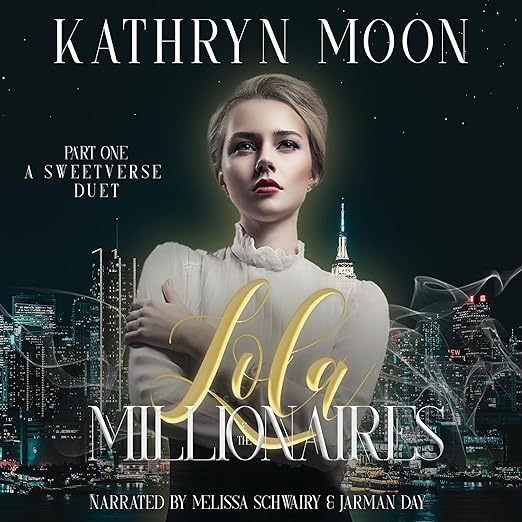
I will admit that the title almost made me pass this one by. Lola and the Millionaires sounds like it belongs to a specific tier of quick-read romance that values wish fulfillment above everything else, and the omegaverse subgenre has enough examples of that tier to make skepticism understandable. What Kathryn Moon is doing in the Sweetverse books is something more thoughtful, and Lola and the Millionaires is, by most accounts, the best of them.
I listened through the second half of an unexpectedly cold spring afternoon, when the right book is one that takes you somewhere warmer without requiring you to think too hard about the mechanics of the world you are visiting. The omegaverse biology, alphas, betas, omegas, pack dynamics, functions here as a metaphor scaffolding rather than a literal world-building exercise. What Moon is actually writing about is trauma, specifically the way abuse leaves a body hypervigilant even after the threat is gone.
The Review
Lola Barnes is a beta who experiences genuine anxiety attacks when alphas are near her. This is not a quirk to be overcome through an alpha's magical presence. It is a physiological response to specific past harm, and Moon is careful never to frame it as a cute obstacle that the right man can simply bypass. The healing in this story is slow and incremental, and it is Leo, the omega character who functions as the pack's bridge to Lola, who does most of the early work of proving that safety is possible. Leo received enthusiastic praise from nearly every reviewer, and the praise is earned. He is written with genuine patience rather than performative sensitivity, which is a harder distinction to maintain across 11 hours than it might sound.
Melissa Schwairy's narration suits the material exactly. She gives Lola's voice enough lightness that the humor in the book lands cleanly, and enough fragility that the anxiety scenes feel real rather than melodramatic. The pacing in those tenser moments, unhurried and unforced, is what keeps the book from tipping into trauma-tourism.
Why Lola & the Millionaires Works as an Audiobook
What distinguishes Moon's approach is the pack's collective patience with Lola's healing process. The alphas do not try to override her fear with dominance. They wait, they adapt, they let Leo run interference until Lola comes to them on her own timeline. One reviewer described this as letting Lola recover and grow rather than pushing her, and that framing is accurate. For a genre that sometimes conflates possessiveness with care, Moon's version of protective love is considerably more nuanced.
The threat posed by Lola's former alpha Indy in the second half of the story arrives as a genuine complication rather than a convenient plot excuse for the pack to swoop in heroically. The danger is real, the fear response it triggers in Lola is consistent with her established character, and the resolution does not ask her to have magically overcome her trauma in order to survive it.
The Caveats
One important structural note: this is a duology, and Part One does not contain a complete happy ending. If you pick up this volume expecting full resolution, you will find the ending deliberately unfinished. One reviewer flagged this clearly: know going in that the complete emotional arc runs across two books, and plan your listening accordingly. The experience of reading both back-to-back was described as clearing your whole day, which suggests the duology structure rewards bingeing.
Prior Sweetverse familiarity is not required. Reviewers confirmed they jumped in here without reading the first book in the universe and did not feel lost. The world-building is self-contained enough that the pack's backstory is established within this novel.
Who Should Listen to Lola & the Millionaires
This is for omegaverse readers who want the genre's warmth and pack dynamics without the emotional shortcuts. The healing arc requires patience from the listener as well as the characters, and Moon rewards that patience. Readers who find the alpha-omega biology too far outside their comfort zone will struggle with the world-building framing, but anyone open to the genre's conventions will find this a more emotionally satisfying example of it than most. Start with Part One, clear your afternoon for Part Two, and let the duology work as it was designed to.
Frequently Asked Questions
Does Lola and the Millionaires have a happy ending, or does it end on a cliffhanger?
This is Part One of a duology and does not have a complete happy ending. The emotional arc is unfinished by design, and the full resolution comes in Part Two. Reviewers who knew this going in found the structure satisfying. Those who assumed a complete story were surprised by the ending's openness.
Do I need to have read other Sweetverse books before starting Lola and the Millionaires?
No. Multiple reviewers confirmed they started here without any prior Sweetverse context and did not feel lost. The relevant world-building and character history is established within this novel, so it functions as a genuine entry point to the universe.
How does Moon handle Lola's anxiety and trauma around alphas, and is it treated with care or used as a convenient plot device?
It is handled with genuine care. Lola's anxiety attacks are physiological responses to specific past harm, and Moon never frames them as quirks to be overcome by the right alpha's presence. The healing is slow, incremental, and driven by Lola's own timeline rather than the pack's desire to fix her.
Who is Leo, and why do reviewers praise his character so specifically?
Leo is the pack's omega who serves as the bridge between Lola and the alphas. He is patient and determined rather than performatively sensitive, and his approach to Lola's healing, unhurried and without pressure, is what makes the early stages of the story work. He is the character most reviewers single out by name, and his dynamic with Lola is the emotional core of Part One.