Key Details
- Voice: Coralie Bywater brings a warm, practical energy to the material that matches the book's tone, readable for both the aspirational and instructional sections.
- Big ideas: Voluntary simplification, full-time mobile living logistics, identity and community on the road
- Atmosphere: Optimistic and grounded, oriented toward action
- Worth it?: The most thorough single-volume introduction to full-time RV living available in audio, and Bywater's narration makes the practical chapters as engaging as the lifestyle ones.
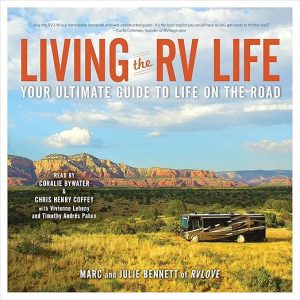
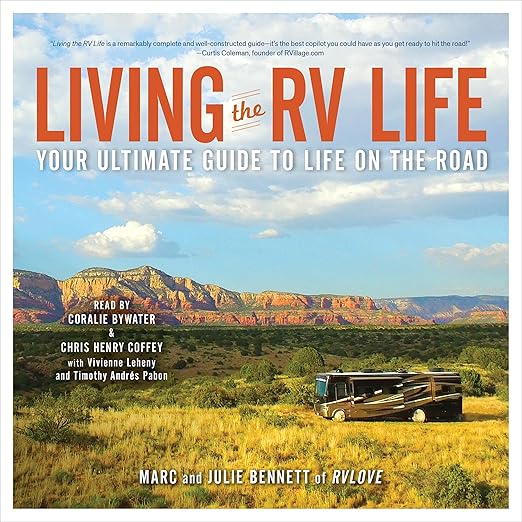
I have a friend who sold her house in 2019 and spent two years traveling the country in a converted Airstream. She recommended Living the RV Life to me before her departure, and I remember being skeptical that a single audiobook could prepare someone for that kind of transition. Having listened to it myself recently, I understand the recommendation. Marc Bennett and his wife Julie, who run the YouTube channel Marc and Julie Bennett RV Love, have produced something that functions as both a practical manual and a lifestyle argument, and the combination is handled with more skill than the genre typically offers.
The book's subtitle, Your Ultimate Guide to Living Life on the Road, is ambitious but not dishonest. This is a wide-scope introduction to a complex lifestyle decision rather than a comprehensive operational handbook, but for someone at the beginning of their thinking about RV living, or in the planning stages of a transition, it covers more ground more reliably than anything else currently available in audio format. The Bennetts have been living this life and documenting it for years, and the combination of YouTube channel research, community interviews, and their own extended experience gives the book a credibility that more desk-bound lifestyle guides lack.
Isolation and Mail Logistics Get Honest Airtime
Bennett structures the first section of the book around the question of fit: is the RV lifestyle actually right for you? This is a more honest starting point than most lifestyle guides offer. The book covers the realities of full-time RV living, including the things that full-time RVers often gloss over in their social media presence: the maintenance burden, the social isolation that can develop when you do not have a fixed community, the legal and logistical complexities of residency and mail while living mobile. One reviewer who had been part-time RVing for seven years described learning things they had not encountered in their own experience, which suggests the book's coverage of these less-discussed dimensions is genuinely substantive.
The honesty about trade-offs is one of the book's most valuable qualities. Bennett does not pretend that full-time RV living is for everyone, and he provides enough specificity about the challenges to let listeners self-select accurately. This is considerably more useful than the unreservedly enthusiastic approach that many RV influencer books take, which tend to minimize difficulty in order to maintain brand consistency. The Bennetts have enough material and enough credibility that they do not need to sell the lifestyle; they can afford to describe it accurately.
Selling the House Gets Its Own Chapter
The middle sections of the book cover what Bennett calls the practical infrastructure of RV life: how to choose an RV by type, size, age, and budget; whether to sell your home or keep it; sample routes and destinations; basic vehicle maintenance; and the legal and governmental considerations that most people do not think about until they are already living full-time. The chapter on whether to sell your house is particularly useful. The decision involves financial, logistical, and psychological dimensions that interact in non-obvious ways, and Bennett walks through each of them without oversimplifying or defaulting to the answer that best suits his own story.
Reviewers with existing RV experience consistently note that they still learned things, which is the strongest possible endorsement for a book in the practical guide genre. A reviewer who had been researching full-time RV living for almost two years across YouTube channels, forums, and blogs described it as the book that pulled together information they had previously been gathering from scattered sources. That aggregation function, providing a coherent, organized account of what is otherwise distributed across hundreds of online sources, is one of the book's most significant practical contributions.
Bywater Handles Both Dreaming and Doing Well
The book moves between aspirational lifestyle content and practical instructional material, and Bywater handles both registers well. The aspirational sections have warmth and energy; the practical sections are read with enough forward momentum that the technical details do not feel like homework. At just under eight hours, the runtime is appropriate for the depth of coverage. The book does not drag, and Bywater does not let the drier sections lose pace.
A minor note: several reviewers reference the photography in the print edition as a significant element of the experience, and obviously the audio format cannot replicate this. The audiobook stands on its own as a practical and philosophical guide, but listeners who respond strongly to visual inspiration for lifestyle decisions may want to supplement it with the print edition or with the Bennetts' YouTube channel for that dimension. The book is also referencing apps and websites that may have changed since publication, which is an inevitable limitation of any practical guide that relies on external resources.
Multi-Source Researchers Get One Coherent Guide
Living the RV Life is ideal for anyone seriously considering a transition to full-time or part-time RV living who wants a comprehensive, honest, and well-organized starting point. It is particularly well suited to listeners who are gathering information from multiple sources and want something that ties those sources together into a coherent framework. Those already living full-time in an RV will find some of the foundational material redundant, though reviewers with extensive experience still report finding value in specific chapters. The book does not go deep on specific mechanical maintenance, which is a subject that would require its own dedicated resource, and the community dimension of RV life is somewhat lighter than the logistical coverage. As a single-volume introduction, however, it is genuinely the most thorough and honest available.