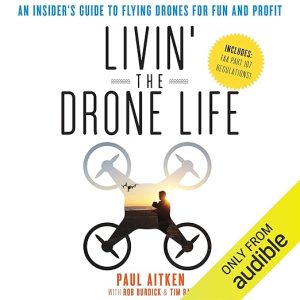
I came to Livin' the Drone Life without any real stake in the subject. I don't fly drones. I have no plans to start a drone business. But I'd been given it as a recommendation by someone who does run a small aerial photography operation, and I was curious whether the hype around the drone industry, circa 2017, when this was published, had produced genuinely useful material or just another wave of entrepreneurial enthusiasm dressed in tech clothing. The answer is somewhere in the middle, and knowing which side you fall on is mostly a function of what you're looking for.
Paul Aitken co-founded Drone U, a training and community platform for commercial drone pilots, and he narrates this book himself. At three hours and twenty-four minutes, it's a brisk listen, closer to an extended podcast episode than a comprehensive manual. The stated aim is to teach aspiring drone professionals the business side of the industry: safety practices, regulatory navigation, company structure, and the shape of the commercial market as it existed at publication. Aitken's energy throughout is that of a true believer in his field, and that conviction is both the book's greatest strength and the lens through which everything it says should be read.
Part 107 and the Industries Drones Are Reshaping
The most useful sections of this audiobook are the ones that contextualize why the drone industry represents a genuine professional opportunity rather than a gadget trend. Aitken covers the range of industries being reshaped by aerial capabilities, agricultural monitoring, construction site mapping, real estate photography, film and video production, with specificity that goes beyond the obvious. Reviewer Matthew McCracken described the book as packed with information he and his family never considered before getting a drone, noting that even his teenage son couldn't put it down and started planning drone-related school projects. That response suggests how effectively Aitken expands the listener's sense of what's possible within a field that most people associate primarily with hobbyist footage.
The regulatory discussion, centered on Part 107 certification from the FAA, is handled with appropriate seriousness. Flying commercially without proper certification carries real legal risk, and Aitken doesn't gloss over that. Reviewer startup_eng1 pulled out the Part 107 material specifically as valuable study content, which tracks with the book's intent: this is a primer for people who want to fly commercially, not a guide to recreational flying. The emphasis on getting certified before getting paid is one of the book's most practically important messages, and it's delivered without the condescension that regulatory content can sometimes carry.
Drone U Advertises Itself Inside Its Own Book
Here is where I have to be honest about a structural tension in the book. Drone U is both the publisher and the subject, and several reviewers noted that the book functions partly as an extended advertisement for Aitken's training platform. Reviewer Chris Davenport, who found the book through the Drone U podcast, put it directly: both the book and the podcast are advertising for the school. That observation isn't necessarily a disqualifier, the Drone U platform has a solid reputation and the advice in the book is generally sound, but it does mean you are absorbing a curated perspective from someone with a commercial interest in your continued engagement with their ecosystem.
The book is also now nearly a decade old, which matters significantly in a field moving as fast as drone technology and regulation. The FAA's rules have evolved. The technology has changed substantially. New commercial applications have emerged. Aitken's core framework about building a sustainable business, practicing safely, and understanding the regulatory environment remains broadly applicable, but specific details should be verified against current sources before acting on them. Reviewer Amazon Customer, writing in detail about what the book does and doesn't cover, described it as well-organized and accessible, while also noting that it should be treated as an overview rather than a definitive guide.
Aitken Narrates Like a Founder Pitching His Field
Aitken reads with the directness of someone who has given this talk many times, confident about the material, occasionally enthusiastic in ways that remind you you're listening to a founder pitch his own field. It's not a polished audiobook narration in the conventional sense, and there are moments where the pacing reflects a speaker habit rather than a storytelling choice. But for a business how-to from a practitioner, that authenticity works in the book's favor. Reviewer startup_eng1 described it as covering the important stuff without fluff, which is accurate: Aitken doesn't pad the runtime with anecdotes or philosophizing, and the three-and-a-half-hour length reflects that discipline.
Aspiring Commercial Pilots Need Current Updates Too
If you are considering entering the commercial drone industry and want a fast orientation to the landscape, the business structure, the regulatory basics, the range of applications, this is a reasonable starting point with the caveat that it needs to be supplemented with current materials. If you are a working professional looking for current technical or legal guidance, this book is too dated and too promotional to serve that need on its own. And if you have no commercial interest in drones and are simply curious about the technology, there are better-suited books that don't assume entrepreneurial motivation as a baseline. Treat this as what it is: an enthusiastic, well-intentioned introduction from insiders who have a stake in your becoming part of their community. Read it alongside current FAA materials and independent industry resources, and it serves its purpose well. Read it in isolation and you'll have a persuasive picture that is missing the edges.
- Voice: Paul Aitken narrates with the enthusiasm of a practitioner rather than a broadcaster, informed and direct, though not polished in the audiobook narrator sense.
- Big ideas: drone entrepreneurship, FAA regulation, commercial aerial photography
- Atmosphere: Practical and energetic, with the evangelical edge of a business pitch
- Worth it?: A useful introduction to the commercial drone space, though its Drone U affiliation colors some of the advice.
A Few Questions About Livin' the Drone Life
Is the FAA Part 107 information in this audiobook still current given it was published in 2017?
The book provides a useful conceptual framework for Part 107 certification, but drone regulations have evolved since 2017. Before applying any specific regulatory guidance, verify current requirements directly with the FAA, which publishes updated rules and resources online.
How transparent is the book about its Drone U affiliation, and does that bias the advice?
The affiliation is not hidden, Aitken founded Drone U and the book promotes their training ecosystem. Several reviewers flagged this as making the book feel partly promotional. The practical advice is generally sound, but readers should be aware of the perspective and supplement with independent sources.
Is Livin' the Drone Life useful for someone who already flies commercially with Part 107 certification?
Less so. The book is designed as an entry-level orientation. Experienced commercial pilots will find most of the content familiar and may be frustrated by the promotional elements. It's more valuable as a first read than a reference for working professionals.
Is Livin' the Drone Life available as a free audiobook on Audible?
Yes, this free audiobook is accessible to Audible members through their subscription. Check the Audible listing for current availability, as catalog access can change over time.