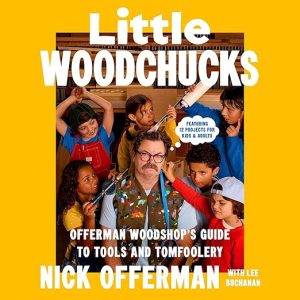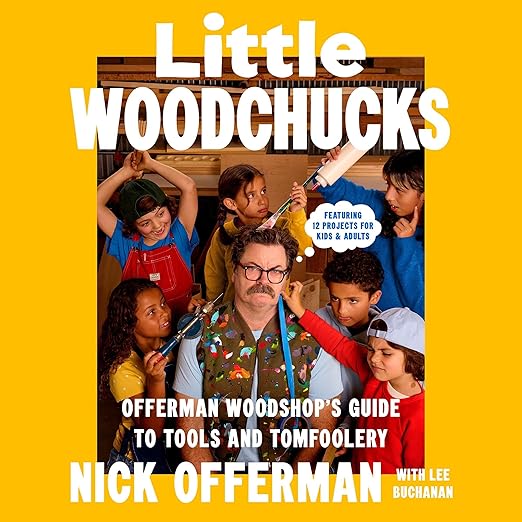
I listened to Little Woodchucks on a Saturday morning while my coffee was still hot, the kind of morning when you have an hour before the household fully wakes up. At just two hours and forty minutes, it fit the window almost exactly, and I found myself pausing to take notes more than once , not because the material was dense, but because the project ideas kept triggering that familiar itch of wanting to actually build something.
Nick Offerman is not a household name in literary circles, but he has carved out a specific and oddly credible niche as a woodworker-philosopher. His earlier book Good Clean Fun brought adults into his Los Angeles woodshop; Little Woodchucks does something different and in some ways more interesting , it opens that same shop to families, scaling the ambitions down without scaling down the sincerity. Twelve projects for kids, from a beginner-friendly box kite to a little free library that Offerman has cheekily labeled a meat locker, are framed inside reflections on why making things with your hands still matters in 2025.
Twelve Family Builds, Backed by a Downloadable PDF
The audiobook format is an unusual choice for a project guide, and Offerman and Penguin Audio have addressed that with a downloadable PDF containing instructions and photos for all twelve builds. It is a sensible workaround, though it does mean you will need to switch between devices if you plan to actually attempt the projects while listening. The audio itself leans into what Offerman does best: the projects are described through storytelling rather than through dry instruction, and original music by Mark Rivers and Offerman himself gives the whole thing the texture of a radio variety show from a more relaxed era.
The humor lands consistently. Offerman's voice is warm without being saccharine, and his observations about the loss of manual skills in American domestic life are made with more wit than lecture. When he talks about the satisfaction of handing a child a saw for the first time and letting them ruin a piece of wood on purpose, it reads as genuine rather than performative. The writing, while undemanding, shows real care.
Kids Motivated to Help Build the Bench
What makes this audiobook work better than you might expect is Offerman's insistence that the projects are genuinely achievable. One reviewer noted that there is something for all skill levels, while another mentioned a bench that his kids were immediately motivated to help build. That combination of attainability and motivation is harder to manufacture than it sounds. Many family craft books promise accessibility and deliver intimidation; Little Woodchucks seems to have genuinely threaded that needle.
The listener reviews also surface a practical caveat: you will need a reasonable set of tools to take on most of the projects. This is not a book for someone who owns only a hammer and hopes for the best. Offerman is clear about what is required, which means no unpleasant surprises mid-project, but it does mean the barrier to entry is real. The downloadable plans help enormously here, as they include supply lists that let you gather materials before you begin.
Offerman Narrates Like It's a Dinner Party
The audiobook edition includes original music composed specifically for this release, which is a genuinely nice touch , it gives the production a character that distinguishes it from a straight read-along. Offerman's narration has the quality of someone who has told these stories at a dinner party and refined them over several tellings. The result is relaxed and funny without feeling off-the-cuff.
There is also a thoughtfulness here about what woodworking actually teaches. It is not just about the finished object. The book circles back repeatedly to the idea that letting a child struggle with a tool, make mistakes, and fix them is a form of education that no screen can replicate. Offerman makes this argument without preachiness, which is the only way it could work. He has too much self-awareness to moralize for long.
Grandparents and Parents Share the Same Twelve Projects
This is a strong choice for parents of children aged roughly six and up who want structured project ideas rather than open-ended creative suggestions. It will also appeal to grandparents looking for a shared activity that requires presence and patience. If you already have a basic set of woodworking tools and a table to work at, you have most of what you need to make this audiobook immediately useful.
Listeners who prefer a comprehensive, tool-by-tool beginner's course in woodworking will find it too narrative-driven and project-selective. This is not a how-to-use-a-chisel manual. It is closer to a love letter to making things, with twelve concrete reasons to start.
Does the audiobook edition of Little Woodchucks include the actual project plans?
Yes. The audiobook includes a downloadable PDF with instructions and photos for all twelve projects, so you are not left trying to visualize dimensions from audio descriptions alone.
Do you need prior woodworking experience to use this book with kids?
Not much, but you do need a reasonable set of tools. Offerman scales the projects from beginner to more advanced, and supply lists are included, but this is not a from-scratch introduction to the craft , it assumes some basic workshop access.
Is Nick Offerman's narration appropriate for listening with children in the room?
Yes. The humor is dry and adult-facing but the content is family-appropriate throughout. It reads more like a knowledgeable uncle than a woodworking manual.
How does Little Woodchucks compare to Offerman's earlier book Good Clean Fun?
Good Clean Fun was aimed primarily at adults and featured more personal reflection on Offerman's own woodworking life. Little Woodchucks shifts the audience toward families and children, with all twelve projects specifically designed for intergenerational building.