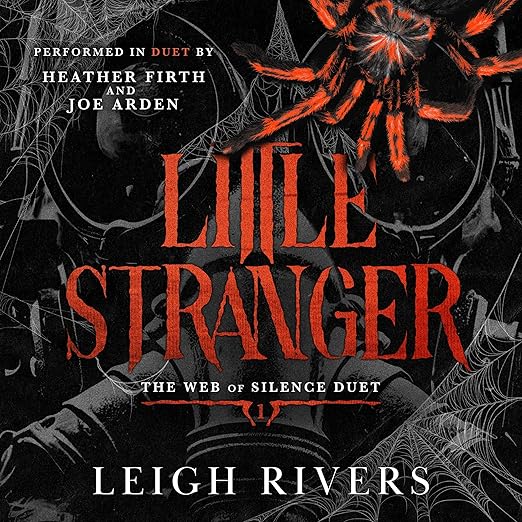
Malachi Vize spends years in prison thinking about the woman who put him there, and by the time he's free, wanting revenge has curdled into something closer to obsession in this audiobook. Little Stranger opens on Halloween night with Malachi finished waiting in the shadows, ready to claim what he considers his: Olivia's mind, her body, her fear, all of it. Leigh Rivers writes dark romance built around possessiveness dressed up as devotion, and the synopsis is upfront about the intensity here, explicitly pointing listeners toward a content warning before they start, which is the kind of honesty this genre doesn't always bother with.
The Review
This is book one of a two-part Web of Silence Duet, and the premise leans hard into revenge-romance conventions: betrayal, imprisonment, an obsessive anti-hero who frames ownership as love. Rivers has built a career in dark romance around obsessive, confession-style internal monologue rather than straightforward menace, characters who are at least partly aware of their own irrationality even as they act on it, and Malachi's introduction here fits that pattern closely.
What separates the listener reaction on this one is real, and worth taking seriously rather than smoothing over. One reviewer called it the craziest, most deranged thing she'd heard about going in, only to find the writing read more like fanfiction than she expected, subpar in places. Another found it simple and easy, not that dark except for one specific scene. That's a wide gap in perceived intensity for the same book, and it suggests the marketing hype around this title has outpaced what's actually on the page for at least some listeners.
The duet structure means this volume won't resolve Malachi and Olivia's story on its own. Readers going in expecting a complete arc within one audiobook should recalibrate: this is half a story, built to end on unresolved tension rather than closure.
The Web of Silence framing that titles this duet is worth sitting with. Silence here isn't just an absence of speech; it implies complicity, secrets kept by people who should have spoken up, and a family structure that let harm continue unchallenged. Reading Malachi's obsession against that backdrop reframes his fixation on Olivia as something tangled up with a much older, quieter betrayal within her own family, not simply a revenge plot layered on top of attraction.
The duet format itself is a specific, increasingly common structure within dark romance publishing, distinct from a trilogy or a single standalone novel: two books conceived and marketed as one continuous story split deliberately in half, usually at the point of maximum unresolved tension. Knowing that going in reframes this book's abrupt or unresolved feeling ending not as a flaw but as the format working exactly as designed.
The Best Parts of Little Stranger
Joe Arden narrates from what reads as a dominant, obsessive male perspective, and dark romance built around a possessive anti-hero lives or dies on whether that voice sounds like genuine, controlled menace or tips into cartoonish villainy. None of the attached reviews comment directly on his performance one way or the other, so I can't confirm how that balance actually lands, but the genre's demands here are specific and I'd flag it as the single biggest variable in whether this audiobook works for you.
At six hours and forty nine minutes, this is a tight, fast listen by dark-romance standards, which suits a story explicitly building toward a second volume rather than trying to contain a full arc. One enthusiastic listener said she absolutely ate the book up and was already anxious for the sequel, which tracks with a duet designed to leave you wanting the second half immediately rather than feeling like a complete standalone experience.
Setting the confrontation on Halloween night is a deliberate atmospheric choice rather than a throwaway detail, giving Rivers a built-in register of shadows, masks, and threshold-crossing to draw on without needing to manufacture that mood from scratch. Dark romance leans on exactly this kind of seasonal, symbolic staging often, and it suits a story about a man finally stepping out of hiding to claim what he believes is his.
Explicit content warnings attached directly to a book's own synopsis, rather than buried in reviews or discovered after purchase, have become a more standard practice across dark romance publishing in recent years, and Rivers including one directly is worth crediting as responsible packaging for a subgenre that doesn't always bother.
Dark romance built around a controlling, obsessive male lead generally succeeds or fails on whether the narrator can drop into a genuinely lower, more contained vocal register for menace without losing warmth entirely, since Malachi still needs to read as someone Olivia, and the listener, could plausibly be drawn to despite everything. That's the specific technical bar this performance has to clear.
The Caveats
The content warning the synopsis points listeners toward isn't decorative. Between the revenge-obsession premise, the prison backstory, and at least one scene involving a parent that one reviewer flagged as the story's genuinely dark moment, this is not a book for readers who want their dark romance to stay mostly implied rather than shown.
Prose quality is where reviewers diverge most sharply. At least one reader found the writing subpar and closer to fan fiction than the hype around this book suggested, which is worth weighing seriously against the five-star enthusiasm from other readers rather than dismissing as one outlier opinion.
This is book one of two, and the story is built to end without full resolution. If cliffhangers or unresolved tension between books frustrate you as a listener, it's worth waiting until the second volume is available before starting.
The wide gap between listener reactions here isn't unique to this book; dark romance built on aggressive, social-media-driven hype cycles regularly produces exactly this kind of mismatch, where a title gets built up as the most extreme thing readers have encountered, and then some portion of the actual audience finds the execution more uneven than the reputation promised. Worth going in aware of that pattern generally, not just as a comment on this specific title.
With 57 ratings behind its 4.2 average, this is a real but still modest sample size, enough to trust the general shape of listener reaction but not so large that outlier experiences, on either the enthusiastic or critical end, should be treated as fully settled consensus.
Who Should Pick Up Little Stranger
This suits dark romance readers who want possessive, morally compromised anti-heroes and are comfortable with revenge-driven plots that don't soften their premise. If you've read and enjoyed Leigh Rivers's other obsession-driven work, this fits squarely within that same register.
Skip it if graphic dark themes around obsession, imprisonment, and family trauma are hard limits for you, or if you specifically want polished, literary prose rather than fast, hooky genre writing. The content warning exists for a reason, and at least one reviewer's complaint about prose quality is worth taking seriously before committing.
At a Glance
- Performance: Joe Arden voices an obsessive, controlling male perspective, assessed on genre fit since no listener review addresses his specific performance.
- What it covers: revenge and possessive obsession, betrayal and imprisonment, dark romance framed as devotion.
- Feel: Intense and unsettling, with real listener disagreement over how far it actually goes.
- Our call: A fast, hard-edged dark romance opener best suited to readers already comfortable with the genre's most possessive tropes and its explicit content warning.
A Few Questions About Little Stranger
How explicit is the Little Stranger audiobook, and what specific content warnings should listeners know about?
The synopsis itself directs listeners to review a content warning before starting, citing extremely triggering material. Combine that with a revenge-obsession premise and at least one reviewer-flagged scene involving a parent, and this reads as a genuinely intense entry even by dark romance standards.
Does the Little Stranger audiobook resolve Malachi and Olivia's story, or do I need the second book in The Web of Silence Duet?
This is book one of two, and the story is built as half of a larger arc. Listeners wanting full closure should plan on the second volume rather than expecting resolution within this audiobook alone.
Is Joe Arden's narration convincing for Malachi's obsessive point of view in this audiobook?
Nobody among the reviewers weighed in on his performance specifically, so that's an open question. The role calls for controlled menace rather than cartoonish villainy, which is the general bar dark romance narration in this vein needs to clear.
Is Little Stranger as dark as the most extreme reviews suggest, or is that reputation overstated?
Reviewers genuinely disagree. One found it not that dark outside a single scene, while another expected the most deranged thing she'd encountered and found the prose more uneven than the hype implied. Go in with the content warning taken seriously rather than assuming either extreme reaction is definitive.