Key Details
- Voice: Matt Bomer is a genuinely surprising choice, and it works. He navigates Preszler's move between South Dakota plainness and Long Island sophistication with impressive tonal control.
- Big ideas: Estrangement and its aftermath, what fathers cannot say, grief as creative labor
- Atmosphere: Quiet and searching, with moments of hard-won peace
- Worth it?: A memoir about grief and woodworking that turns out to be about neither, and is all the better for the discovery.
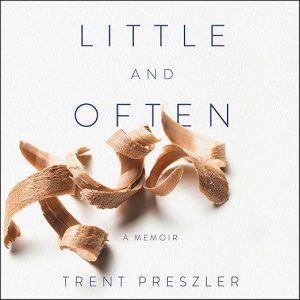
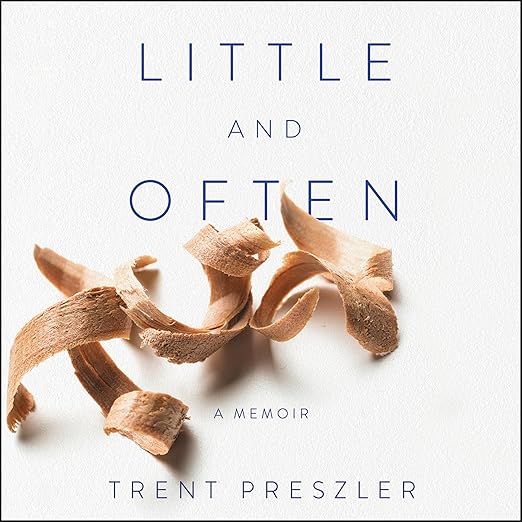
I finished Little and Often on a cold Tuesday evening, having started it that morning with no particular expectations beyond the Elizabeth Gilbert blurb, which I take as a reliable indicator of emotional ambition if not always of personal taste. I was sitting in my kitchen with my headphones in, theoretically doing other things, and by the middle of the second chapter I had stopped doing the other things entirely. This is the kind of memoir that asks for your full attention and makes you realize it deserves it before you've consciously decided to give it.
Trent Preszler's book is about building a wooden canoe from his estranged father's toolbox after his father dies of cancer. That sentence makes it sound more metaphorical than it is. The canoe-building is real, painstaking, and documented in specific detail. The grief is real, present from the first pages and never resolved in the way that therapeutic narrative promises. And the tools are real: their weight, their history, their inadequacy in hands that have never used them. Preszler is smart enough to understand that what the canoe represents is more interesting than what it literally is, and he trusts his readers with that complexity rather than underlining it.
Rodeo Champion, Vietnam Veteran, Silent Father
Preszler's father was a cattle rancher, a rodeo champion, and a Bronze Star recipient from Vietnam. He was also a man who could not find language for the things that mattered most, including his gay son, whose life in winemaking on Long Island represented a kind of departure from everything the father had built and valued. The estrangement between them is never reduced to a simple cause in the memoir, which is one of its signal virtues. Preszler doesn't make his father a villain. He makes him a person who was trying and failing to bridge a distance that neither of them had the tools for until, literally, one of them left the other a toolbox.
The toolbox is the book's central object, and Preszler earns its symbolic weight by never overdoing it. He describes the tools with the same careful attention he brings to the emotional material, which means the reader learns something real about woodcraft while learning something real about grief, and neither lesson feels like a detour from the other. The descriptions of the South Dakota plains where his father lived have the quality of language that has been lived in rather than researched, and they contrast with his Long Island present in ways that illuminate both without forcing the comparison.
From Viticulture PhD to Woodcraft Beginner
The boatbuilding sections are more technically specific than you might expect from a literary memoir. Several reviewers mentioned that Preszler goes into real detail about the mechanical processes involved, and a few found it dense. I found it necessary. The difficulty of what he's attempting physically maps onto the difficulty of what he's attempting emotionally, and following both processes simultaneously gives the memoir its particular layered texture. Preszler holds a doctorate in viticulture and comes to woodcraft as a complete beginner. The learning curve is steep and documented with an honesty that stops short of being performative about struggle: he is not martyring himself at the workbench for our edification but rather genuinely trying to figure something out, and we watch him do it.
What emerges from the building process are unexpected revelations about his father's secret history, and here the memoir opens into something more complicated and surprising than a simple grief narrative. Preszler discovers things he did not know about the man he is mourning, and he has to integrate that new knowledge into a grief that was already difficult to manage. This is the part of the book that hit hardest for me: the way grief keeps revising itself as new information arrives, and the way love for a difficult person has to keep finding new shapes to contain what you know about them.
Bomer Tracks the Shift From South Dakota to Long Island
Matt Bomer is best known for his acting work, and narrating a literary memoir is a different discipline than his most prominent screen roles. The surprise is how good he is at the prose's register shifts. Preszler moves between the plain-spoken language of his South Dakota childhood, rendered in sentences that have the directness of his taciturn father's speech, and the more stylized observation of his adult life as a winemaker and craftsman on Long Island. Bomer tracks those shifts with precision rather than smoothing them into a single consistent register, which would have flattened the memoir's structural intelligence.
He is particularly effective in the passages where Preszler is describing physical labor: there's a restraint in the performance that keeps the emotional weight from tipping into sentimentality, which is the constant risk with grief memoir. One reviewer described hearing Preszler see the world authentically and artistically through chosen word and expression, and Bomer serves that quality well. He doesn't impose himself on the text. At nine hours and seventeen minutes, this is a substantial listening commitment, and Bomer makes it feel worth sustaining even through the book's more technically demanding passages.
Grief Without Resolution, for Complicated Relationships
This memoir will mean most to listeners who have navigated complicated parental relationships, or who have experienced the particular grief of losing someone before the relationship was repaired or fully understood. It is not a book that promises resolution in the therapeutic sense. The reconciliation it offers is partial, posthumous, and made of wood and sweat and a lot of sanding. That makes it more honest than most memoirs in this territory, and ultimately more consoling for precisely that reason.
It is not for readers looking for momentum or forward narrative drive. The pace is deliberate, the emotional register quiet for long stretches, and the book rewards the kind of listening attention you might bring to a piece of music rather than a thriller. The title's meaning arrives late, as one reviewer noted, and when it does it reframes everything that came before with the quality of a good piece of craftsmanship: something you didn't know you were building until it was finished. If you want a book that demands something of your patience in exchange for something genuinely earned, Little and Often delivers on that contract.