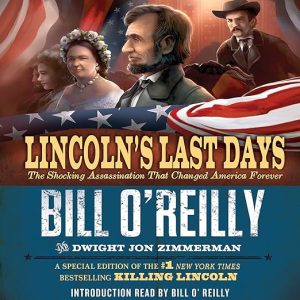
Adapting Killing Lincoln for a younger audience meant more than just trimming pages, and Bill O'Reilly's Lincoln's Last Days audiobook makes some genuinely careful choices in how it compresses a book that has sold more than a million and a half copies into something a middle schooler can finish in an afternoon.
At just under four hours, this is a fraction of the original's length, and O'Reilly narrates it himself, which matters for continuity if you already know his voice from the Killing series or his broadcast career. The question worth asking going in is whether that compression loses anything essential, or whether it manages to keep the core story, one gunshot changing the direction of the country, intact.
A Closer Look at Lincoln's Last Days
Reviewer S. Lee describes this as a speedy read that is difficult to put down, with facts easily understood and matched visually with the text, and that combination of pace and clarity is exactly what a YA adaptation of assassination-era history should deliver. M. Ducreaux, who bought it for two kids ages eleven and thirteen, specifically chose this version over the adult Killing Lincoln and came away satisfied with that decision, which suggests the adaptation succeeds at its actual goal: accessible history for younger readers without talking down to them.
Killing Lincoln itself was the first entry in what became O'Reilly's much larger Killing series, which later expanded to cover other historical figures and moments using the same brisk, thriller-influenced narrative style. Lincoln's Last Days adapts specifically that inaugural book, which means younger listeners are getting an introduction to the approach that later defined O'Reilly's entire historical writing brand.
What Makes Lincoln's Last Days Worth Hearing
O'Reilly's narration carries the same brisk, declarative style that made the original Killing Lincoln a bestseller, and that register translates well to a shorter runtime aimed at younger listeners. Margaret Young's review captures the appeal directly: she wanted her eleven-year-old granddaughter to learn American history at a moment when, in her words, current history education felt inadequate, and this book gave her a way to do that without the density of the adult edition.
The shorter length also works in the book's favor as an audiobook specifically. Four hours is a genuinely manageable listen for a younger audience or a family road trip, long enough to cover the assassination's key events with real narrative tension but short enough not to lose a listener's attention partway through.
The compression itself is a real skill, and not every adult bestseller survives being cut down for a younger audience without losing its narrative tension. This one keeps the assassination's chronology tight and suspenseful even at a fraction of the original length, which is part of why S. Lee's review specifically highlights how hard it is to put down despite, or perhaps because of, its shorter runtime.
The book's illustrated, photo-heavy print design also reflects a broader trend in adapting dense adult nonfiction for middle-grade readers, where visual pacing does real work alongside text simplification, and Lincoln's Last Days follows that established playbook closely even though the audio edition necessarily loses the visual half of that equation.
Things to Know Before Starting Lincoln's Last Days
The print edition's defining feature, according to both the synopsis and reviewer S. Lee specifically, is its abundance of photographs paired directly with the text, described as creating the flavor of the times. None of that visual material carries over into the audio listening experience, which is worth knowing before you buy: you are getting O'Reilly's narration of the text alone, without the image pairing that print readers specifically praise.
This edition also currently shows just a single listener rating, so treat the 4.7 score as a data point from one household rather than a broad consensus. And while M. Ducreaux's review confirms this works well as the intentionally lighter version alongside the adult Killing Lincoln, families should be clear going in that this is the abridged, younger-audience adaptation, not a shorter version of equal depth.
Because this is adapted specifically from Killing Lincoln rather than written as an original younger-reader history, some of the more mature content around the assassination and its aftermath has necessarily been softened for the audience, and parents of younger or more sensitive listeners may still want to preview the content themselves before sharing it with a child on the younger end of the recommended range.
Who Bill O'Reilly Is Writing For
The book's positioning as a companion to the adult Killing Lincoln also raises a natural sequencing question for families: some parents may prefer to start their kids here and graduate to the full adult version later, while others, like M. Ducreaux, deliberately chose the younger edition as the intended destination rather than a stepping stone, which suggests the book works as a standalone rather than strictly a preview. O'Reilly's broadcast background shows clearly in the pacing choices throughout, favoring short, punchy scene breaks over long expository passages, a structural habit carried over from decades of television work that translates naturally into an audio format built for shorter attention spans.
This audiobook is built for exactly the audience the reviews describe: parents looking for an accessible entry point into Civil War and assassination history for kids around ten to thirteen, or classrooms wanting a manageable single-sitting listen. Margaret Young and M. Ducreaux both used it this way and reported real success. Margaret Young's specific framing, choosing this book because she felt current history education was falling short, points to a real use case beyond entertainment: this works as a supplementary history resource for families who want to fill gaps a school curriculum might leave open.
Adult listeners who already know the broader Killing Lincoln should not expect additional depth here; this is a compression, not a companion volume with new material. But as an entry point for younger listeners or a family history discussion starter, O'Reilly's brisk narration and the tightly compressed runtime do exactly what they set out to do.
Quick Take
- Performance: Bill O'Reilly narrates his own adaptation with the same brisk, declarative delivery that made the original Killing Lincoln land, well suited to a younger audience's attention span.
- What it covers: Lincoln's assassination, Civil War history compressed for younger readers, history as family discussion starter
- Feel: Brisk and accessible, built for a single sitting
- Our call: A well-executed compression for younger or first-time listeners, though the print edition's photographs are a real loss in the audio format.