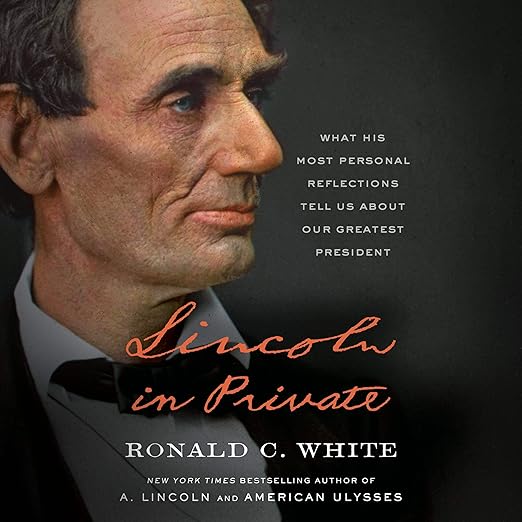
- Narrator: Ronald C. White narrating his own Lincoln scholarship produces a rare and effective pairing - his deep familiarity with the material results in a narration that carries genuine intellectual weight and authentic engagement with every sentence.
- Subjects: Private thought versus public rhetoric, the formation of moral conviction, the theology of leadership under crisis
- Tone: Reflective and intimate, with the gravity of proximity to history
- Bottom line: A compact and genuinely illuminating audiobook for anyone who wants to understand how Lincoln actually thought, not just what he said in his famous public addresses.
Abraham Lincoln's private notes, written for himself and never intended for outside eyes, reveal something that his public addresses necessarily concealed: the process. Lincoln was not simply a man with great thoughts who then expressed them in memorable speeches. He was a man who worked out his thinking through private writing, producing short fragments he kept in desk drawers and his top hat, returning to them, revising his positions, arriving at stances through private argument before he committed to any public declaration. Ronald C. White's audiobook Lincoln in Private brings twelve of the most significant of these notes together for the first time and reads them with contextual analysis that makes clear why they matter both historically and as a window into how serious thought actually works.
White is the right guide for this material. The New York Times bestselling author of A. Lincoln and American Ulysses, he has spent his career studying Lincoln's language and thought with the close attention of a scholar trained in both history and rhetoric. That he also narrates this audiobook himself creates an unusual intimacy: the scholar's voice is present not just in the analysis but in the reading of Lincoln's words, and the result is less a conventional audiobook experience than an extended seminar conducted by someone with genuine lifelong investment in his subject. The production runs four hours and fifty-six minutes, proportionate to the depth of analysis it contains.
White Narrates Lincoln's Own Note on Slavery
The decision to have White narrate his own work pays off in specific and audible ways. When he reads Lincoln's private note on slavery, "As I would not be a slave, so I would not be a master. This expresses my idea of democracy," the weight White places on those parallel clauses is the weight of someone for whom those words have accumulated meaning through decades of study. A professional narrator could read the sentence. White's narration of it carries something additional: the sense that these words mean something specific to him, which transmits to the listener in a way that text alone cannot quite replicate.
The private notes White examines range across Lincoln's intellectual and political life in ways that revise simplistic narratives about who he was. The note where Lincoln writes "the race of ambition has been a failure, a flat failure" after his Senate defeat shows a vulnerability that the Lincoln of popular imagination, the steady, resolved president standing firm during the Civil War, does not readily accommodate. The theological fragment written during the war, where Lincoln explores the possibility that God's purpose is something different from both parties' understanding of the conflict, is among the most genuinely surprising documents in the American presidential record. Jon Meacham called the result a fascinating tour inside the mind and heart of Abraham Lincoln, and the description is accurate.
All 111 of Lincoln's Known Private Notes
Reviewer Logical Thinker's description of being completely enthralled by the insight into Lincoln's thought processes names exactly what the audiobook delivers. The notes reveal how Lincoln arrived at his great gift for expressing complex thoughts in plain language: he practiced, privately, working through arguments and counter-arguments before settling on the version he would speak publicly. Watching that process in retrospect is like watching a craftsman's working sketches. You understand the finished speeches differently for having seen the working method that preceded them.
The audiobook includes an appendix, available via a companion PDF with the Audible purchase, containing all 111 of Lincoln's known private notes transcribed. This is a genuinely significant addition, described in the synopsis as a historic first bringing together documents scattered across several different archives. For listeners with serious interest in Lincoln, the appendix transforms the audiobook into a reference document rather than just a one-time listen. Reviewer Christian Schlect described the book as helping the reader make sense of important written fragments and coming away with a greater appreciation for Lincoln's logical method of reasoning privately, which describes the experience well.
God's Purposes Might Transcend Union and Confederate Causes
The notes on Lincoln's religious thought are the material where White's close reading is most essential and most illuminating. Lincoln is frequently claimed by both the religious and the secular as evidence for their preferred interpretation of American public life. The private theological reflections cut through that dispute with actual evidence of what Lincoln believed, or at least how he thought about belief. His conclusion during the Civil War that God's purposes might transcend both the Union and Confederate causes is theologically sophisticated and historically significant, and White's analysis gives it the careful treatment it deserves rather than assimilating it into either camp's preferred narrative.
The sections on Lincoln's preparation for the debates with Stephen Douglas are worth extended attention for listeners interested in rhetoric and persuasion. Lincoln's private notes show a man building arguments methodically, testing positions against counter-arguments before committing to them publicly. That working method is itself a lesson in how serious thought about complex problems actually proceeds, and it is more interesting than any account of Lincoln as a natural orator who simply knew what to say. Reviewer Dthomasla noted being impressed by White's scholarship and committed to reading more of his Lincoln books, which is the natural response to five hours spent in close proximity to this material.
More Illuminating If You Know the Gettysburg Address
This audiobook rewards listeners who come to it with some existing familiarity with Lincoln's public record. Knowing the Gettysburg Address and the Second Inaugural makes the private notes more illuminating because you can trace the connection between private working notes and public finished product. Those encountering Lincoln primarily through this audiobook may find the context sections challenging without that prior foundation.
The production runs just under five hours and works well as a focused single-topic listen rather than background audio. Listeners who have read White's longer Lincoln biographies will find this a genuinely additive complement to those works, offering access to material not covered elsewhere. Those new to Lincoln scholarship will find it an unusually direct route into understanding how one of history's most carefully studied minds actually worked, provided they bring the patience to follow White's careful, incremental analysis rather than looking for dramatic revelations delivered at speed.
Is it useful that Ronald C. White narrates his own Lincoln audiobook?
Yes. White's deep familiarity with the material produces a narration that carries genuine intellectual weight. His emphases and pauses reflect decades of engagement with Lincoln's language rather than a professional performer's interpretation, which creates a different and more intimate listening experience for this kind of scholarly work.
What are Lincoln's private notes that the Lincoln in Private audiobook examines?
Short written fragments Lincoln kept for himself, often in desk drawers or his top hat, where he worked through his positions on major issues before speaking publicly. White examines twelve of the most important, covering slavery, the Douglas debates, his Senate defeat, religious conviction, and the meaning of the Civil War.
How long is the Lincoln in Private audiobook and is it suitable for casual listeners?
Just under five hours. The audiobook rewards attentive listening rather than background play. Some familiarity with Lincoln's public speeches and biography will make the private notes more illuminating, though White provides sufficient historical context for listeners approaching without deep prior knowledge of the period.