Key Details
- Narration: George Guidall lends real gravitas to a genre combination that's new territory for him: tech, military strategy, and internet culture at once.
- Themes: weaponized social media, information warfare, platforms as geopolitical terrain
- Mood: Urgent and unsettling
- Verdict: A sharp, case-study-driven listen for understanding how platforms reshape real conflicts, not a balanced tech-optimist take.
Social media stopped being a sideshow to war and politics a while ago, and this audiobook is one of the clearer accounts of exactly when and how that happened. LikeWar, by defense analyst P. W. Singer and co-author Emerson Brooking, treats the collision of war, politics, and platforms not as a metaphor but as a literal new kind of battlespace, one that plays out on ordinary smartphones rather than traditional battlefields, reshaping both military strategy and everyday political life at the same time.
The examples the book builds its argument around are specific enough to stick: ISIS borrowing Taylor Swift's Instagram marketing tactics, a former World of Warcraft player helping expose real war crimes from thousands of miles away, internet trolls actively shaping the outcome of real elections, and China using a smartphone app to monitor the thoughts and behavior of 1.4 billion citizens. Eleven hours and twenty-one minutes gives Singer and Brooking real room to build out that case study by case study rather than rushing past any single example.
What Can Actually Be Kept Secret Anymore?
One reviewer opens with a sharp, almost uncomfortable framing device: quoting a well-known conspiracy broadcaster's own slogan about a war for your mind, and noting that while he's wrong about nearly everything else, he isn't wrong about that specific claim. It's a smart way into the book's actual argument, that the platforms shaping public attention have become genuine strategic terrain, regardless of who's using them or why, and the authors return to that framing again and again across the book's central case studies.
A 4.6 rating across 954 ratings for a dense, research-driven nonfiction title is a strong result, and the book's structural device, meeting a rapper turned jihadist propaganda strategist alongside Russian internet trolls waging deliberate infowars against Western audiences, keeps the argument grounded in real people and real cases rather than abstract theorizing about the internet and its effects on public life.
Singer's credentials are worth naming directly: a defense analyst affiliated with the Brookings Institution, he's spent his career studying how technology reshapes warfare, and LikeWar reads as a natural extension of that research into the platforms most listeners actually use every day rather than abstract future battlefields. Brooking brings a complementary, more digitally native lens, and the combination is likely why reviewers single out the partnership as unusually well matched.
The synopsis poses its own central question plainly: what can actually be kept secret in a world built on networks? That's a genuinely different question from the more familiar debate over whether social media is simply good or bad, and it's the more useful one, since it treats privacy and secrecy as strategic resources under direct, active assault rather than personal preferences some people happen to value more than others.
Guidall Stretches Into an Unfamiliar Genre Well
George Guidall narrates, and his decades of experience carrying long, complex nonfiction and thriller material across many hours is a real asset here, even though this specific genre combination, tech, military strategy, and internet culture together, is newer stretch for him relative to his more established territory in epic fantasy series and literary biography. The gravitas he brings to serious, high-stakes material should suit a book arguing that online platforms are now genuine geopolitical terrain worth taking as seriously as any physical front line.
One reviewer calls LikeWar a worthy successor to Singer's earlier book Ghost Fleet, and an excellent debut for Brooking, which is a useful signal for anyone deciding whether to trust the authors' authority on this specific intersection of subjects. Defense analysts writing about internet culture could easily read as out of their depth; the reviews suggest that isn't the case here, and the pairing of a veteran strategist with a younger co-author fluent in platform culture seems to be exactly why the book holds together.
Like and War Fused Without Even a Space
Anyone doomscrolling through a platform's comment section and wondering why a particular argument or meme suddenly went everywhere, per one reviewer's own framing, is exactly the reader this book is built for, but know going in that the internet culture it documents moves fast, and even a well-researched book like this one is describing platforms and dynamics that keep shifting underneath it year over year.
This is unapologetically a book about weaponization, not a balanced or optimistic take on what social media can also do well. Listeners hoping for a more even-handed accounting of technology's upsides alongside its dangers should know the emphasis here sits firmly on the danger side of that ledger, by clear authorial design rather than oversight, since Singer and Brooking are explicitly interested in what can be kept secret in a networked world, not in celebrating its conveniences.
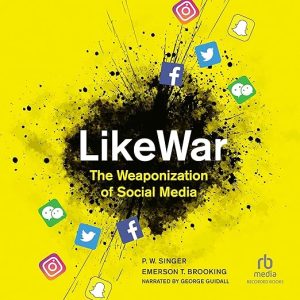
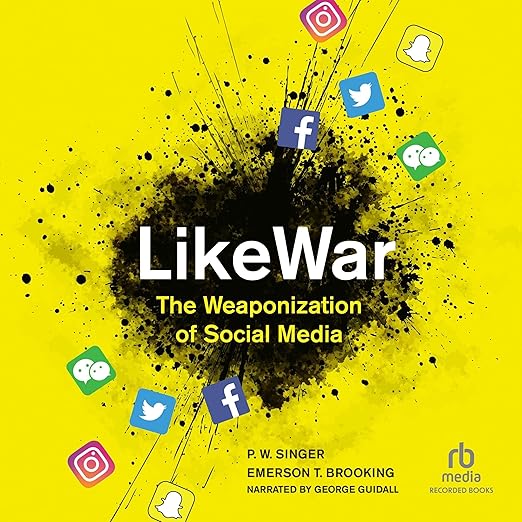
The title itself is a small piece of wordplay worth noticing: 'like,' the social media approval mechanism, fused directly onto 'war,' the oldest form of organized human conflict, without so much as a space between them. That collision is the entire argument in miniature, that a mechanism built for approval and attention has become genuinely indistinguishable from a mechanism for conducting conflict.
Older accounts of propaganda and information warfare assumed real infrastructure behind them, broadcast towers, printing presses, a state media apparatus. LikeWar's more unsettling premise is that none of that infrastructure is required anymore; a single ordinary smartphone in a single ordinary hand is now sufficient to participate in what the book treats as genuine warfare, collapsing a barrier to entry that used to separate state actors from individuals almost entirely.
Leans Hard Into Weaponization by Design
Readers of tech-and-society nonfiction, anyone trying to understand how social media reshapes real conflicts and elections rather than just personal attention spans, and existing fans of Singer's other work looking for his nonfiction side will get real value here. The specific case studies keep the eleven-hour runtime moving rather than feeling like a lecture on abstract media theory.
Skip it if an optimistic or balanced take on technology's role in society is what's wanted, since the book's whole thesis leans hard into weaponization and danger by design. Listeners wanting only the most current examples rather than the book's original case studies should also adjust expectations, since the platforms it documents have kept evolving since publication, even as the underlying argument holds up.
Common Questions
Is this audiobook balanced, or does it lean toward alarm about social media?
It leans deliberately toward alarm. The book's thesis centers on weaponization and danger by design, not a balanced accounting of technology's upsides and downsides.
Who narrates the LikeWar audiobook?
George Guidall.
Is this audiobook still relevant given how fast social media changes?
The core argument holds up well, though the specific platforms and case studies it documents have naturally kept evolving since publication.
How long is the LikeWar audiobook?
Eleven hours and twenty-one minutes.