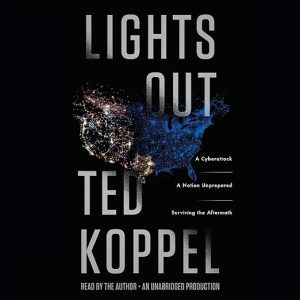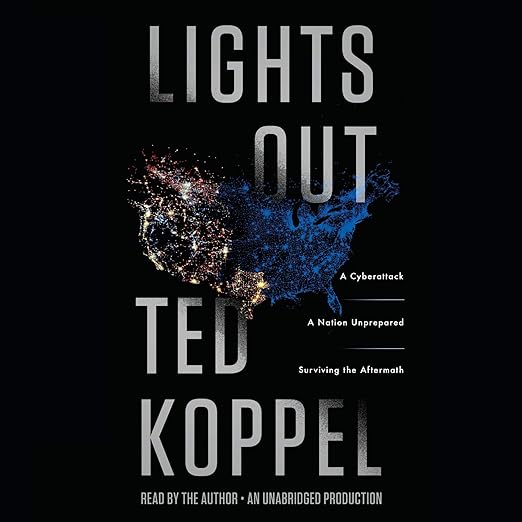
I listened to Lights Out during a week when the news was dominated by infrastructure discussions, which is either a coincidence or the permanent condition of reading Ted Koppel's 2015 investigation. The book was a New York Times bestseller the year it came out, and a reviewer writing about it in March 2026 still calls it essential reading with the same countries still posing the same threats. That durability, not as vindication but as failure, is what makes this audiobook unusual among nonfiction from the mid-2010s.
Koppel narrates his own work, which matters here more than it typically does. His career at ABC News and Nightline gave him a specific register: careful, balanced, skeptical of easy answers but never dismissive of expert consensus. That voice is present throughout, and it makes the most alarming claims in the book land differently than they would from a more excitable narrator. When Koppel reports that China and Russia have already penetrated the US power grid, as told by a former NSA chief scientist, the measured delivery makes the information more unsettling, not less.
Preppers, Mormons, and Three Vulnerable Power Grids
The core argument of Lights Out is not speculative. Koppel is not writing science fiction. He is reporting on a real vulnerability in the three US electrical grids, the eastern, western, and Texas interconnections, and the absence of any coordinated federal plan for managing a long-term blackout. The scenario he constructs, a cyberattack taking down a major grid for weeks or months, is drawn from the assessments of military commanders, cybersecurity officials, and former intelligence figures. The Centcom Commander's quote, not a question of if, only of when, is reported as on the record.
The human dimension of the book occupies roughly equal space with the policy analysis. Koppel visits individual preppers, including one with a self-sufficient mountain retreat complete with a stocked lake. He examines the Mormon Church's extraordinary disaster preparedness infrastructure: warehouses, high-tech dairies, proprietary trucking operations built on generations of theological commitment to self-sufficiency. These sections ask an implicit question about what preparedness actually means and who gets access to it.
Koppel Narrates a Warning With No Solution
Koppel's journalism background shows in how he structures his investigation. He interviews the right people, follows the evidence where it leads, and resists the temptation to resolve the anxiety he generates with false reassurance. The book ends without a solution because there is not one readily available, and he does not pretend otherwise. One reviewer praises his true media reporting skills and the fact that the content is expert information rather than opinion. That distinction matters for a subject this complex.
A reviewer in Canada notes that Koppel repeats himself somewhat, which is a fair observation. The warnings about grid vulnerability come from multiple angles, which reinforces the seriousness of the threat but can feel repetitive over eight hours. The same reviewer forgives this because the subject warrants emphasis. That seems like the right call. This is not a book where the stakes benefit from understatement.
Dated Politics, an Unchanged Grid Vulnerability
The book is from 2015, and some of the specific technical and political context has shifted. The officials and programs Koppel cites are from that era. What has not changed, reviewers consistently note, is the fundamental vulnerability he identifies and the absence of a comprehensive federal response to it. The book should be read as a durable warning rather than a current policy analysis.
One reviewer raises a practical dimension that the book itself touches: the healthcare implications of an extended blackout. Medical equipment, refrigerated medications, hospital systems, diagnostic tools, all of these depend on continuous electricity in ways that were not true a generation ago. The nurse's observation about blood pressure equipment is a small window into a systemic vulnerability that the book addresses at scale.
Infrastructure Readers Get Alarm, Not Reassurance
Anyone with an interest in infrastructure security, cybersecurity policy, or emergency preparedness will find this essential and alarming reading. Listeners who appreciate long-form investigative journalism from a practitioner with decades of credibility will respond well to Koppel's approach. The book is not partisan and does not require any particular political alignment to take seriously.
Readers looking for solution-oriented content will find this frustrating. Koppel's prescription is largely absent because at the time of writing, federal preparedness was largely absent. If you need a book that ends with reassurance or a clear action plan, this will leave you unsatisfied. If you can sit with the discomfort of a well-documented problem without an obvious solution, the eight hours are worth your time.
How accurate is Lights Out's threat assessment given it was published in 2015?
The core vulnerability Koppel identifies, cyberattack risk to the US electrical grid and the absence of a comprehensive federal response, remains credible according to more recent reporting. Multiple reviewers writing in 2025 and 2026 note that the same threats he identified persist. The specific officials and programs he cites are dated, but the structural argument has not been overtaken by subsequent events.
Does Koppel offer any practical guidance for individual preparedness?
Yes, though the book is primarily investigative rather than prescriptive. He examines the Mormon Church's extensive preparedness infrastructure, individual preppers' approaches, and community-level emergency systems. The implicit question throughout is whether ordinary civilians could survive an extended blackout, and the answer he arrives at is: not without preparation, and not alone.
Is this book partisan in how it discusses government failure to address the threat?
Koppel is deliberately non-partisan. The vulnerability he describes predates any particular administration and his criticism of federal unpreparedness is directed at the institutional failure rather than any political party. Reviewers across the political spectrum have found the analysis credible, which reflects both Koppel's journalism training and the nature of the subject.
Does Koppel's self-narration add to or distract from the listening experience?
Most listeners find it adds considerably. His broadcast journalism voice carries institutional authority that a third-party narrator would have to work hard to replicate. The calm, measured delivery of alarming material creates a specific tension that makes the warnings land harder than an excitable narration would.