Life on Earth
Audiobook & Ebook

Life on Earth by David Attenborough | Free Audiobook

By David Attenborough

Narrated by David Attenborough

🎧 12 hours and 26 minutes 📘 HarperCollins Publishers Limited 📅 September 20, 2018 🌐 English
🎧 Listen Free on Audible 📖 Read on Kindle

Free 30-day trial · Cancel anytime

About This Audiobook

A new edition of David Attenborough’s groundbreaking Life on Earth.

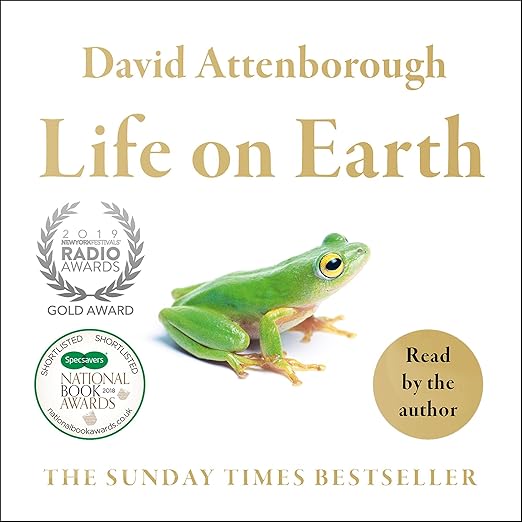
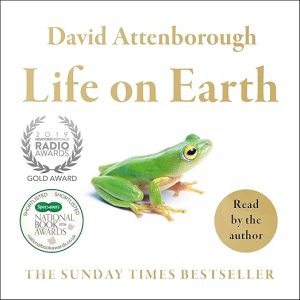
Winner of Best Non-Fiction Audiobook at the New York Radio Awards 2019.

Shortlisted for Best Audiobook at the Specsavers National Book Awards 2018.

Shortlisted for Futurebook of the Year at the Futurebook Awards 2018.

The nation’s greatest voice, David Attenborough, reads a brand-new edition of Life on Earth, now available as an audiobook for the first time.

David Attenborough’s unforgettable meeting with gorillas became an iconic moment for millions of television viewers. Life on Earth, the series and accompanying book, fundamentally changed the way we view and interact with the natural world, setting a new benchmark of quality, influencing a generation of nature lovers. Told through an examination of animal and plant life, this is an astonishing celebration of the evolution of life on earth, with a cast of characters drawn from the whole range of organisms that have ever lived on this planet. Attenborough’s perceptive, dynamic approach to the evolution of millions of species of living organisms takes the reader on an unforgettable journey of discovery from the very first spark of life to the blue and green wonder we know today.

Now, to celebrate the 40th anniversary of the book’s first publication, David Attenborough has revisited Life on Earth, completely updating and adding to the original text, taking account of modern scientific discoveries from around the globe. This special anniversary edition provides a fitting tribute to an enduring wildlife classic, destined to enthral the generation who saw it when first published and bring it alive for a whole new generation.

This audiobook includes wildlife sounds from BAFTA Award winning sound recordist, Chris Watson, who has worked extensively with David Attenborough on his BBC projects. A soundscape appears at the beginning of each chapter to provide a fully immersive experience of the habitat and some of the species described. A full list of the tracks, as they appear in the audiobook, is available below.

Prologue – Acacia scrubland dawn chorus in the Masai Mara, Kenya, featuring White-browed Robin-chat.
Chapter One, The Infinite Variety – Tropical rain forest in Panama with the calls of Montezuma oropendola.
Chapter Two, Building Bodies – Fish and crustaceans recorded underwater on a coral reef off Seligan island, Borneo.
Chapter Three, The First Forests – Geysir and geothermal activity at Haukadalur hot springs in Iceland. This track also features the Strokkur geysir erupting.
Chapter Four, The Swarming Hordes – Evening insect chorus in the Conkouati forest reserve, Republic of Congo.
Chapter Five, The Conquest of The Waters – Ocean currents through sea kelp recorded at a depth of 8m, Moray Firth, Scotland.
Chapter Six, Invasion of The Land – Reed frog chorus at sunset, Amboseli National Park, Kenya.
Chapter Seven, A Watertight Skin – Seawash around basking marine iguanas, Isla San Cristóbal, Galapagos.
Chapter Eight, Lords of The Air – Springtime dawn chorus with nightingale, Hambleton wood, Rutland Water nature reserve, UK.
Chapter Nine, Eggs, Pouches and Placentas – forest chorus along riverside platypus territory, Queensland, Australia.
Chapter Ten, Theme and Variation – Common Pipistrelle bats echolocating after sunset, Holystone woodland, Northumberland.
Chapter Eleven, The Hunters and The Hunted – Spotted hyena contact calls at midnight in the Masai Mara, Kenya.
Chapter Twelve, A Life in The Trees – Black howler monkeys calling across the tree canopy at sunrise in Belize.
Chapter Thirteen, The Compulsive Communicators – Street market, Ramnagar, Uttarakhand, Northern India.
Epilogue – Beach habitat in mangroves with Great frigatebirds and red footed boobies, Isla Genovesa, Galapagos.

🎧 Listen Free on Audible

Free 30-day trial · Cancel anytime

Quick Take

  • Narration: David Attenborough narrating his own work is as close to a perfect audiobook casting decision as the medium allows, authoritative, warm, and unmistakably alive to the material.
  • Themes: Evolution, biodiversity, the emergence of life across geological time
  • Mood: Expansive and wonder-struck, deeply humane
  • Verdict: One of the most immersive natural history audiobooks available, the wildlife soundscapes make this a genuinely different listening experience from the page.

I finished the final chapter of Life on Earth on a Sunday morning, sitting by a window with a cup of tea going cold beside me. I had started it the previous Thursday during a long train journey, and it had become one of those audiobooks I found reasons to return to, an extra loop around the block, the long way home from the shop. Twelve hours and twenty-six minutes is substantial for a natural history title, but in David Attenborough’s hands, it does not feel like endurance listening. It feels like being shown something.

This is a 40th anniversary edition of a book that first appeared in 1979 alongside the landmark BBC television series. Attenborough has revisited the text comprehensively, incorporating modern scientific discoveries into what was already a foundational document of popular natural history writing. It won Best Non-Fiction Audiobook at the New York Radio Awards in 2019, and was shortlisted for two other major prizes in 2018. Those accolades are deserved.

Our Take on Life on Earth

The scope of the book is extraordinary. Attenborough traces the full arc of life on this planet, from the first spark of biological complexity to the extraordinary biodiversity of the present. Each chapter moves through a different domain, the invasion of land, the conquest of the air, the emergence of pouched and placental mammals, the communicative primates, and does so with the kind of precision that comes from decades of direct encounter with the creatures being described. This is not a writer rendering research at second hand. Attenborough has stood in the places he describes, watched the animals he writes about, and the prose carries that embodied knowledge in every paragraph.

The 40th anniversary update is not merely cosmetic. Modern paleontology has revised our understanding of major evolutionary transitions significantly since 1979, and Attenborough has integrated those revisions into the text without disrupting the flow of the original argument. What emerges is a book that is simultaneously a historical document, a record of what one of the twentieth century’s greatest science communicators understood about the living world, and a current, reliable account of where our knowledge stands.

Why Listen to Life on Earth

The audio production is the decisive reason to choose this format over the printed book, and it deserves serious attention. BAFTA Award-winning sound recordist Chris Watson, who worked with Attenborough extensively on his BBC projects, contributed wildlife soundscapes at the opening of each chapter. These are not stock nature sounds or ambient filler. Each soundscape is site-specific and matched precisely to the habitat and species discussed in that chapter: the dawn chorus of a White-browed Robin-chat in Kenya’s Masai Mara for the prologue; tropical rain forest in Panama with Montezuma oropendola calls for the chapter on variety; a Springtime nightingale in Rutland Water nature reserve for the chapter on birds; the echolocation of Pipistrelle bats in Northumberland for the chapter on mammals.

The effect is immersive in a way that is genuinely difficult to describe without experiencing it. You are placed into the soundscape of the world being described before Attenborough even begins to speak, which means the words that follow land with a different quality, not information arriving from outside, but narration from within a place you can almost hear. One listener called Attenborough’s writing style engaging to the point of being unable to put the book down; another noted the informational richness around extinct species alongside living ones. The soundscapes amplify both responses.

What to Watch For in Life on Earth

The book’s breadth is also its only meaningful limitation for some listeners. Attenborough covers enormous evolutionary territory, which means some chapters move quickly through complex material. The origin of the first forests, the mechanics of insect evolution, the transition to warm-blooded physiology, these are each given attention, but not the kind of sustained, granular treatment a specialist would want. This is a general audience work, and the trade-off for the sweeping journey is that no single topic receives the depth available in a dedicated monograph.

That is a reasonable trade-off. The ambition of Life on Earth has always been to offer a coherent narrative of life’s entire history, not to function as a textbook. As a narrative achievement, it succeeds entirely. Attenborough’s prose has always balanced scientific precision with literary quality in a way very few writers in any genre manage, and this edition represents that quality at its most fully realized.

Who Should Listen to Life on Earth

Anyone with genuine curiosity about the natural world and its history should hear this. It is particularly valuable for listeners who have watched Attenborough’s documentaries and want the extended, uninterrupted version of that perspective in writing. The soundscape production makes it a richer experience than a print read, and the 40th anniversary updates ensure the science is current. Those who want highly technical evolutionary biology should go elsewhere, but for everyone else, this is among the finest natural history audiobooks in the English language.

Frequently Asked Questions

Do the wildlife soundscapes at the start of each chapter actually add something, or are they just decorative?

They genuinely add something. Each soundscape is site-specific and recorded by BAFTA-winning sound recordist Chris Watson to match the habitat discussed in that chapter. The immersive effect is noticeable and makes the audio format meaningfully different from the print edition.

How significantly was the text updated for the 40th anniversary edition compared to the 1979 original?

Attenborough describes it as a comprehensive update rather than minor corrections, incorporating modern paleontological and biological discoveries throughout. It is not simply a reissue of the original with a new introduction.

Is this suitable for listeners without a scientific background, or does it assume prior knowledge?

It is written for a general audience. Attenborough’s gift as a communicator is making complex evolutionary concepts accessible without oversimplifying them. No prior scientific knowledge is required.

At over twelve hours, how does the pacing hold across the full runtime?

It holds well. The chapter structure, each introduced by a distinct soundscape, gives the listening experience natural rhythm and variation. Most listeners report the runtime passing quickly rather than feeling like a commitment.

Ready to listen?

🎧 Listen to Life on Earth for free

Free 30-day trial · Cancel anytime

Alexandra Reed

Written by Alexandra Reed

Founder & Literary Critic