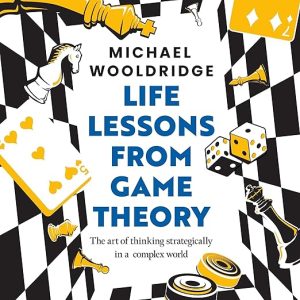
I started listening to Life Lessons from Game Theory on a Tuesday morning when I was supposed to be doing something else entirely. Michael Wooldridge's opening framing, that game theory has been systematically misread as a science of greed and inevitable conflict, was enough to make me put down what I was doing and pay proper attention. That setup alone is worth something. Too many popular science audiobooks spend their first chapter congratulating the listener for picking up the book. Wooldridge just gets on with it.
I should say upfront that I arrived skeptical. Game theory is one of those subjects with an almost comically inflated reputation in popular nonfiction. The prisoner's dilemma has been explained in so many airport paperbacks that I assumed a new entry in the genre would have to work hard to justify its existence. What Wooldridge does instead of retreading familiar ground is use his twenty-one lessons as a genuine corrective, an argument that the field has been sold short by its own popularizers.
What We Made of It
The structure here is elegant: twenty-one self-contained lessons, each built around a real-world scenario. Wooldridge draws on the Cuban Missile Crisis, overfishing agreements in the Atlantic, advertising wars between rival consumer brands, and security protocols at international airports. That last example is particularly effective. The way he uses airport security to illustrate mixed-strategy equilibria, where the point is precisely that no one should be able to predict your pattern, is the kind of explanation that makes a complex idea feel inevitable rather than arcane.
What separates this from similar titles is the tonal shift Wooldridge pulls off in the final third of the book. He isn't interested in leaving you with a cynical toolkit for exploiting others. The lessons accumulate toward something surprisingly optimistic: an argument that game theory, properly understood, reveals the conditions under which cooperation becomes rational. That's a harder case to make than it sounds, and he makes it without fudging the math or the ethics.
The audiobook format suits this material particularly well. Wooldridge has a lecture-room rhythm that translates naturally to audio, he builds toward each lesson's payoff with the timing of someone who knows when to pause and let an idea settle. He reads his own work, which is always a gamble. In this case it pays off. There's a dryness to his delivery that fits the subject: he's clearly enjoying the examples without overselling them, and the occasional flash of British wit (praised specifically in the blurbs from his colleagues at Stanford and Northwestern) lands as a genuine beat rather than a performance.
The production from Wildfire is clean and the pacing is well-managed across the seven-plus hours. Nothing feels padded. Each lesson earns its place, and the connective tissue between them builds a cumulative argument rather than a list of entertaining factoids.
Before You Commit to Life Lessons from Game Theory
Listeners with a serious background in economics or mathematics may find the treatment more accessible than rigorous. Wooldridge is writing for a general audience, and he makes that choice consistently, this is not a substitute for a technical introduction to the field. If you have already worked through a proper game theory textbook, you are unlikely to encounter much that surprises you at the conceptual level, though the real-world applications are often freshly chosen.
There is also a structural limitation built into the lesson-by-lesson format: some of the twenty-one entries feel more substantial than others. A handful of the middle lessons cover ground that the stronger ones render slightly redundant. It's a minor complaint in a book this efficiently argued, but worth flagging for listeners who prefer a tightly wound single-thread narrative over a more episodic structure.
Best Suited For
This works best for listeners who have encountered game theory concepts in passing, through news coverage of international negotiations, through business or economics reading, through films that reference the prisoner's dilemma, and have always wanted a clear, honest account of what the field actually claims and why it matters. Wooldridge's corrective framing makes it especially useful for anyone who came away from previous encounters feeling vaguely depressed about human nature. The book argues, persuasively, that you were sold a distorted version of the story.
Skip it if you are looking for tactical advice on competitive decision-making. This is not a strategy guide. It is an intellectual history with moral stakes, and it is better for being exactly that.
Questions Listeners Ask
Do you need a math background to follow Life Lessons from Game Theory?
No. Wooldridge is writing explicitly for a general audience and avoids formal notation throughout. The mathematical reasoning is present in the argument but expressed in plain language and illustrated through real-world examples like the Cuban Missile Crisis and Atlantic fishing agreements.
Is this audiobook suitable for listeners who have already read popular game theory books like The Evolution of Cooperation?
It covers some overlapping ground but approaches the material with a different emphasis. Wooldridge's central argument, that game theory has been misrepresented as a science of inevitable conflict, gives even familiar concepts a fresh framing. Veteran readers may find the early lessons less novel but the later chapters rewarding.
How does Michael Wooldridge perform as his own narrator?
Confidently. He reads with the pacing of an experienced lecturer, building to each lesson's payoff deliberately and allowing the drier moments of wit to land without forcing them. Listeners who prefer a professional audiobook narrator's polish may notice the occasional flatness of self-narration, but it suits the material's conversational register.
Does the book follow a single argument or is it more of a collection of standalone essays?
It's structured as twenty-one discrete lessons but they build cumulatively toward a central thesis: that cooperative outcomes are rational under the right conditions. Each lesson stands on its own but the later ones gain extra weight from the groundwork laid in the earlier ones.