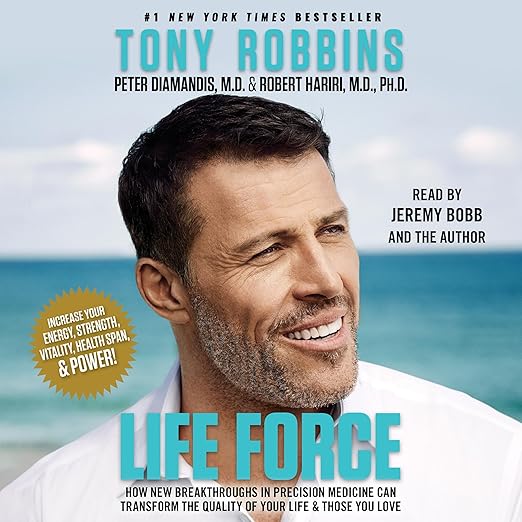
Tony Robbins spent years believing he had found every tool for peak performance, and then his body started disagreeing. After being told his physical challenges were irreversible, he turned to a cohort of more than a hundred physicians, scientists, and researchers working in regenerative medicine. That personal reckoning is where this audiobook begins, and it gives the material a weight that distinguishes it from the crowded shelf of wellness titles. I listened to the first three hours on a long train ride north, and by the time I stepped off the platform I had filled three pages of notes.
Life Force is a sprawling 22-hour production covering everything from stem cell therapy and continuous glucose monitors to telomere research and precision diagnostics. The scope is enormous. Robbins covers infrared therapy, platelet-rich plasma treatments, cryotherapy, ketamine-assisted protocols, and NAD+ supplementation all within the same sweeping framework. The organizing idea is that the best tools previously reserved for elite athletes and billionaires are now becoming accessible, and that understanding them is the first step toward using them.
Hariri's Credibility Grounds Robbins's Enthusiastic Claims
What separates Life Force from a standard biohacking survey is the combination of Robbins's own healing arc and the sheer density of expert voices woven through the text. The book is co-written with Peter Diamandis and Tony Robbins's son-in-law Dr. Robert Hariri, and the medical credibility keeps the more enthusiastic claims grounded. One reviewer described it as 'a veritable index of amazing recent medical information,' and that description is accurate. This is less a narrative and more a reference work that happens to have a compelling personal spine.
The production runs to almost twenty-three hours, which reflects how much material is packed in. Robbins writes the framing sections himself; the expert chapters often read like annotated interviews. That structure rewards listeners who approach it as a resource rather than a linear story. Several reviewers said they listened through once and then returned repeatedly by chapter topic. The audiobook format suits that use pattern well because chapter titles function as navigation points.
Bobb Skips Robbins's Platform Cadence on Purpose
Jeremy Bobb narrates, and his delivery is clear and professionally warm without mimicking Robbins's own platform cadence, which is the right call. Bobb keeps the medical terminology accessible without oversimplifying, and he handles the shift between personal anecdote and clinical explanation smoothly. For a book where the content includes genetic test protocols and cell biology, that translational register is essential. A narrator who performed the material with too much evangelical energy would undercut the scientific credibility the authors work hard to establish.
The DRESS Code material (Diet, Relationships, Exercise, Stress, Sleep) forms the practical backbone that listeners looking for immediate application will find most useful. The book consistently returns to the distinction between lifespan and healthspan, arguing that adding decades of compromised function is not the goal. That framing feels genuinely different from longevity discourse that treats survival itself as the metric. One reviewer, a practicing physician, noted that the DRESS framework aligns with clinical practice in ways that most popular health books do not manage.
Robbins Insists He Isn't Prescribing Any Therapy
The book's breadth is also its main limitation. Listeners looking for deep dives on single interventions will sometimes find themselves wanting more granularity than Robbins provides. The introduction to stem cell therapies, for example, is genuinely illuminating but stops short of the mechanistic detail a specialist would want. This is a deliberate choice; the book is explicitly positioned for a general audience that may never have encountered regenerative medicine concepts before. Managing that expectation is important before you start.
The promotional register appears occasionally, particularly in sections that feel more aspirational than evidence-based. Robbins's coaching voice is unmistakable, and for listeners who find that style motivating it adds energy; for those who prefer drier scientific communication, it can feel like an interruption. The book is most purely useful in the chapters where the expert voices take over and Robbins steps back. Those passages are consistently the strongest in the production.
The book's treatment of stem cell therapy, gene therapy, and continuous glucose monitoring sits in a register that requires careful reading. Robbins is explicit that he is not prescribing any specific therapy and that individual medical decisions require individual medical consultation. That caveat appears frequently enough to feel genuine rather than legal boilerplate. The distinction matters because the scale of the claims in some chapters, particularly around biological age reversal, can outpace the current state of the science if read without that interpretive frame. Listeners who come away with a framework for having more informed conversations with their own physicians will have gotten precisely what the book intends to deliver.
Newcomers Get a Comprehensive Entry Point Here
Listeners already familiar with longevity research through books by Peter Attia, David Sinclair, or Rhonda Patrick will find Life Force covers significant familiar ground, though Robbins's access to clinical practitioners adds angles those works do not always include. For someone coming to regenerative medicine completely fresh, this audiobook is one of the most comprehensive entry points available in audio form. The twenty-three hour runtime is a genuine time investment, but the chapter-by-chapter structure means it can be absorbed in segments without losing the thread.
Skip this one if you are looking for a concise, tightly argued case for a single health intervention. Life Force is encyclopedic by design. It rewards the listener who wants a broad map of what is happening at the frontier of longevity science and is willing to follow the threads that matter most to their own situation outward into deeper reading or medical consultation.
Key Details
- Voice: Jeremy Bobb delivers with clinical clarity and appropriate warmth, navigating medical terminology and personal narrative without defaulting to Robbins's signature coaching intensity.
- Big ideas: Regenerative medicine, lifespan versus healthspan, democratizing elite health technology
- Atmosphere: Encyclopedic and energizing, occasionally evangelical
- Worth it?: An unusually dense and well-sourced entry point into longevity science, best approached as a reference audiobook rather than a linear listen.
How long is the Life Force audiobook and is it worth the full runtime?
The audiobook runs 22 hours and 50 minutes. Multiple reviewers note that the chapter structure makes it worth returning to specific sections rather than listening straight through. For the breadth of material covered, the runtime is justified.
Who are the co-authors of Life Force and how does that shape the audiobook?
Life Force is co-written by Tony Robbins, Peter Diamandis, and Dr. Robert Hariri. The medical co-authorship gives the regenerative medicine sections more clinical specificity than a Robbins book alone would typically offer.
Does the audiobook version of Life Force include the research references and expert contacts mentioned in the text?
The audiobook narration covers the expert names and key claims, though the full citations and resource lists are more navigable in print. Several reviewers purchased the physical book as a companion reference after finishing the audiobook.