Quick Take
- Narration: Rob Shapiro handles the material with clean precision, his voice has the right neutral authority for a book that wants to present multiple AI futures without bias.
- Themes: Artificial general intelligence, existential risk, the future of human purpose
- Mood: Dense and ruminative with occasional bursts of genuine awe, best absorbed in focused sittings
- Verdict: Tegmark’s framework for thinking about AI futures is still among the most systematic available, even as specific predictions have been complicated by events since publication.
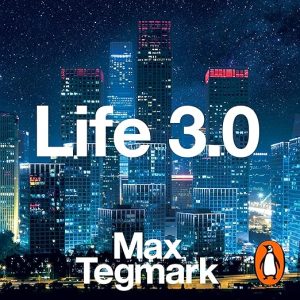
I came to Life 3.0 several years after it was published, which turned out to be both an advantage and a complication. The advantage: I could hold Tegmark’s 2017 predictions against what had actually happened by 2025 in the AI landscape and find, unsettlingly, that most of his scenarios had moved from speculative to merely accelerated. The complication: the specific capabilities Tegmark described as decades away arrived, in partial form, much faster, which makes some passages feel both prescient and already dated in the same breath.
Max Tegmark is an MIT physicist and co-founder of the Future of Life Institute, which has been at the center of AI safety conversations since before that phrase became mainstream. He is not a neutral observer. He is an advocate for taking AI risk seriously, and Life 3.0 is at least partly a recruiting document for that position. That transparency helps rather than hurts.
The Taxonomy That Makes This Book Useful
The book’s central contribution, the thing that makes it worth returning to even now, is its taxonomic framework. Tegmark distinguishes between Life 1.0 (life that evolves both hardware and software through biological processes), Life 2.0 (humans, who can redesign their software through learning but not their hardware), and Life 3.0 (an intelligence that can redesign both). This is not an especially technical distinction, but it is a clarifying one. It allows Tegmark to discuss AI futures at a conceptual level without constantly getting tangled in the specifics of current machine learning architectures, which would have dated the book even more severely.
He then walks through a series of possible futures, ranging from broadly beneficial AI-assisted prosperity through various authoritarian scenarios to outright human obsolescence. The breadth is the point. Tegmark is trying to map the possibility space rather than predict a single outcome, and that intellectual honesty gives the book a durability that more confident forecasting books lack.
The Consciousness Question at the Center
What distinguishes Life 3.0 from most AI policy books is Tegmark’s willingness to engage with the hard problem of consciousness, not just the engineering problem of capability. He asks genuinely difficult questions: what would it mean for an AI system to be conscious, to experience suffering or satisfaction, to have interests worth considering morally? These sections are the book at its most philosophically ambitious and also its most speculative. They are also, I would argue, the sections that age best. The engineering specifics of 2017 are already outdated. The ethical and philosophical questions about machine consciousness have only become more urgent.
Rob Shapiro’s narration is competent and unobtrusive, which is what this material needs. The book is dense with argument and hypothetical scenarios, and a narrator who pushed too hard for emotional effect would work against the text. Shapiro lets the ideas carry the weight.
Reading Across the Political Spectrum of AI Concern
The reviews for Life 3.0 reflect a genuine tension in the book’s audience. Readers already embedded in the AI safety community find it an excellent primer that brings non-specialists up to speed. Readers from outside that community sometimes find the existential risk framing itself to be the book’s perspective rather than its conclusion. That is a fair reading. Tegmark is not arguing from a position of artificial neutrality; he genuinely believes the questions he raises are among the most important of our time, and he says so. Gary Moreau’s review calling it required reading for everyone on the planet captures the evangelical quality the book occasionally takes on.
What I found most valuable is the book’s insistence that the trajectory of AI is not predetermined. Tegmark makes the case, carefully and with genuine urgency, that the decisions being made now, about research priorities, safety standards, governance frameworks, and international coordination, will shape outcomes that are not yet fixed. Whether or not you accept the specific risk framings, that argument for collective agency is worth hearing.
Who Should Listen, Who Should Skip
Life 3.0 is best suited to listeners who want a systematic philosophical framework for thinking about advanced AI rather than a technical primer or a current-events summary. If you have read Nick Bostrom’s Superintelligence and found it too dense, Tegmark’s book is more accessible without being less rigorous. Skip it if you want a neutral accounting of AI progress: Tegmark has a point of view, and it will color everything you hear. Also be aware that some early-chapter scenario modeling feels compressed given subsequent events; treat those sections as thought experiments rather than forecasts.
Frequently Asked Questions
Does Life 3.0 require technical knowledge of artificial intelligence or machine learning?
No. Tegmark writes for an educated general audience and explains technical concepts from first principles. The book’s framework is conceptual rather than technical, which is both its accessibility and its limitation for readers who want engineering depth.
How has Life 3.0 aged since its 2017 publication?
The philosophical and ethical frameworks remain relevant and in some cases more urgent. Specific capability timelines have been compressed faster than Tegmark anticipated, which makes some passages feel both prescient and already partial. The book rewards reading with that context in mind.
Is Tegmark neutral about AI risk, or does this book have an advocacy dimension?
Tegmark is transparent that he believes AI safety is an urgent priority. He co-founded the Future of Life Institute for this reason. The book presents multiple futures rather than predicting one, but the underlying argument for taking existential risk seriously is consistent throughout.
How does Life 3.0 compare to other major AI futures books like Nick Bostrom’s Superintelligence?
Tegmark is more accessible than Bostrom and more willing to engage with policy and cultural questions alongside pure philosophy of mind. Bostrom is more technically rigorous on the alignment problem specifically. They complement each other well and share a broadly precautionary stance.