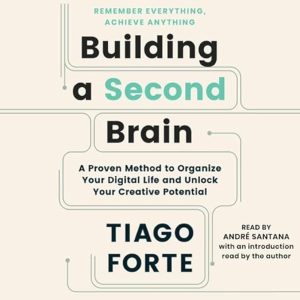
A book about organizing information has to survive the format it arrives in, and an audiobook is the least organizable format going. Tiago Forte's proposal is a personal system for capturing, keeping and retrieving what you learn, built for people drowning in saved articles they will never find again. Simon & Schuster Audio's edition spans seven hours and twenty-nine minutes with André Santana reading, and the honest first question is whether a method you are meant to implement survives being heard rather than seen.
PARA Method Is the Book's Load-Bearing Idea
Forte starts from a real condition rather than an invented one. The description names it precisely: instantaneous access to the world's knowledge has not left anybody feeling capable, it has produced the paralyzing stress of believing you will never know or remember enough. A Second Brain is the proposed answer, a trusted and organized digital repository of your ideas and notes synced across your devices, doing the remembering so that you can do the thinking.
The five-star account at the head of the list singles out what most readers carry away: the PARA method, described there as a clear roadmap for organizing your digital life. That is the load-bearing element. Two named frameworks, somewhere to put everything, and a process for turning saved material into finished work. The rest of the book is illustration, and how you feel about illustration will decide how you feel about the whole thing.
Nobody Disputes the Frameworks Themselves
As a verdict, that reads as both compliment and complaint, and the split runs straight through the accounts posted about it. Nobody disputes the frameworks. What people disagree about is how much book gets built around two ideas that could be diagrammed on an index card. That is not a fatal objection to a book, but it is worth knowing which half you are buying.
Santana Reads a Book No Review Mentions
André Santana reads the Simon & Schuster Audio edition, and none of the five posted accounts mentions the reading at all. All five discuss the book as a thing read rather than heard, right down to Boydad's headline, "A Practical, Enjoyable Read." The recording plainly exists; the enthusiasm attached to this listing was earned on the page, and anyone choosing the audio edition is doing so without a single data point about it.
What audio handles well here is the case rather than the configuration. The argumentative half of the book, the part explaining why saved information stays inert, travels fine through headphones. Forte's insistence that a system has to be trusted before it becomes useful is a psychological claim rather than a technical one, and it lands as cleanly spoken as written. The instructional half is where the format starts costing you something. That split runs through the whole book, and knowing which half you actually want is the single best guide to choosing between editions.
Boydad's five-star account opens with the two questions that settle whether you need this book at all: do you consume valuable information and then fail to put it to use, and do you have trouble locating your notes exactly when you need them? Answer yes twice and the argument is aimed at you. That same account supplies a detail the listing leaves out, dating the work to 2022 and naming Atria Books as its print publisher.
Two Reviewers Get the Author's Name Wrong
Riley Sheehan's four-star account is the most useful thing written about this book anywhere on the page, and the diagnosis deserves quoting: it "suffers from familiar business-book bloat, padded with meandering anecdotes" and name-dropping of high performers that strains credibility. The example given is Taylor Swift turning up as a case study for one of the frameworks. Sheehan still grades those frameworks as excellent, clear and portable, which is exactly the right place to draw the line.
Something else deserves flagging: how slippery the identifiers get. GP's five-star account introduces the author as Tiago Monte, while Rodrigo's calls the book Build a Second Brain. Two of the five people who liked it enough to write about it could not reproduce the author's name or the title accurately, which is a real discoverability problem for a work whose entire subject is retrieval. Search either mistake and this page is not where you land.
An oddity sits in the score itself. A 4.5 average rests on six ratings, while the five written accounts average 4.8 between them, which means one silent sixth vote is doing all the work of pulling the figure down. Six ratings on a title this widely discussed is a thin sample by any standard, and a swing of that size from a single anonymous vote is precisely the reason to ignore the number.
Practical cautions close the list, and both are real. Methodology needs doing rather than hearing, and you will want to pause and build something, which audio makes awkward in a way print does not. And the listing files this under computers and technology with a data science tag, which is wrong in a way that costs readers. Nothing here is data science. It is note-taking for people with jobs, and the people who need it most are not browsing that shelf.
Saved Links From a Decade Meet Their System
The clearest fit is somebody with a decade of saved links and no route back into any of them. Knowledge workers, writers, researchers, anyone whose output depends on material gathered months before it gets used: the system was designed for that exact shape of problem, and the frameworks give it a structure that does not depend on owning any particular software.
It also suits people at a transition point, when the volume of what you have collected suddenly outruns whatever arrangement you improvised for it. That moment usually arrives with a career change, a large research project, or simply more reading time than you used to have. The book is at its most persuasive when it is talking to somebody standing in that gap rather than to a general audience.
Anyone already running a note system that works will gain little beyond vocabulary, and anyone allergic to the cadence of business nonfiction will spend a lot of the running time waiting for the next framework to arrive. The honest recommendation is a narrow one: take this if you have the problem the opening chapters describe, and leave it if you do not, because the frameworks are genuinely excellent and the packaging around them is entirely ordinary.
At a Glance
- Voice: One credited reader, André Santana, on a book whose entire review pool discusses it as a printed object.
- Big ideas: Personal knowledge management, information overload, turning saved notes into finished work
- Atmosphere: Brisk, evangelical, intermittently padded
- Worth it?: Two genuinely portable frameworks inside a standard business book, worth it if you have the retrieval problem it describes.