- Voice: Brian Christian narrating his own book is an immediate asset, his familiarity with the technical material means he never sounds like he is decoding it on the fly, and his genuine enthusiasm for the interdisciplinary connections comes through in the delivery.
- Big ideas: Computer science as human decision-making framework, optimal stopping, sorting and scheduling problems
- Atmosphere: Intellectually playful and genuinely illuminating, with accessible math throughout
- Worth it?: One of the most successfully executed science-and-life crossover audiobooks in recent memory, and Christian's self-narration makes it the format to reach for first.
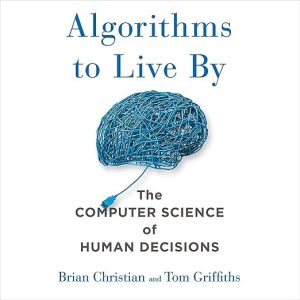
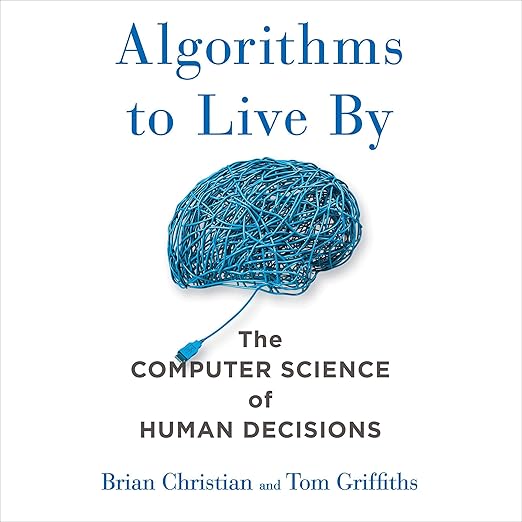
Sorting algorithms at a parking lot. Optimal stopping theory applied to finding an apartment. The explore-exploit tradeoff at a restaurant when you are deciding between a favorite dish and something new on the menu. Brian Christian and Tom Griffiths wrote Algorithms to Live By from the premise that the computational problems faced by computers and the decision problems faced by humans are not merely analogous - they are often identical, which means the solutions computer scientists developed over decades have direct practical implications for how we live. At eleven hours and fifty minutes, this audiobook explores that claim with more rigor and more care than the elevator pitch might suggest.
Christian has degrees in computer science, philosophy, and poetry and works, as the synopsis notes, at the intersection of all three. That background shows throughout. The book is not a pop-science simplification of computational concepts - it is a genuine intellectual project that takes both the computer science and the human decision-making seriously. One reviewer, a non-specialist who worried the material would be beyond her, found the book accessible without being condescending. Another described it as offering a concise history of early computing alongside ways in which computer science mirrors human thought. Both reactions are accurate, and the fact that such different readers found their way into the same material is a measure of how well Christian and Griffiths calibrated the writing.
Explore Thirty-Seven Percent, Then Commit
The optimal stopping problem - when to stop searching and commit to a choice, whether for a parking spot, a hire, or a life partner - is the book's most immediately compelling chapter, and it earns its prominent placement. The mathematical solution (the 37% rule: explore your first 37% of options, then commit to the next one that exceeds what you have seen so far) is presented with enough rigor to be genuinely informative and enough human application to be immediately relevant. Christian and Griffiths are careful to note where the algorithmic solution does and does not map cleanly onto real human situations, which is one of the book's most intellectually honest habits throughout.
Christian narrating his own work is a significant advantage here. His is not the voice of a performance narrator moving through unfamiliar material - it is the voice of someone who has spent years thinking about these ideas and who knows exactly where each chapter needs to land and why. When he describes the intuition behind a sorting algorithm or the implications of bandwidth versus latency for human cognitive limits, you can hear that he is drawing on genuine understanding rather than following a prepared script. That distinction matters over nearly twelve hours of listening.
The chapter on caching - and its application to how human memory works - is one of the most surprising and satisfying in the book. The insight that forgetting is not a failure of memory but an optimization strategy (the mind discards what it has not used recently precisely because recently unused information is statistically less likely to be needed) reframes a common human frustration as a rational design feature. Christian and Griffiths deliver this kind of reversal repeatedly throughout the book, and each one feels earned rather than forced.
Christian's Narration Draws on Genuine Understanding
The audiobook format works particularly well for this kind of interdisciplinary nonfiction. Christian's narration keeps the technical sections from becoming reference material - you cannot flip back to re-read a page, which forces him to be consistently clear rather than assuming that confusion can be resolved by rereading. The pacing of the audio delivery also means you cannot skim, which is actually advantageous: the chapters that feel less immediately relevant to your own life are often the ones that turn out to change how you think about something months later. The scheduling chapter and the networking chapter are examples of sections that can seem dry on paper but that come alive in audio with Christian's enthusiasm for the applications.
One reviewer came to the book as a member of the Long Now Foundation and used the phrase "great substance" to describe the content. Another called it a "fitting title for this book" that could have been named "How to Think Like a Computer." Both framings are useful. The book is simultaneously a history of computer science as a field and a practical guide to decision-making, and Christian manages both registers without letting either feel like filler for the other.
Griffiths, the UC Berkeley professor of cognitive science and psychology, brings a different disciplinary lens to the collaboration than Christian does, and the book benefits from that friction. The chapters on social algorithms - how the problems of individual decision-making scale up to group dynamics and institutional design - reflect Griffiths' influence and are among the most intellectually ambitious in the book.
Randomization Asks Readers for Extra Faith
The book's core claim - that computational algorithms offer directly applicable guidance for human decision problems - is more qualified and careful than a simple pop-science summary would suggest, but some readers still find individual chapter applications strained. The randomization chapter, for instance, which argues for introducing deliberate randomness into certain decision processes, requires more faith in the algorithmic framing than some practical readers will be willing to extend. Christian and Griffiths acknowledge the caveats consistently, but listeners should bring their own critical faculties to sections where the human applications feel more illustrative than prescriptive.
The technical depth varies across chapters. Some sections - particularly those involving probability and statistics - move quickly through mathematical concepts that non-quantitative listeners may want to slow down on. Christian's narration handles these passages with clarity, but the audio format means you cannot pause on a diagram or re-read a formula at your own pace. Listeners who want to engage deeply with the underlying mathematics may benefit from pairing the audio with the print edition for specific chapters.
At nearly twelve hours, the book covers a lot of ground. Some chapters will feel more immediately relevant than others depending on your specific life situation and professional context. The scheduling chapter is particularly valuable for anyone managing complex work schedules; the optimal stopping chapter is most compelling for anyone facing major life decisions. The book rewards being revisited rather than consumed once and shelved.
Rigorous Without Requiring a Math Degree
This audiobook is ideally suited for intellectually curious listeners who want their popular science to be genuinely rigorous rather than merely entertaining. It is strong for people who work in or adjacent to technology, for behavioral science readers, and for anyone who has found themselves frustrated by decision-making under uncertainty and wants a framework that is mathematically grounded without requiring a mathematics degree. Brian Christian's self-narration makes this the preferred format over print for most listeners. Those who want algorithmic applications without any technical scaffolding will need to look for lighter treatments of the same territory.