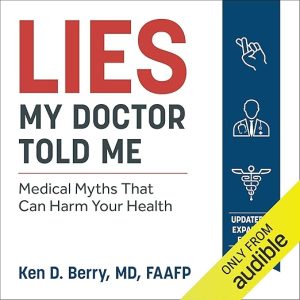
- Narrator: Geoff Sugiyama narrates with measured authority that suits Berry's clinical tone, though the pace of dense lists occasionally challenges retention.
- Subjects: Medical education gaps, nutrition science versus dietary dogma, patient empowerment
- Tone: Clear-eyed and purposeful, clinical without being cold
- Bottom line: A well-argued case that the low-fat dietary consensus has caused real harm, best heard as a serious contribution to an ongoing debate rather than a definitive verdict.
Titles like this one tend to produce immediate skepticism in me. 'Lies My Doctor Told Me' is the kind of provocation that can signal either genuine corrective medicine or motivated contrarianism dressed as iconoclasm. I started listening to this audiobook with that caution fully intact. Geoff Sugiyama's narration opens with a tone that is measured rather than conspiratorial, which helped. And then Dr. Ken Berry's actual argument began to unfold, and it became clear that whatever one makes of the specifics, this is a serious engagement with nutrition science, not a wellness polemic built on anecdote.
Berry's core contention is that the dietary advice most physicians dispense, low-fat, high-carb, 'healthy whole grains,' is not supported by current nutritional research and in some cases actively harms patients. He traces the origin of the food pyramid, the influence of the food industry on government nutritional guidelines, and the gap between what medical schools teach about nutrition and what the science currently shows. This is well-trodden territory in critical nutrition writing, but Berry presents it with clinical specificity and without the hectoring tone that mars similar books.
What Dr. Ken Berry Delivers
Geoff Sugiyama's narration is competent and professional throughout this audiobook, though the medical content occasionally demands a listening pace slower than his default delivery. Berry's writing includes dense lists of physiological claims, and Sugiyama reads them with the same pace he brings to the narrative sections, which can make it difficult to absorb the specifics without replaying. That said, for general listeners rather than those trying to extract precise clinical data, the narration serves the material adequately. Sugiyama's voice carries authority without condescension, which suits Berry's intended tone of 'educated conversation with your doctor' rather than patient lecture.
The book covers a specific and useful range of topics: fat intake and heart health, the effects of whole wheat on the human body, the role of dairy, the truth about dietary salt, dangers and benefits of hormone therapy, and emerging research on inflammation. What distinguishes Berry's treatment is that he consistently returns to the question of what well-meaning but misinformed physicians were taught versus what the evidence now shows. He is not accusing doctors of malice. He is documenting a systemic failure in how nutritional science is transmitted through medical education.
One reviewer, himself a physician, described the book as 'a refreshing read that takes a critical look at medical myths and misinformation,' and that framing captures what Berry is actually doing here. This is not anti-medicine. It is a call for medicine to update its nutrition curriculum. The distinction matters. Listeners who come to this audiobook expecting validation for dismissing their doctors wholesale will find that Berry consistently directs them toward better, more informed conversations with physicians rather than away from medical care.
Where Dr. Ken Berry Loses Some Ground
Berry's position on dietary fat and low-carbohydrate eating aligns with a specific school of nutritional thinking that is influential but not universally accepted. Listeners should engage with the book as a well-argued advocacy position rather than a settled scientific consensus. Berry presents his evidence clearly, but the nutritional science landscape is genuinely contested. Hearing one articulate voice in that conversation is valuable; treating it as the final word would be a misreading of what Berry himself seems to intend.
The accompanying PDF, which includes book and website recommendations for further study, is noted in the product description and adds genuine value for listeners who want to follow the research independently. At six hours and forty-one minutes, the runtime covers the core arguments without significant repetition.
Berry also does something useful with the history of how nutritional policy was made, not just what policy was made. The story of the food pyramid's origins, the role of lobbying from agricultural and food manufacturing interests, and the specific decisions that shaped federal dietary guidelines is presented as institutional history rather than conspiracy. Berry is arguing that well-meaning people made decisions inside a system that was subject to pressures they did not always adequately resist, and that the resulting guidance encoded errors that physicians then transmitted in good faith to patients. That framing is more useful, and more accurate, than a simpler argument about bad actors, and it points toward a more productive kind of institutional reform than outrage alone can deliver.
What also stands out in Berry's writing is his refusal to make the listener feel foolish for having believed the advice they were given. He is explicit that the information doctors transmitted was what they themselves were taught, and that the gap between what physicians knew and what the research showed was a systemic failure in medical education rather than individual negligence. That grace toward both patient and physician makes the audiobook more useful as a tool for starting difficult conversations with a doctor than if it were written as an accusation. Listeners can bring Berry's arguments to their next appointment without having to frame the conversation as a confrontation.
Who Should Pick Up Lies My Doctor Told Me
This audiobook works best for listeners who feel that standard dietary advice has not served them well and want a framework for understanding why, and for those who want to approach medical appointments with more specific, research-informed questions. It is equally useful for anyone who has been confused by conflicting nutritional messaging and wants a single, coherent alternative account. Listeners with thyroid conditions, cardiovascular concerns, or metabolic health issues will find specific sections directly relevant. Those who find Dr. Berry's low-carb perspective ideologically objectionable, or who prefer nutritional mainstream, should read this as useful counter-argument rather than recommendation.
A Few Questions About Lies My Doctor Told Me
Is the Lies My Doctor Told Me audiobook suitable for people with no medical background?
Yes. Berry writes in accessible language specifically aimed at non-specialists. The book's stated goal is to help listeners become more informed patients, not to train them as clinicians. Sugiyama's narration keeps the tone approachable throughout.
Does the audiobook cover specific conditions like thyroid disease or cardiovascular risk?
Yes. The book addresses thyroid management, heart health and fat intake, hormone therapy, and inflammation in dedicated sections. Listeners dealing with these conditions will find specific material relevant to their situations, though Berry consistently recommends using this information to have better conversations with physicians rather than replace them.