Quick Take
- Narrator: Shannon Downey self-narrates with the conversational urgency of someone who has been delivering this message in workshops for years, which gives the audiobook an energy a professional narrator would have struggled to replicate.
- Subjects: Craftivism and social justice art, collective action and community building, finding political agency through creative practice
- Tone: Energizing and warm, like the best kind of community organizing meeting
- Bottom line: A practical, joyful guide to art-based activism that works precisely because its author refuses to make the subject feel grim.
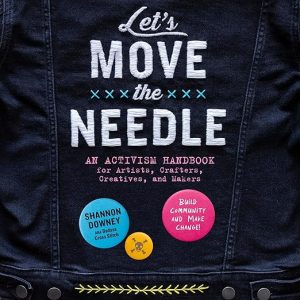
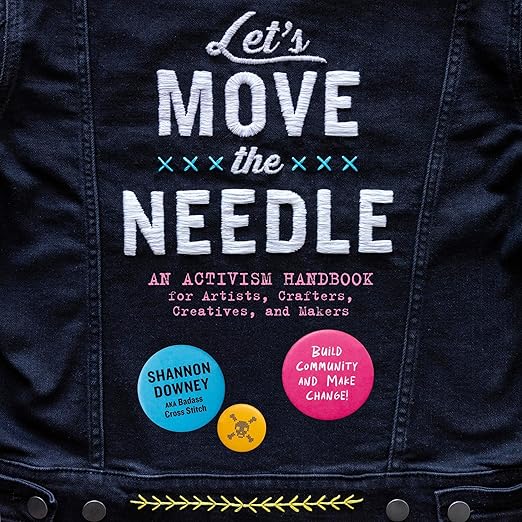
Shannon Downey's Let's Move the Needle is the kind of audiobook that asks you something in return for your attention. It does not settle for inspiration as a destination. Downey, the artist and activist behind Badass Cross Stitch, has spent over a decade building one of the more distinctive voices in the craftivism movement, the space where art and social justice organizing meet, and this audiobook, which she narrates herself, carries the accumulated conviction of someone who has tested these ideas in community workshops, protests, and public galleries before committing them to the page. At just over six hours, it is a concentrated listen, and one reviewer specifically noted they returned to it multiple times because there is so much to absorb in a single pass.
The book's central question, whether creative practice can function as genuine political agency rather than mere decoration, is one Downey has been living rather than theorizing. Her answer across six hours is layered, specific, and more rigorous than the warm, crafts-adjacent framing might suggest to first-time listeners.
Downey moves between self-reflective activities, exercises, and prompts on one hand, and personal stories and broader political context on the other. In print, those exercises would require a pen. In the audiobook, they function differently, as invitations to pause, reflect, and perhaps return to the recording with a notebook nearby. The multi-pass quality reviewers have noted is real: the book is dense in the best sense, not overwhelming but genuinely substantive in a way that a single listen might not fully capture.
The politics of the book are explicit and consistent. Downey is writing for people who want to make change around political, social, or community issues they are most passionate about, and she does not pretend the framework she offers is ideologically neutral. That clarity is a strength rather than a limitation. The book is not trying to convert skeptics; it is written for people who are already motivated toward progressive social justice work and want a practical framework for channeling that motivation through creative practice. One reviewer described it as refreshing to encounter a book about activism with so much joy and hope, which captures the tone accurately.
Downey's Framework Reaches Well Beyond Needle Arts
The self-narration is the central reason to choose the audiobook over the print version. Downey reads with an authenticity that comes from having lived the ideas rather than simply written them. She is funny in the places the book is meant to be funny. She is urgent in the places it needs urgency. The word authentic appears in multiple reviews of both the prose and its delivery, and that quality is palpable across the full six hours. Another reviewer described it as an inspiring and practical guide that challenges listeners to take actionable steps toward meaningful change, noting Downey's artful blending of social justice passion with her unique creative identity.
The examples Downey draws on are diverse, reaching well beyond needle arts into painting, ceramics, writing, photography, and community-based creative work. The framework she offers for centering art around collective action is genuinely transferable across disciplines, and the audiobook's consistent energy makes that transferability feel accessible rather than theoretical. Listeners whose creative practice has nothing to do with cross-stitch will still find the organizing principles directly applicable to their own work. Downey is also attentive to questions of access: she does not assume that art activism requires expensive materials, institutional connections, or a large platform. The book's consistent message is that the capacity to make change through creative practice is already present in most people who care about something, and that what is missing is usually a framework for channeling that care effectively. The audiobook delivers that framework with genuine practical specificity.
Political Strategy Matters More Than Stitch Technique
Listeners expecting a traditional how-to guide with step-by-step craft instructions will find the book operating at a different level. This is not a needlework tutorial. The practical exercises are more about self-reflection, community building, and political strategy than about specific artistic techniques. Listeners seeking the more instructional side of Downey's work may want to pair this audiobook with her online workshop content and community platforms, where the hands-on component lives more naturally.
The book's explicit social justice framing means that listeners who are skeptical of or opposed to that general orientation will find little common ground here. Downey is writing for her community, and she makes no apologies for that. Within that community, the reception has been consistently enthusiastic, with a 4.7 average rating across 61 reviews. The reviewers who connect with the work describe it as exactly the resource they needed, and the specificity of that response tells you something about how precisely calibrated this audiobook is to its intended audience.
Six Hours Answers Whether Art and Activism Mix
This audiobook is for artists, crafters, and creatives who want to understand how to connect their practice to political and social action without losing either the joy of making or the rigor of organizing. It is particularly valuable for people who feel torn between creative work and activism, who have wondered whether those two impulses can coexist productively. Shannon Downey's answer across six hours of self-narrated, direct, energizing audio is an unequivocal yes, and she makes that case with evidence drawn from over a decade of movement building. Listeners who prefer neutral, non-advocacy-oriented creative guides should look elsewhere. For anyone who wants to understand how creative practice can carry political meaning, this audiobook delivers on that premise with both intelligence and warmth that the self-narration makes uniquely real.
Does the Let's Move the Needle audiobook include the exercises and prompts from the print version?
Yes, the exercises and self-reflective prompts are included in the audiobook. Several listeners recommend having a notebook handy as you listen, and some reviewers found the audiobook worth a second pass to fully engage with the material Downey presents.
Is this audiobook relevant to creative disciplines beyond cross-stitch and needlework?
Very much so. Downey explicitly addresses multiple creative mediums and frames craftivism broadly as any art practice oriented toward collective social action. The framework she offers is applicable to visual art, writing, photography, performance, and community-based creative work.
Does this audiobook require any prior knowledge of the craftivism movement or Shannon Downey's work?
No prior knowledge is required. Downey builds the context for craftivism from the ground up, and the audiobook works equally well as a first introduction to the concept and as a deeper dive for listeners already familiar with her Badass Cross Stitch work.