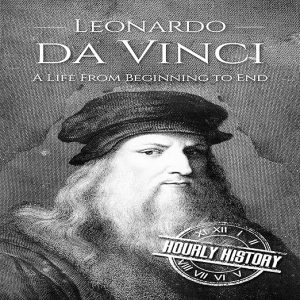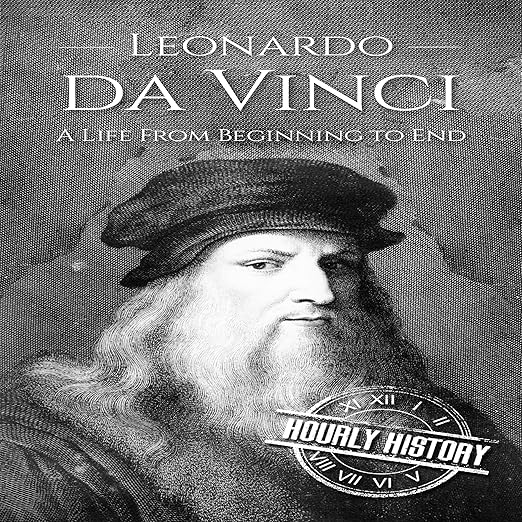
Leonardo da Vinci's notebooks have been sitting in libraries and private collections for five centuries, and the act of imagining them being opened is still startling. Anatomical drawings precise enough to be used in medical education. Flying machine sketches that would not be built for four hundred years. The preparatory studies for the Last Supper and the Mona Lisa. All of it written in mirror script, left-handed, in a hand so personal that scholars spent decades developing methods to read it. The audiobook Leonardo da Vinci: A Life From Beginning to End, from Hourly History's Biographies of Painters series and narrated by Nate Sjol, covers this extraordinary life in just over an hour, which tells you immediately what kind of audiobook this is and is not.
At 1 hour and 4 minutes, the production is exactly what the Hourly History format promises: a competent, efficiently organized introduction to the subject's life and significance, covering the key biographical moments, works, and intellectual contributions without claiming to provide the depth that a Walter Isaacson-length treatment offers. The question for this kind of audiobook is not whether it is comprehensive, it is not designed to be, but whether it provides a useful orientation to the subject and whether the narrator carries the material with sufficient engagement to make the hour worthwhile.
Past the Mona Lisa, Into Engineering and Anatomical Work
The biography is organized along the chapter structure listed in the synopsis, moving from early beginnings through the Italian Renaissance context, Leonardo's personal life, his artistic development, specific periods of his painting output, his scientific and anatomical studies, his engineering inventions, and his later life. This is a sensible structure for an overview because it mirrors the way Leonardo himself moved between domains: not sequentially but in an ongoing improvisation between art and science, between commission and independent inquiry.
Sjol's narration is clear and unhurried within the tight runtime, which is the right choice for a subject whose significance can get compressed into a list of famous works if the pacing is too fast. The sections on the Mona Lisa and the Vitruvian Man get appropriate attention, but the more interesting material for listeners who already know those works is the coverage of Leonardo's engineering inventions and anatomical studies, which represent a less publicly celebrated dimension of his output. One reviewer who was an art history major notes finding things here they were not aware of, which suggests the script is drawing on sources beyond the most commonly repeated Leonardo narrative.
Sjol's Clean Delivery Fits a Short Commute
The case for the audiobook format with Hourly History titles is specific: they work best as orientation tools before longer reading, as refreshers for material encountered years ago, or as introductions for listeners who want reliable biographical coverage without a major time investment. At just over an hour, this audiobook is appropriate for a commute or a short focused session, and Sjol's clean delivery means the information lands without requiring repeated listening to parse it.
For listeners coming to Leonardo with no prior knowledge, the audiobook covers enough context about the Italian Renaissance to make the subject's significance legible rather than assumed. The treatment of Leonardo's birth in 1452 to a peasant woman and his development as an entirely self-taught figure rather than a formally educated one is particularly useful because it contextualizes his later independence from guild conventions and commissioned subject matter. The script is written for accessibility, and reviewers note that it is accessible enough for younger readers while still containing material of substance for adults.
The Salai Relationship and 1476 Sodomy Charges
The sexual content that one reviewer mentions is a reference to the historical record of Leonardo's personal life, including his documented relationship with Gian Giacomo Caprotti, known as Salai, and the sodomy charges brought against him in Florence in 1476. Hourly History handles this material straightforwardly rather than suppressing it or sensationalizing it, which is the appropriate approach for a factual biographical overview. Listeners who plan to use this audiobook with younger listeners should be aware that these sections are present, though the treatment is factual rather than explicit.
The limitation of the format is most felt in the sections on scientific studies and engineering inventions, where the material genuinely demands more space than an hour allows. The anatomy work alone, the dissection of over thirty human corpses, the detailed muscle and skeletal studies, the mapping of the cardiovascular system, represents a scientific contribution that gets summarized when it deserves exploration. Listeners who find these sections most interesting will want to move to a longer treatment, such as the Isaacson biography, to pursue the subject properly.
A Map of the Territory, Not a Tour
Listeners who want a quick, reliable biographical overview of Leonardo for general knowledge, as preparation for visiting exhibitions or museums featuring Renaissance work, or as an introduction before reading longer accounts, will find this audiobook delivers exactly what it promises. Students at secondary level who need biographical context for art history or Renaissance history coursework will find the structure and accessibility helpful.
Listeners who already have solid familiarity with Leonardo's life and work will find the format too compressed to offer new perspective. And anyone hoping for substantive engagement with Leonardo's notebooks, his scientific methodology, or the specific technical analysis of individual paintings will find the Hourly History format unsuited to those goals. This is a map of the territory, not a tour of any single landscape within it.