
In Brief
- Narration: Eric Ledermann delivers the instructional content with a clear, unfussy pace that suits the beginner-facing material without making the listen feel like a lecture.
- Themes: Manual mode fundamentals, the exposure triangle, composition as storytelling
- Mood: Practical and encouraging, entry-level focused
- Verdict: Learning Photography is a compact and well-structured introduction to manual mode and composition for beginners who want to move beyond auto and understand why their shots look the way they do.
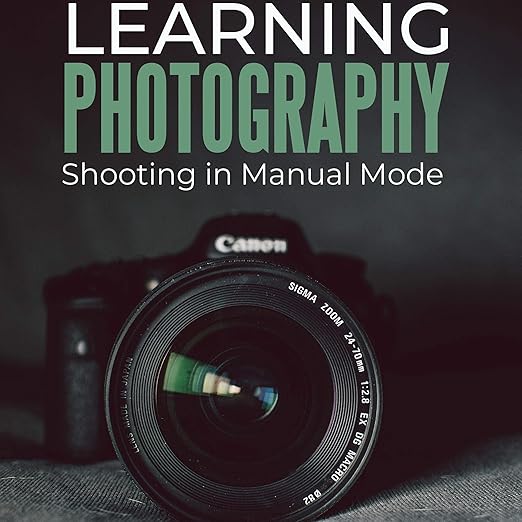
Why does the photographer with the same camera as you get dramatically better results? Learning Photography audiobook opens with exactly that question, and its answer is both simple and genuinely useful: manual mode, understood as the deliberate control of the exposure triangle, is the difference between a camera operator and a photographer. David Edwards's ninety-minute listen is not trying to be a comprehensive reference on the entire field of photography. It is trying to answer one specific question for a specific listener: the person who has bought a semi-professional camera, is intimidated by the manual controls, and wants to understand what they are doing rather than letting the camera decide for them.
At one hour and twenty-nine minutes, this is among the shortest audiobooks in its genre. That brevity is the book's most honest feature. Edwards makes no claim to be providing a complete photography education; he is providing the foundational layer that makes everything else buildable. The three elements of the exposure triangle, aperture, shutter speed, and ISO, are the core of the instruction, and the promise that "you can easily master them" is not false modesty. They are learnable in the time this book provides, and the composition chapter at the end extends the instruction from technical to artistic without overclaiming the artistic territory.
From Aperture Priority to True Manual Control
The book's structural honesty is one of its strengths. Edwards does not pretend that manual mode alone will transform your photography; he frames it correctly as the prerequisite for intentional creative control. The discussion of depth of field decisions, the specific effects achievable through shutter speed manipulation for motion blur and freeze, and the ISO noise trade-offs are presented in the kind of practical language that makes those concepts stick. Reviewer Peter Andolfi's experience, moving from aperture priority to genuine manual understanding after decades of shooting, reflects what the book actually accomplishes: it fills in the conceptual gaps that informal learning leaves behind.
The composition chapter is a genuinely valuable inclusion. Edwards's decision to end with the creative dimension rather than the technical one is the right structural choice: once the exposure mechanics are settled, the question becomes what you are doing with the control they provide. The rule of thirds, leading lines, and the storytelling function of framing are introduced with enough practical grounding to be immediately applicable rather than abstractly aspirational. Reviewer Jocelyn's specific praise for the coverage of histograms, RAW shooting, and light metering alongside the aperture and shutter content reflects the density of useful information Edwards manages within the tight runtime.
Ledermann Paces Concepts Without Screen Dependence
Eric Ledermann's narration is clean and appropriately paced for instructional material aimed at beginners. The exposure triangle concepts benefit from a narrator who does not rush through the explanations, and Ledermann gives each element enough space to register before moving on. For a subject that traditionally demands visual accompaniment, photography instruction in audio form requires a narrator who can make spatial and visual concepts comprehensible in language alone, and Ledermann manages this without the awkwardness that can make technical audiobooks frustrating.
The audio format is not the obvious choice for photography instruction, which is inherently visual. Edwards and Ledermann address this by keeping the instruction principle-focused rather than screen-dependent. The concepts of aperture, shutter speed, and ISO are physical phenomena with predictable effects, and explaining those effects in language is entirely achievable. Listeners who want to pair the audio instruction with visual examples will benefit from having a camera in hand during the listen and applying each concept immediately after it is explained, which is how instructional audio works best.
Ninety Minutes Skips Lighting and Post-Processing
The runtime is both the book's primary feature and its primary limitation. Ninety minutes covers the exposure triangle and basic composition. It does not cover lighting in depth, advanced composition techniques, post-processing, specific genre photography, lens selection, or any of the dozens of other topics that constitute serious photographic education. Listeners who arrive expecting a comprehensive photography course will find it significantly underdelivers on that expectation. As a foundation for beginner photographers specifically, it does exactly what it sets out to do.
The book also does not differentiate significantly between camera systems. The principles of the exposure triangle apply across all modern cameras including many smartphones, which Edwards notes, but specific interface guidance for different camera brands and models is not present. Listeners who have recently purchased a specific camera body and want model-specific instruction will need manufacturer resources or platform-specific tutorials alongside this foundational audio content.
Nothing New for Photographers Past the Basics
This audiobook belongs in the rotation of any beginner photographer who has been shooting in auto mode and wants to understand what manual control actually means before committing to a longer, more comprehensive course. The 4.4 rating across fifty reviews reflects satisfaction from exactly that audience. Kat L.'s description of it as "a great book for photography beginners" is accurate and captures the market positioning precisely.
Experienced photographers who have already mastered the exposure triangle and understand composition theory will find nothing new here. The book is not for them, and it does not pretend to be. For the specific listener it targets, someone who has a good camera and wants to stop being afraid of the manual mode dial, ninety minutes with Eric Ledermann and David Edwards will provide a clearer foundation than hours of informal experimentation or YouTube tutorials that assume too much prior knowledge. The instruction is clean, the runtime is honest, and the payoff is immediately applicable.







