Quick Take
- Narration: Derek Lettman delivers the technical content with a clean, measured cadence that suits Manning’s instructional style, clear articulation of command names and service terms makes the dense material easier to follow on audio.
- Themes: Cloud infrastructure fundamentals, Azure hands-on learning, practical application deployment
- Mood: Structured and confidence-building, like a well-run training workshop that respects your time
- Verdict: One of the more honestly structured cloud learning audiobooks available, the 21-lesson format works well in audio, but the lab exercises demand you have a screen nearby to extract full value.
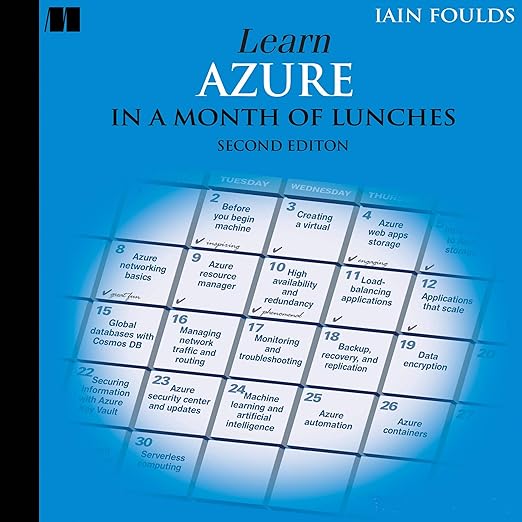
I finished the bulk of this one on a series of commutes over two weeks, which put me in roughly the right frame of mind for it. Manning’s Month of Lunches series is built around the idea that dense technical subjects can be broken into twenty-one digestible lessons, each short enough to complete on a lunch break. That constraint is a genuine editorial discipline, and it shows in how this second edition is structured. Iain Foulds, a Microsoft engineer and Azure trainer, brings the credibility of someone who actually builds and teaches the technology rather than someone who summarizes documentation.
The second edition covers significant changes to the Azure UI, adds container-focused content, and updates the Azure Kubernetes Service material. For anyone who worked through the first edition, the container and AKS additions alone justify returning. For first-time learners, the revision means the interface screenshots and service references are aligned with what you will actually encounter when you open the Azure portal today rather than what it looked like in a prior iteration.
The Lab Structure as Learning Architecture
The most distinctive feature of this book is that each of the twenty-one lessons includes a hands-on lab. The reviewer who described it as a book of exercises rather than a concepts book is identifying exactly what Foulds prioritized. The content is organized around the labs; the explanations exist to prepare you to execute the exercise, not the other way around. This is a fundamentally different philosophy from the textbook approach where concepts are explained in detail and exercises appear at the end of chapters as optional reinforcement.
In audio format, this creates a specific listening dynamic. You will hear a concept explained, followed by guidance on what you are about to do in the Azure portal. To actually complete the lab, you need a screen, an Azure account, and ideally the PDF companion that is included in your Audible Library with purchase. That companion document is not optional if you intend to follow along. The reviewer who noted that you cannot just listen and hope to absorb Azure fully is pointing at a real constraint. This is an audiobook that functions as the audio track of a lab course, not a standalone listening experience.
Scope and Honest Boundaries
Foulds is disciplined about what this book covers and what it does not. The focus is on creating cloud-based applications in Azure: understanding virtual machines, securing resources, using Azure services for containers, machine learning integration at a surface level, and automating environments. What it does not cover is enterprise-scale architecture, cost optimization strategies, or the breadth of Azure services that a cloud architect would need to understand. That is intentional. The goal is confident first-step mastery, not comprehensive certification preparation.
The narration by Derek Lettman handles the technical vocabulary competently. Azure service names, CLI commands, and acronyms are pronounced consistently and clearly, which matters more than it might seem in a topic where confusion between similar-sounding service names can send a learner down the wrong path. Lettman’s pace is measured without being slow, and the lesson breaks give natural pausing points. For a technical audiobook, the production quality is above average.
The PDF Companion as a Required Element
Worth addressing specifically: the accompanying PDF mentioned in the synopsis is load-bearing for this audiobook, not just a supplementary nicety. Foulds references diagrams, command sequences, and lab instructions throughout the text that assume you have access to visual materials. The Audible Library download process for these PDFs is straightforward, but you should confirm you have it accessible before starting the audio. Listeners who skip it will find the lab chapters significantly harder to follow and will miss the code examples and configuration sequences that anchor the conceptual content.
At 11 hours and 48 minutes, this is a substantial listen. The Month of Lunches framing suggests bite-sized sessions, and the lesson structure genuinely supports that kind of spaced listening. Returning to the audio after completing a lab and before starting the next lesson is a natural rhythm that the content accommodates. Whether you are preparing for the AZ-900 or AZ-104, building a side project on Azure, or simply trying to understand what Azure actually is before a workplace migration, this second edition lands as one of the more reliable entry points available in audio format.
Frequently Asked Questions
Is the PDF companion essential, or can I follow the audiobook without it?
The PDF companion is effectively required for the lab sections. It contains diagrams, command sequences, and configuration references that the audio track refers to throughout. Download it from your Audible Library before starting and keep it accessible on a second screen.
Does this book prepare you for Azure certification exams like the AZ-900 or AZ-104?
It provides solid foundational coverage that overlaps with AZ-900 content, but it is structured as a practical skills course rather than an exam prep guide. For certification-specific preparation you will want to supplement it with practice tests and official Microsoft learning paths.
How does the second edition differ from the first in terms of content?
The second edition adds coverage of Azure containers, updates the Azure Kubernetes Service material, and aligns interface descriptions with the current Azure UI. If you used the first edition, the container additions and UI updates are the most significant changes.
Do I need an active Azure subscription to get value from this audiobook?
The lab exercises require an Azure account, though a free-tier account covers most of what the early lessons need. Without an account you can still follow the conceptual content, but you will miss the hands-on reinforcement that the book is specifically built around.