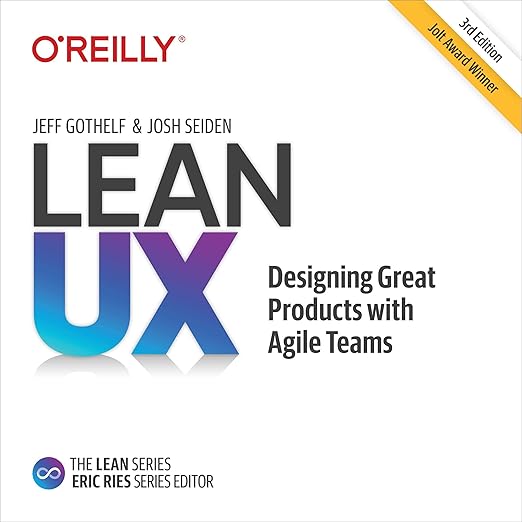
Quick Take
- Narration: Douglas Martin reads with a composed, professional delivery that suits the collaborative, workshop-oriented tone of Gothelf and Seiden’s writing – measured without being flat.
- Themes: User experience design in agile contexts, product discovery, outcome-driven development
- Mood: Collaborative and methodical, with a genuine sense of conviction behind the framework
- Verdict: The clearest articulation of how UX and agile actually work together, updated for the third edition with practical tools like the Lean UX Canvas – essential for product designers and PMs on cross-functional teams.
I listened to most of this one on a gray November morning with my second coffee, in the particular frame of mind that comes from reading too many sprint retrospectives the night before. The tension between design practice and agile delivery is something I have watched teams navigate badly for years – the UX designer stuck producing wireframes two sprints ahead while developers ship something different, the product manager caught between a customer journey map and a burn-down chart. Lean UX is the book that, more than any other, tries to resolve that tension at a structural level rather than a cultural one.
Jeff Gothelf and Josh Seiden published the first edition in 2013, and the third edition released in 2021 represents a genuinely updated document rather than a light revision. The core argument remains: design deliverables are not the product; the product experience is the product. The job of a designer on an agile team is not to produce comprehensive specifications but to generate hypotheses, test them quickly, and integrate findings into the next iteration. This sounds obvious when stated plainly, and yet the organizational defaults of most companies push against it at every stage.
The Lean UX Canvas and What It Actually Changes
The most tangible addition in the third edition is the Lean UX Canvas, a workshop facilitation tool that helps teams align on problem statements, assumptions, hypotheses, and success criteria before work begins. The book devotes real time to explaining how to use the canvas in practice, which is more than many frameworks do with their own tools. Gothelf and Seiden are explicit about what the canvas is for and what it cannot do – it is a conversation starter and a shared reference point, not a project plan. That honesty about scope is characteristic of the book’s approach generally: they tell you what works, what does not, and why.
The hypothesis-first framing – every feature is a hypothesis about what will improve user behavior or business outcomes, and the design work is an experiment to test that hypothesis – is the intellectual heart of the book. For product managers, it reframes the question from “what do we build next” to “what are we trying to learn and how quickly can we learn it.” For designers, it shifts the value proposition from craft output to insight generation. These are significant reframes, and Gothelf and Seiden handle them with enough concrete examples that the abstraction stays grounded.
Where Douglas Martin’s Narration Earns Its Keep
Douglas Martin reads this with a quiet confidence that matches Gothelf and Seiden’s writing style. The book is not a polemic – it does not shout about revolution or promise that everything changes when you adopt Lean UX. It makes a reasoned argument, illustrates it with scenarios, and trusts the listener to apply the logic to their own context. A narrator who pushed harder for excitement would undermine that register. Martin reads as if he has worked in product design himself, which may or may not be true, but the effect is that the material lands as practical advice rather than theoretical prescription.
At six hours and eleven minutes, the book is efficiently sized for its content. There is no filler. Each chapter builds on the previous one in a way that a cover-to-cover listen reinforces – unlike reference books that can be navigated randomly, Lean UX benefits from being heard sequentially because the framework is cumulative.
What the Third Edition Adds Beyond the Canvas
Beyond the canvas, the third edition expands its treatment of distributed and remote teams – a topic the first two editions could not have anticipated at its current scale. The remote collaboration sections are practical and specific, covering how to run Lean UX workshops asynchronously and how to maintain hypothesis alignment when a team is not co-located. There is also updated content on how Lean UX principles apply to continuous discovery, the Teresa Torres framework that has become central to many modern product teams’ operating models.
Reviewer responses are uniformly positive, with one describing it as “the most valuable book I read about UX” and another noting its applicability to low-code platform work – an interesting extension of the core framework into contexts the original book did not explicitly address. The breadth of applications reviewers describe suggests the principles are genuinely transferable rather than limited to traditional web product teams.
The Audience This Framework Was Built For
Lean UX is essential listening for UX designers, product managers, and engineering leads who work in cross-functional agile teams and find the relationship between design and sprint cycles constantly contentious. It is also strong for scrum masters and agile coaches who want to articulate why design must be integrated into sprints rather than running ahead of them. Less directly relevant if you are a solo designer or working in a non-agile organization with no immediate plans to change delivery methodology – the framework is built for team contexts. And if you are purely interested in visual or interaction design craft rather than product discovery process, you will find this book more organizational than technical.
Frequently Asked Questions
Does the third edition change the core Lean UX methodology significantly, or are the changes mostly surface-level updates?
The core methodology – hypothesis-driven design, outcome focus over deliverables, integrated cross-functional teams – is unchanged from earlier editions. The third edition adds the Lean UX Canvas as a practical facilitation tool, expands coverage of remote and distributed teams, and updates the continuous discovery sections. It is a meaningful revision worth reading even if you have covered earlier editions.
Is this book aimed at UX designers specifically, or is it equally useful for product managers and engineers?
Gothelf and Seiden deliberately write for cross-functional audiences. The book addresses designers, product managers, scrum masters, and engineers at different points, and much of its argument is about how these roles relate to each other in an agile context. Product managers often find it as immediately useful as designers.
How does Lean UX differ from other UX frameworks like design thinking or jobs-to-be-done?
Lean UX is specifically a delivery framework – it tells you how to integrate design work into agile sprints, not what design work should produce. Design thinking and jobs-to-be-done are more concerned with the nature of the problem being solved. Lean UX is compatible with both and can use their outputs as inputs to the hypothesis and experiment cycle the book describes.
Does listening to this audiobook require familiarity with agile methodology first?
Basic familiarity with agile concepts – sprints, backlogs, retrospectives – helps the material land more quickly. Gothelf and Seiden do not teach agile from scratch, though they explain how Lean UX fits within agile structures as they go. Someone with no prior agile exposure might want to pair this with a basic agile primer to get the full benefit.