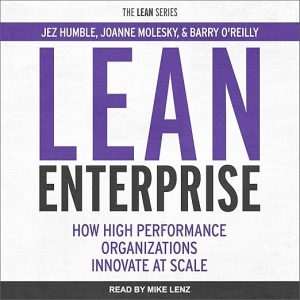
A companion PDF of value stream maps and governance frameworks ships alongside Lean Enterprise, and this audiobook is honest enough about its own structural limits to make that companion feel necessary rather than optional. Jez Humble, co-author of the widely cited Continuous Delivery, builds this book around a harder question than most Lean and Agile guides attempt: not how a single team adopts these practices, but how an entire organization, governance, finance, architecture, and culture together, rethinks itself around them. Across eleven hours, the book moves through real case studies of enterprises that made this shift, treating the organizational and cultural obstacles as seriously as the technical ones.
Gene Kim Calls It the Text for Our Generation
The book's credibility gets an unusually strong endorsement directly in its reader reviews. Gene Kim, himself a well-known figure in the DevOps community and author of several major books in the space, compares Lean Enterprise to Michael Hammer and James Champy's Reengineering the Corporation, calling it the equivalent text 'for our generation.' Kim also notes Humble's earlier work with David Farley on Continuous Delivery as foundational reading in this field, positioning Lean Enterprise as a natural, ambitious extension of that earlier, narrower technical focus into full organizational scope.
Reviewer Kenneth L. Smith describes reading an early Rough Cuts version before the final release and being 'already sold on the Lean Startup concepts,' specifically praising the book's practical view of leading transformation inside an established organization rather than a scrappy startup. That distinction matters: plenty of Lean and Agile material assumes a small, flexible team with few legacy constraints, and this book's actual subject is the harder, messier version of that transformation inside large, regulated enterprises.
O'Reilly's House Style Meets Regulated Industries
The book's publisher context is worth naming directly. O'Reilly Media has built its entire catalog around dense, practitioner-focused technical books that assume real prior context, and Lean Enterprise fits that house style closely: case-study-dense, allergic to oversimplification, and structured for readers who already know why Agile and DevOps matter and want the harder organizational-scale version of that conversation rather than an introduction to the basic concepts.
The synopsis specifically promises guidance for regulated environments, industries like finance, healthcare, and government where compliance requirements genuinely constrain how fast any team can iterate, not just organizational habit or resistance to change. That specificity matters because a great deal of Agile and DevOps literature implicitly assumes a tech company with minimal external oversight, and Humble's willingness to address genuine regulatory constraint head-on, rather than waving it away as a solvable culture problem, is part of what separates this book from more generic transformation guides.
Lenz Narrates With Measured, Consistent Authority
Mike Lenz narrates with measured, consistent authority and no theatrical flourish, which is exactly the right register for dense analytical material built around governance structures and financial management as much as software practice. He does not attempt to inject artificial energy into content that is inherently about process and organizational discipline, and that restraint keeps eleven hours of case studies and frameworks from feeling like a performance layered on top of the content.
Reviewer William H. offers a wry but genuinely useful piece of context: the book's real audience, in his assessment, skews toward individual practitioners at startups more than the enterprise management layers the title targets, since, as he puts it, 'your management will never read it or listen to your feedback.' That observation does not undercut the book's value so much as clarify who actually acts on it, engineers and technical leaders looking to build a case for change from below rather than executives implementing top-down.
Agile Started as a Small-Team Document
The book's actual ambition becomes clearer against the backdrop of where Agile methodology started. The original Agile Manifesto, written in 2001, was explicitly a small-team, software-focused document, and most Agile guides since have stayed close to that original scope: how one team ships better software faster. Lean Enterprise's real contribution is refusing to stop there, insisting that governance, budgeting cycles, and organizational culture have to change too, or team-level Agile practices eventually hit a ceiling no amount of better sprint planning can fix.
The book's emphasis on experimental problem-solving, testing assumptions and gathering real user feedback rather than committing to a fixed roadmap, extends a core Lean Startup principle into a much larger organizational context than a scrappy founding team. Applying that same experimental discipline inside a multi-thousand-person enterprise, with layers of existing process and sunk investment, is a genuinely harder problem than applying it inside a five-person startup, and the book treats that difficulty honestly rather than assuming the same techniques scale down cleanly.
Diagrams and Value Stream Maps Are Load-Bearing
The companion PDF is not a minor supplement here. Diagrams, governance frameworks, and value stream maps are genuinely load-bearing to several chapters, and listeners who skip downloading it will lose real content the audio-only experience cannot fully substitute for through description alone. This is a case where pairing the audiobook with its printed materials is close to essential rather than a nice-to-have.
At eleven hours across dense organizational and technical material, this is a significant commitment, and reviewer William H.'s caveat about management buy-in is worth taking seriously as a practical listening note. Listeners hoping to use the book to convince leadership of a Lean transformation should expect to do real translation work themselves; the book diagnoses and prescribes clearly, but does not include a ready-made pitch for skeptical executives.
Listeners should expect the book to spend real time on genuinely unglamorous organizational material, budgeting cycles, compliance processes, governance structures, alongside the more familiar technical DevOps content. That is by design and central to the book's argument, but listeners hoping for a purely technical, code-and-architecture-focused listen should recalibrate toward a broader organizational-change book that happens to include technical practice as one piece of a larger puzzle.
Listeners should also expect real attention to financial management as its own discipline within the book, not a brief aside. Traditional enterprise budgeting cycles, often annual, front-loaded, and resistant to mid-year change, sit in direct tension with the iterative, feedback-driven approach Lean and Agile methods assume, and Humble spends real time on how that specific tension gets resolved in organizations that have actually made the shift.
Hitting the Ceiling of Small-Team Practices
This audiobook suits engineers, technical leaders, and product managers inside larger, more regulated organizations who want a serious framework for organizational-scale Lean and Agile adoption, not just team-level process tweaks. It is especially useful for listeners who have hit the ceiling of what small-team agile practices can accomplish without governance and financial structures changing alongside them.
Skip it if you are looking for a lightweight introduction to Agile basics, since this assumes real familiarity with the underlying concepts already, or if your organization has no realistic path toward the kind of structural change the book assumes is possible.
- Voice: Mike Lenz brings measured, consistent authority to dense organizational and technical material without unnecessary flourish.
- Big ideas: Lean and Agile at enterprise scale, organizational culture change, DevOps in regulated environments
- Atmosphere: Serious, practical, and case-study driven
- Worth it?: A genuinely valuable resource for practitioners in larger organizations, best experienced alongside its companion PDF.
Is the Lean Enterprise audiobook useful outside of software teams?
Yes. The book's actual subject is organization-wide transformation, governance, financial management, and culture alongside technical practice, making it relevant to leaders beyond engineering teams, even though reviewer William H. notes management engagement is not guaranteed.
Does Mike Lenz's narration handle the technical density of the Lean Enterprise audiobook well?
Yes, his measured, consistent delivery avoids artificial energy, letting eleven hours of case studies and organizational frameworks read as credible and steady rather than performed.
Is the Lean Enterprise audiobook mainly theory or does it include real case studies?
It leans heavily on real case studies of enterprises that adopted Lean and Agile practices at scale, using those examples to ground what could otherwise be an abstract organizational framework.