At a Glance
- Performance: Oliver Wyman delivers Kotter's framework with the measured authority the material requires. At 6 hours and 34 minutes, the narration keeps the eight-step model clear without flattening the analytical nuance Kotter builds around each stage.
- What it covers: Organizational transformation, the difference between leadership and management, why well-intentioned change efforts fail
- Feel: Methodical and clear-eyed, a business classic that earns its reputation through diagnostic precision
- Our call: Kotter's eight-step change model remains the most cited framework in organizational transformation, and this audiobook delivers it with the rigor and clarity of a thinker who spent twenty-five years watching change efforts succeed and fail for identifiable reasons.
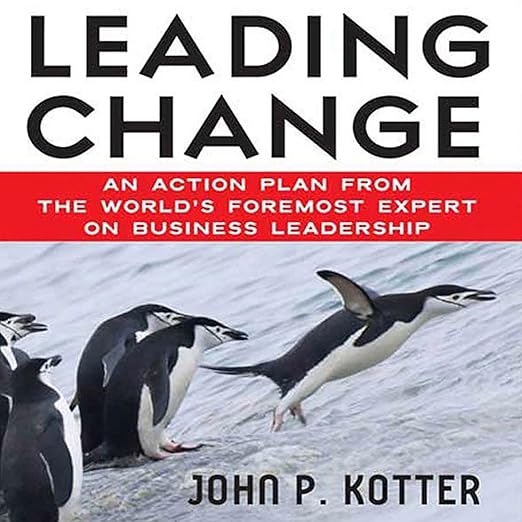
Leading Change by John Kotter arrived in 1996 and became, over the following three decades, the most widely referenced framework in organizational transformation. That durability is not accidental. Kotter, who spent twenty-five years studying change efforts across organizations of every size and sector before writing this book, did not build a framework around success stories. He built it around failure patterns. The eight-step process at the book's center is designed around the specific, recurrent ways that good people with genuine organizational resources fail to make change stick. Oliver Wyman's narration of this audiobook carries that diagnostic clarity with appropriate authority across 6 hours and 34 minutes, making this one of the more efficient business audio experiences available for the subject matter.
The book begins with a claim that is still provocative in organizations that conflate the two: management and leadership are not the same thing, and the methods that work for managing ongoing operations fail systematically when applied to transformation. Kotter identifies eight points where change efforts derail, and the eight steps correspond precisely to those failure modes. This structural mirroring between problem and solution is what gives the framework its staying power. It is not a to-do list but a diagnosis, and the difference between those two things is what most change management frameworks miss entirely.
Kotter's prose has the quality of someone who has watched enough change efforts fail that he has stopped being polite about the common mistakes. The eight stages, establishing urgency, building a guiding coalition, developing a vision, communicating that vision, empowering broad-based action, generating short-term wins, consolidating gains, and anchoring change in culture, are described not as boxes to check but as stages that have to be worked in order and at depth. Skipping urgency to get to vision, or celebrating short-term wins without consolidating gains, are not tactical errors but structural failures that Kotter has watched repeatedly undermine otherwise sound initiatives.
The reviewer who describes the book as addressing the critical difference between change efforts that succeed and those that fail is accurately summarizing Kotter's method. The book is not inspirational in the conventional business-book sense. It is analytical, occasionally sobering, and requires the reader to apply its diagnostic lens to their own organization honestly. Wyman's narration suits this register: authoritative without being warm, clear without being simplistic. The measured delivery helps listeners absorb the cumulative logic of the eight-step argument rather than treating each chapter as a standalone insight.
Wyman's Delivery Suits a Hierarchical Framework
The audiobook format works well for this material because Kotter's framework is most powerful when absorbed structurally rather than mined for individual insights. Wyman's delivery maintains the thread of the eight-step argument across the full runtime, which helps listeners track the cumulative logic rather than treating each stage as a standalone lesson. The six-and-a-half-hour runtime is appropriate for the material: substantial enough to develop each stage properly, compact enough to be absorbed in a focused listening session or two.
One reviewer who identified as relatively experienced in change management described the book as a classic that nonetheless carries a traditional management flavor, meaning the framework assumes relatively hierarchical organizational structures and a centralized change leadership model. That is an accurate characterization. Kotter's change model is built around visible leadership coalitions, which fits some organizational contexts better than others. Listeners working in flat organizations, distributed teams, or contexts where bottom-up transformation is the mode will find the framework requires translation to their specific situation. The diagnostic logic still holds even where the prescribed structure needs adaptation.
The Accelerator Model Answers a Later Critique
The book is now three decades old, and some of its examples and organizational assumptions reflect the corporate landscape of the mid-1990s rather than the current environment. Kotter updated the work in subsequent publications and the accelerator model in later books addresses some of the network-versus-hierarchy critique. But this audiobook is the original framework, which means some listeners will want to supplement it with more recent thinking on adaptive and agile organizational change to round out the picture.
That said, the failure modes Kotter identifies remain accurate. Insufficient urgency, weak coalitions, inadequate communication of vision, and insufficient consolidation of gains are as common in contemporary organizations as they were in 1996. The specific examples age; the diagnostic framework does not. The audiobook is most valuable as a lens for analyzing real change efforts rather than as a script to follow sequentially, and Wyman's measured narration supports that kind of active, analytical engagement with the material.
The Most Cited Framework, Made Efficient to Revisit
Organizational leaders, managers navigating transformation initiatives, consultants, and MBA students encountering change management for the first time will find this audiobook foundational. The reviewer who recommended it specifically for people interested in leading change initiatives at their jobs is pointing at the primary use case accurately. Wyman's narration is accessible enough that the audiobook does not require prior management training to follow, and the framework is clearly enough structured that listeners can begin applying it to real situations before the runtime ends.
Listeners who prefer case-study-heavy business books or who work in organizational contexts where the centralized-leadership model does not apply should supplement this with more contextually specific material. But as the most cited framework in organizational transformation, Leading Change is a reference point that anyone serious about change management needs to understand, and the audiobook format makes that understanding efficient to acquire and easy to revisit when a specific change effort is underway.
Does this audiobook require prior business or management background to follow?
No prior training is required. Kotter explains each stage from first principles, and the failure patterns he describes are intuitive to anyone who has watched a change initiative struggle or collapse. Listeners with some organizational experience will recognize the patterns more readily and find the framework more immediately applicable, but newcomers to management will follow the argument without difficulty.
How does Leading Change differ from other business audiobooks on organizational change?
Kotter's primary distinction is the diagnostic orientation: the eight steps correspond to specific failure modes rather than being aspirational principles. The emphasis on the difference between leadership and management as distinct functions is also more analytically rigorous than most change management frameworks. Reviewers consistently note it as a classic, though one with a traditional, hierarchy-friendly management flavor that may require translation for more distributed organizational structures.