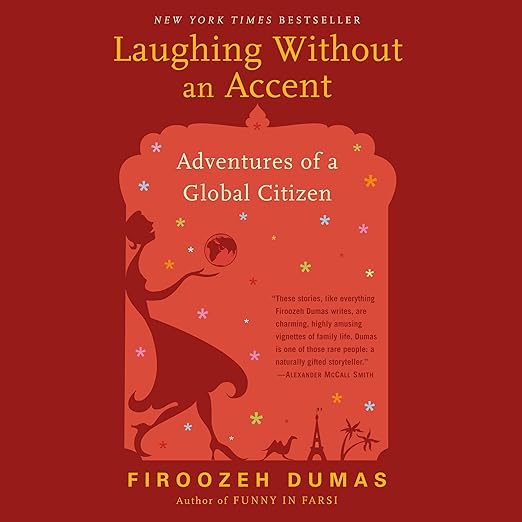
The test of a sequel memoir is whether it earns its existence independently of the original or simply coasts on the affection readers developed for the first book. Laughing Without an Accent by Firoozeh Dumas passes that test, and this audiobook, narrated by Dumas herself, is the ideal way to encounter it. This is the second installment in what the publisher frames as the Funny in Farsi series, following Dumas's debut memoir about growing up Iranian-American in Southern California. The new collection moves outward from childhood memory into adult life, marriage, new parenthood, extended family, and the ongoing project of holding two cultures simultaneously without losing either one.
At 6 hours and 11 minutes, this audiobook has the pacing and texture of a particularly good conversation. Dumas narrates with the timing of a practiced storyteller, which she is, and the humor in these essays lands with more precision in her own voice than it would in any hired narrator's interpretation. The jokes depend on rhythm and on the specific relationship between what is said and what is implied, and Dumas knows exactly where those beats fall.
Persian Censors Cut Every Reference to Ham
The essays in this collection are assembled around the theme of cultural collision and reconciliation, but Dumas never allows that frame to become heavy-handed. The piece about braving her French-born husband's uncommon palate is a masterclass in using family detail to reveal something true about cross-cultural negotiation without editorializing about it. The observation about Iranian wedding anniversaries, noting that it seemed odd to celebrate the day that our families decided we should marry even though I had never met you, and frankly it's not working out so well, is delivered with a timing that makes it genuinely funny while also being genuinely accurate about arranged marriage as a custom.
Dumas has been compared to Anne Lamott and Erma Bombeck, and those comparisons serve as useful orientation: she writes about family life with affection and honesty in roughly equal measure, and she is interested in the specific rather than the universal even when she is reaching for both at once. The pieces about becoming a new mother, removing the television from the house, taking 51 family members on an Alaskan birthday cruise, and road-tripping through Iowa with a former American hostage in Iran each carry their own weight independently. That is the mark of genuine essay craft as opposed to chapters that only make sense in sequence.
The material about her book being translated for Persian audiences, where censors edited out all references to ham, is a wonderful capsule of the specific absurdity that arises when a writer who exists between two cultures tries to communicate across the border that separates them. Dumas does not make that absurdity into a grievance; she makes it funny. That choice is politically meaningful whether or not she announces it as such.
A Perspective That's Never Being Translated
Self-narrated audiobooks by writers with strong comedic voices are a specific pleasure that the format rewards generously. Dumas's delivery has the quality that Booklist identified in her writing: warmth that invites the reader to pull up a seat at her table. In audio, that warmth is literal. You are listening to Firoozeh Dumas tell you stories about her family, and the experience carries the ease and intimacy of exactly that.
The cultural material in these essays also benefits from Dumas's own voice in a way that deserves mention. Her observations about Iranians and Americans and the space between them are funnier and more pointed when they arrive in her voice, because the perspective is not being translated. She is the Iranian-American writing about being Iranian-American, and the authorial position is legible in the delivery in ways that a neutral narrator would flatten. Alexander McCall Smith called her a naturally gifted storyteller, and the audio version is where that gift is most directly on display.
A 4.5 Rating From Over 700 Listeners
Listeners who have not read Funny in Farsi will find this collection immediately accessible, but they will miss the accumulated family history that makes some of the recurring characters feel fully dimensional. Dumas does not assume you know her mother or her father or the extended Persian family apparatus that recurs across her work, but the emotional payoffs are richer for those who do. Reading or listening to the first memoir first is recommended if you want the full experience.
The essay format also means the collection does not have the narrative momentum of a single sustained story. Some pieces are funnier, some more moving, and the tonal range across the collection is wider than a conventional memoir. Listeners who prefer sustained narrative arc over episodic reflection will find the structure loose, though the individual essays are consistent in quality. The 4.5 rating from over 700 listeners is solid and broadly consistent with the reading community's enthusiasm for Dumas's particular sensibility.
Narration Inseparable From the Experience Itself
Anyone who enjoyed Funny in Farsi should listen to this audiobook in Dumas's own voice rather than reading it in print. The narration is inseparable from the experience in a way that few self-narrated memoirs achieve so cleanly. Listeners interested in immigrant family narratives told with wit rather than grievance, readers who find cross-cultural comedy most satisfying when it comes from inside the experience rather than outside it, and anyone who simply wants six hours of good storytelling that leaves them feeling more generous toward the human species will find exactly that here.
Listeners expecting linear narrative or sustained dramatic tension should know this is an essay collection rather than a memoir with a through-line. The pleasures are episodic and cumulative rather than progressive. That is a stylistic characteristic of the book rather than a flaw in execution, and it is worth understanding before you begin.
Questions Listeners Ask
How does the audiobook experience compare to reading the print version?
Significantly better, for this specific book. Dumas narrates her own work with exceptional comedic timing, and the cultural humor in particular depends on rhythm and delivery that the written page captures incompletely. Self-narrated memoirs are a format where the audio version frequently surpasses print, and this is a strong example of that.
Is this audiobook appropriate for listeners who are not familiar with Iranian-American culture?
Yes. Dumas writes explicitly for cross-cultural audiences, and the humor works precisely because she explains the gap between cultural expectations without condescending to either side. One reviewer noted that the book helps readers understand that not all Iranians are defined by political stereotypes, and the warmth of Dumas's framing makes cultural education feel like a pleasure rather than a lesson.