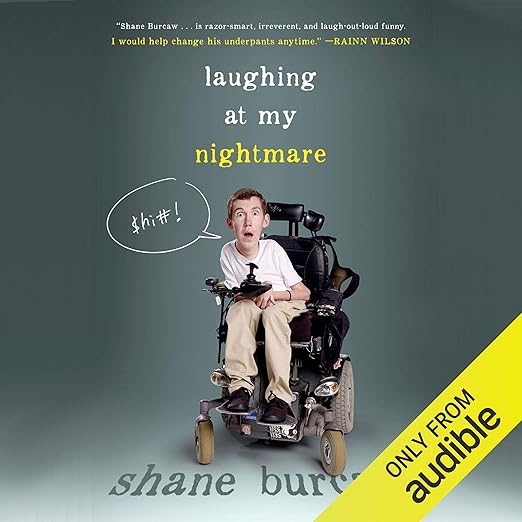
Shane Burcaw was twenty-one when he wrote this, and the audiobook hands his sentences to somebody else. That arrangement is completely standard and still worth pausing over here, because the thing everyone who writes about Laughing at My Nightmare praises is the voice: acerbic, funny, refusing to be sentimental about a body that is failing on a schedule. A memoir like this one lives or dies on tone, and tone is the single thing a product page cannot show you in advance.
Is Laughing at My Nightmare Worth Your Time?
The publisher's own description contains a word that one of the responses on this page objects to directly. The copy calls spinal muscular atrophy a life threatening disease. Ben Mattlin, writing the longest and most searching response here, says outright that referring to a disability as a disease is something to resist, because it emphasizes medicalization and casts the person as a victim of it. Those two statements sit on the same page arguing with each other, and nobody has reconciled them.
Five written responses appear on this listing and the vote counter reads one. That is not a rounding artifact or a convention I can talk my way around: a single whole-star vote cannot produce 4.7 under any arithmetic at all. Something in the aggregation has broken, and the practical effect is that the score means nothing while the five responses beneath it mean a great deal. Read those instead. They run longer and more specific than the average product page ever manages.
Kirby Heyborne holds the narration credit for six hours and seven minutes. A first-person memoir voiced by a third party is the normal arrangement in publishing, and it remains an interesting one here, because the book's whole proposition is one young man's particular way of describing his own life. The reading has to carry a joke structure, a great deal of self-deprecation, and passages where the humor is plainly doing defensive work. The listing gives you the name and nothing further.
Ben Mattlin's response is the one I would send a hesitant reader to, and it is equally the one that gets cut off. It opens with a confession of mild trepidation, a fear that Burcaw might be currying praise for being inspirational when all he is doing is surviving, and it works through that suspicion honestly before landing on approval. Then the text simply stops mid-sentence, partway through a point about not wanting pity. What survives is genuinely useful and visibly incomplete.
Squirmy and Grubs turns up in another response, and it explains a lot about how people find this book. Ellen writes about watching the YouTube channel, learning that Burcaw had written a later title called Strangers Assume my Girlfriend is my Nurse, and deciding to start at the beginning instead. Kris Rubi describes following Shane and Hannah on Facebook first and discovering the books afterward. A 2014 memoir is being found by an audience that formed years later, and the response dates running through 2019, 2022 and 2025 show it plainly.
Give it a miss if what you want is a medical account. Nobody on this page describes getting one, and the publisher's framing points elsewhere: awkward handshakes, having a girlfriend, and everything in between. Angela's four-star response catches the actual argument in a single line, that physical disabilities can be confining but need not be defining. That is the register throughout, and it explains why the book keeps turning up on teen shelves rather than health ones. The publisher's phrase for the attitude is a you-only-live-once perspective on life, which reads like a slogan until you notice how much weight it has to carry across six hours.
Before You Commit to Laughing at My Nightmare
Teen biography is the shelf this listing chooses, and the fit is only partly right. Burcaw was twenty-one at the time of writing, which puts him nearer in age to those readers than most memoirists ever manage, and the everyday material about school, friendship and dating is genuinely pitched at them. The responses here, though, are overwhelmingly from adults, several of whom arrived through a YouTube channel rather than a bookstore. The category is a starting point rather than a boundary.
Audible Studios is the imprint named on this listing, and the stated release date reads October 14, 2014, which makes this one of the older titles on the shelf with an audience still actively arriving. Debra Allen's response, posted five years after publication, describes it as the first book finished in years, read fast despite serious difficulty concentrating. That is a specific and unusual endorsement, and it tells you something about pacing that no synopsis could.
Readers who bounce off comedy about serious subjects should know precisely what they are walking into. The humor is aggressive rather than gentle, and Mattlin's opening suspicion, that a disabled author might be trading on inspiration, is a reaction worth taking seriously before you press play. The conclusion Mattlin reaches, quoting Shane's own line that he is just a normal guy, is the book's position arrived at independently by somebody who started out unconvinced. That trajectory, suspicion to endorsement, persuades me more than the four unqualified raves beneath it, and it is where I would send anyone the subject makes uneasy.
Who Should Pick Up Laughing at My Nightmare
Adults are the audience the responses actually reveal, and I would not steer anyone away on age grounds in either direction. What deserves flagging is the distance between what the publisher's copy promises and what the page demonstrates. The copy sells an eye-opening perspective on a life threatening disease. The responses talk about jokes, family, formative years, and a writer who models a way of carrying something heavy without asking anyone to stare at it. Nothing on the page sets a lower age bound either, and parents of younger teens should know the material takes in dating and a body that does not cooperate.
Six hours and seven minutes is a modest commitment for a book that several people here describe finishing faster than they expected to. The score above them is unusable, the publisher's vocabulary is contested by its own longest response, and all five people who took the trouble to write recommended it regardless. Heyborne's name is on the credit, and the case for pressing play sits in those five responses rather than in the badge above them.
A Few Questions About Laughing at My Nightmare
Does Shane Burcaw narrate the Laughing at My Nightmare audiobook?
No. Kirby Heyborne holds the narration credit for the full six hours and seven minutes. The book is written in first person by a twenty-one-year-old with spinal muscular atrophy, so a third-party reading is the standard publishing arrangement here, and worth knowing about before you begin.
How long is the audiobook, and does it move quickly?
Six hours and seven minutes. One four-star response calls it a short read, and another describes getting through it fast despite serious difficulty concentrating, which is unusual praise indeed. The book moves in episodes rather than one continuous argument, so it survives interrupted listening better than most memoirs.