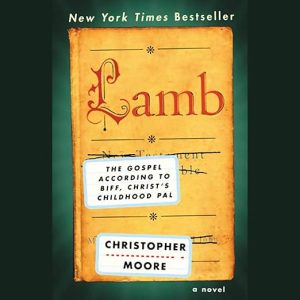
I came to Lamb on a long drive through the Texas Hill Country, somewhere between Fredericksburg and Junction, when I needed something that would keep me awake without demanding the close attention that dense literary fiction requires at highway speed. A colleague had pressed it on me for years, and I had always quietly assumed it would be the kind of broad, frat-house biblical comedy that mistakes irreverence for wit. I was wrong within the first twenty minutes, and wrong enough that I pulled over at a rest stop just to laugh properly.
Christopher Moore's novel covers the missing years of Jesus's life as narrated by his best friend Levi, called Biff, who has been resurrected in a contemporary hotel room by the angel Raziel to set the record straight. The Philadelphia Inquirer comparison to Vonnegut and Douglas Adams is not idle flattery. Moore shares Adams's gift for comedy that conceals genuine philosophical weight, and Vonnegut's willingness to use laughter as an approach to subjects that would otherwise be too painful to face directly.
First, the Big Picture
What Moore pulls off here is genuinely difficult. The book is very funny, full of kung fu lessons from a Buddhist monastery, Biff's escalating schemes to protect Joshua from his destiny, and the kind of absurdist energy that could easily tip into farce. But it never reduces Joshua himself to a punchline. One reviewer described it as making Jesus come alive on the page in a way that even the Gospels don't quite manage, and that is not entirely wrong. Moore's Joshua is curious, loving, and occasionally baffled, and the friendship at the novel's center feels completely real in the way that the best comic novels make everything feel real. Fisher Stevens's narration is a significant part of why this works as an audiobook. Stevens finds Biff's voice, a kind of eternal wiseacre who is sardonic but not cynical, and holds it consistently across fifteen hours without the performance ever feeling effortful. He trusts the material, which is the highest compliment you can pay a narrator.
What Makes Lamb Worth Hearing
Listeners who read widely will notice that Lamb sits in a specific comic tradition: the theological romp that uses humor to ask questions religious texts leave unanswered. It belongs alongside Good Omens and A Prayer for Owen Meany in a small category of books that are genuinely funny about genuinely serious things. The novel doesn't require religious belief to work; it requires only some familiarity with the broad outlines of the Gospel story, which most Western readers will have. Moore's research into first-century Judea, Buddhist practice, and various Eastern philosophies gives the picaresque journey real texture, and the jokes operate on multiple levels simultaneously.
Some listeners will find the adult content incompatible with their reading of the source material. That objection is fair. Moore is not writing a reverent text and doesn't pretend otherwise. But the critical consensus from readers of faith who have engaged with the book on its own terms tends toward appreciation rather than offense, particularly for how seriously the novel takes Joshua's inner life and moral development.
A Few Reservations
Pay attention to the structural arc. Moore isn't just stringing comic set pieces together; Biff's narration has genuine stakes, and the closer the story gets to Jerusalem and Golgotha, the more the comedy shades into something else. The tonal shift is gradual and earned rather than sudden, and it is the chief reason the book lingers after you've finished it. Also watch for Maggie, Mary of Magdala, whose characterization is one of Moore's cleverest acts of revisionism. Her scenes with both Joshua and Biff give the novel much of its emotional core, and she is far more than the supporting role her canonical status might suggest.
Who Should Pick Up Lamb
Listen if you enjoy comedy that operates on more than one register at once, if you've read Good Omens and wanted more, or if you're curious about what the Gospels deliberately leave out. Also listen if you need something that will carry fifteen hours of driving without a single dull stretch. Skip it if biblical humor of any kind strikes you as categorically off-limits, or if you're expecting a straightforward comedy with no emotional investment required. Lamb will make you laugh and then, without warning, make you feel something. Consider yourself forewarned.
Frequently Asked Questions
Does Lamb require familiarity with the Bible to be funny?
A basic familiarity with the Gospel story is helpful but not essential. Moore provides enough context that readers with only a cultural awareness of the story will follow everything. The comedy works on its own terms even without theological background.
Is this audiobook appropriate for teenagers or younger listeners?
Lamb contains adult content, including Biff's romantic escapades and some crude humor. It is written for adults and is best suited to listeners 17 and older. The publisher does not market it as a young adult title.
How does Fisher Stevens handle the distinction between the comic and the serious scenes?
Stevens is notably restrained throughout. He plays the humor naturally rather than broadly, which lets the dramatic weight of the later chapters land without a tonal collision. His performance is consistent across both registers and trusts the material to do its own work.
Does Lamb stand alone or does it require knowledge of other Christopher Moore novels?
It stands completely alone. Lamb is set in its own self-contained world and shares no characters or continuity with Moore's other books. It is an ideal starting point for readers new to his work.