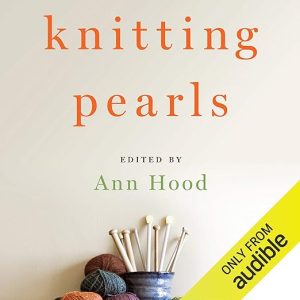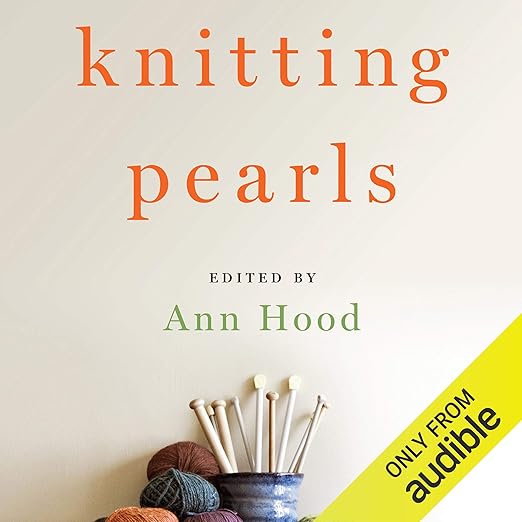
I picked up Knitting Pearls on a Friday evening when I wanted something I could drift in and out of without losing a thread, which turned out to be both a practical choice and an accidentally appropriate metaphor. This is an anthology edited by Ann Hood, collecting essays from two dozen writers on the subject of knitting: not how to do it, but what it means, what it holds, what it carries across time. It is the kind of collection that is at its best listened to in pieces rather than marathon sessions, with time between essays to sit with what each one leaves behind.
The contributor list is impressive: Lily King, Laura Lippman, Jodi Picoult, Steve Almond, Bill Roorbach, Christina Baker Kline among the fiction writers, and figures from the knitting world including Jared Flood of Brooklyn Tweed and Clara Parks. The range of voices is the collection's strength and occasionally its limitation. At its best, Lily King's essay about her daughter adjusting to Italy through a knitted hat; Bill Roorbach's account of knitting his way through a broken heart in his freshman year of college; Jodi Picoult on her grandmother, this anthology does something genuinely moving. It makes the case that hands occupied with repetitive work unlock a part of the mind unavailable by other means, and that what emerges from that unlocking is often memory and grief and love in their most precise forms.
Lippman Turns a Christmas Stocking Into Inheritance
The collection is uneven, as anthologies generally are. Not every essay earns its place, and some of the shorter pieces feel more like notes than developed reflections. One reviewer compared it unfavorably to the KnitLit series and found the overall effect lacking something she could not precisely name. I recognize that response. The essays that work best here are the ones that use knitting as a way into something larger, a relationship, a loss, a cultural identity, rather than the ones that stay on the surface of the craft itself. When the writers trust that the needles and yarn are vehicles rather than subjects, the writing opens up.
Laura Lippman's essay on how converting to Judaism changed her experience of her mother's knitted Christmas stocking is a good example of the kind of thematic complexity the best pieces achieve. It is not really about knitting; it is about inheritance, belief, and the objects that carry both, and knitting is the precise, specific frame that makes those large subjects navigable. That is the anthology at its best.
Dufris Doesn't Feminize His Voice for Women's Essays
William Dufris is a steady and warm narrator who handles the range of tones across two dozen essays without jarring shifts. A male narrator for an anthology this intimate with traditionally female domestic practice is a slightly counterintuitive choice, but Dufris reads with respect and attention rather than distance, and the result works. He does not attempt to feminize his voice for the essays by female writers, which would be patronizing; instead he reads the prose for what it is and lets the content carry its own gender complexity.
The knitting patterns interspersed from shops like Purl Soho, Hill Country Weavers, and Churchmouse Yarns are noted in the synopsis but are more relevant in print than in audio format. Listeners using this primarily as a literary anthology rather than a knitting resource will not miss the patterns; those who want them alongside the essays may find the companion text version more useful.
Knitting as Time-Keeping Runs Through the Grief Essays
The essays that involve grief are the collection's emotional core. Picoult on her grandmother, Hood's own contributions, and several others approach loss through the specific vehicle of a garment, a finished object that outlasts its maker, or a project abandoned at death and left for a family member to find. There is a recurring theme in these essays of knitting as a form of time-keeping: the hours embedded in a hand-knitted sweater, the way a project records the months it took to complete, the way finishing something carries the weight of every moment spent on it. That is the philosophy running under the anthology's surface, and it makes even the lighter essays feel part of something larger.
The audiobook format is genuinely well suited for an anthology like this. Individual essays average fifteen to twenty minutes at Dufris's reading pace, making them natural listening units during a commute or a craft session of your own. There is something pleasingly recursive about listening to essays on the meditative nature of a repetitive physical practice while engaged in a commute's own version of autopilot.
Knitters Who Read Essays Are the Target
This is a narrow target but a precise one: literary readers who knit or have knitting in their lives, and knitters who also read literary essays. Within that overlap, it is genuinely satisfying. Outside it, the stakes of individual essays are lower than they need to be to hold a non-knitting reader's investment. Gift recommendation: this is an unusually accurate book to give to someone who knits and also loves good personal essays, the description is specific enough that if it fits, it really fits.
Quick Take
- Read by: William Dufris brings a warm, unhurried reading style to the anthology, his male voice narrating essays by and about women knitters works better than you might expect, given the intimacy of the material.
- At its heart: Craft as memory and grief, the domestic as site of meaning, community and inheritance through making
- Vibe: Reflective and gentle, with flashes of humor and grief woven through the quieter essays
- Short version: An anthology for knitters who also read and readers who also knit, the overlap is the entire point, and within that intersection it delivers with real warmth.
Questions Listeners Ask
Does the audiobook include the knitting patterns mentioned in the synopsis?
The patterns from Purl Soho, Hill Country Weavers, and Churchmouse Yarns are included in the print edition. In the audiobook format they are not practically accessible as audio content. Listeners primarily interested in the literary essays rather than the pattern content will not miss anything essential.
How is an anthology of this kind organized, thematically or by contributor?
The essays are arranged by contributor rather than strict theme, though grief, memory, and inheritance form recurring threads across the collection. The lack of thematic organization means quality and emotional register vary from essay to essay, which is best approached as you would a curated short story collection, some pieces will resonate more than others.
How does William Dufris's narration handle an anthology written almost entirely by and about women?
Better than the casting choice might suggest. Dufris reads with warmth and attentiveness rather than attempting character impersonation, which is the right approach for essay narration. He serves the prose rather than interpreting it, which allows the voices of the individual writers to remain distinct despite a single narrator.