In Brief
- Voice: Clara Parkes reads her own essays with unhurried affection, the voice of someone who has been writing for her community for years and knows exactly who is listening.
- Big ideas: Craft as a way of knowing places, the fiber arts community as a global network, creative life and its quiet rituals
- Atmosphere: Warmly wandering and deeply cozy
- Worth it?: Knitlandia is a love letter to a specific kind of passionate attention, and Parkes makes it compelling even for listeners who have never touched a pair of needles.
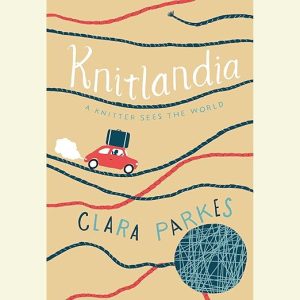
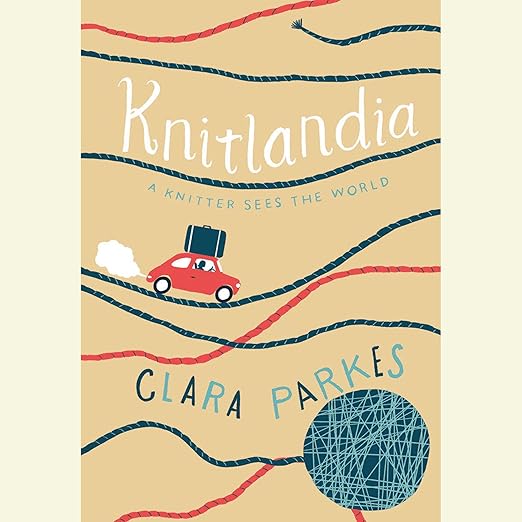
I am not a knitter. I want to say that upfront, because I suspect it affects how I hear Knitlandia differently than the devoted fiber community that Clara Parkes has cultivated over fifteen years of writing, teaching, and producing small-batch handcrafted yarns. I came to this audiobook because a travel-writing enthusiast colleague pressed it on me, insisting that Parkes's sense of place rivals the best in the genre regardless of subject matter. She was right, which is either a testament to Parkes's writing or a reminder that the best memoir is never really about its ostensible subject.
Knitlandia collects seventeen essays from Parkes's travels across the last fifteen years, each centered on a location where fiber arts intersect with local culture, community, or event. The chapters range from Iceland's fjords to a yarn shop in Paris's 13th arrondissement, from the New York Sheep and Wool Festival in Rhinebeck to a behind-the-scenes visit to Craftsy. At six hours and forty minutes, the book has the pleasant, ambling quality of someone taking you on a walk and pausing everywhere there is something interesting to point out.
Rhinebeck Becomes a Lens on Fiber Community
The essay on the New York Sheep and Wool Festival in Rhinebeck became the touchstone I kept returning to while listening to the rest of the book. It is a piece about an event, which sounds limiting, but Parkes uses the annual gathering as a lens for examining what it means to have a community built around a material. The festival draws thousands of people who organize significant portions of their calendars around attendance, who develop friendships and rivalries centered on fiber, who travel internationally to participate in what is essentially, from the outside, a very enthusiastic marketplace.
Parkes writes about this with the precision of someone who has been inside it long enough to see both its warmth and its occasional absurdities. A reviewer compared her tone to a brilliant but humble college roommate who has gone on to remarkable things but remained the entertaining, slightly wicked friend you adored. That description captures something true about the essays: Parkes has opinions, she occasionally lets her dry humor run free, and she does not sentimentalize the fiber world into a soft-focus idyll.
Iceland's Sheep Culture and a Paris Commitment
The Iceland chapter, described by one reviewer as especially vivid and descriptive, demonstrates what Parkes can do when she is writing about a landscape that genuinely moves her. She connects the country's sheep culture, its specific wool traditions, and its geography in a way that feels earned rather than touristic. The Paris chapter takes a different approach: Parkes commits herself to not buying yarn and to not entering yarn shops, and the essay becomes partly about the effort of keeping that commitment and what it reveals about her relationship to her own obsession. It is one of the better pieces of self-aware travel writing I have encountered in this format.
The prose throughout is what one reviewer called eloquently down-to-earth, which is a difficult register to sustain. Parkes writes with genuine literary ambition but no self-importance. She uses the specific and the sensory to carry meaning that a more conceptual writer might belabor. In audio format, with Parkes reading her own work, the effect is intimate in a way that serves the essay form well.
Clara Parkes Reads With Warmth, Never Affectation
Author-narrated audiobooks are sometimes an indulgence that does not serve the listener. Knitlandia is the exception. Parkes's voice has a warmth and ease that makes the essays feel like correspondence between friends. She reads without affectation, which might sound like faint praise, but for memoir it is essential: the moment a narrator performs emotion that does not feel lived, the contract between writer and listener breaks.
She also knows when to pause, which is a genuinely rare skill. The essays have natural rhythms, and Parkes respects those rhythms in the reading. A reviewer described the experience as feeling like traveling alongside her, which is exactly the sensation that a well-narrated travel memoir should produce. At six hours and forty minutes, the pacing never drags despite the book having no traditional plot arc to drive momentum.
Non-Knitters Will Recognize Their Own Obsessions Here
Several reviewers noted that Knitlandia works for readers beyond the fiber community, and I can confirm that from my own experience as a non-knitter. The book is ultimately about what happens when a person finds the thing they love and builds a life around pursuing it in depth. The knitting is specific; the insight is general. If you have a craft, a hobby, or a community that organizes your year around gathering and making, this book will reflect something true about your life back at you, regardless of whether it involves needles. Clara Parkes at Rhinebeck and Edinburgh and Portland is really just a woman paying close attention to what she loves, and that act of close attention is, it turns out, worth six hours and forty minutes of anyone's time.
I should add that the Craftsy chapter, which Parkes frames as a behind-the-scenes look at a company most knitters had interacted with only as students, is one of the more unusual pieces in the collection. It is part profile, part cultural observation about how the internet reorganized craft education, and it captures a specific moment in the history of the fiber community that has since shifted considerably. Reading it now has a nostalgic texture that Parkes could not have intended but that the passage of time has given it.
Good to Know
How does Clara Parkes reading her own essays affect the listening experience compared to a professional narrator?
It improves it considerably. Parkes knows exactly where the humor lives and where the emotion should land. The informal warmth in her narration fits the personal essay format in a way that a more technically polished reading might not achieve.
Is there a logical order to the seventeen essays, or can the audiobook be sampled non-sequentially?
The essays are largely self-contained and do not depend on each other for context. The book rewards listening in order for the cumulative sense of Parkes's voice and perspective, but individual chapters work on their own for listeners who want to sample specific locations or events.
How does Knitlandia compare to The Yarn Whisperer, Parkes's earlier memoir mentioned in the synopsis?
The Yarn Whisperer is more focused on Parkes's relationship to yarn and craft as identity; Knitlandia is more explicitly travel writing, with place and community taking precedence. Knitlandia stands alone, but readers who enjoyed The Yarn Whisperer will find familiar themes developed in a different direction.