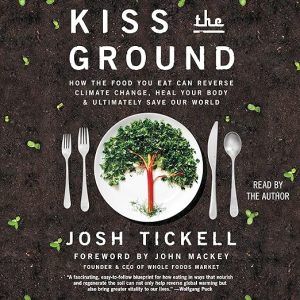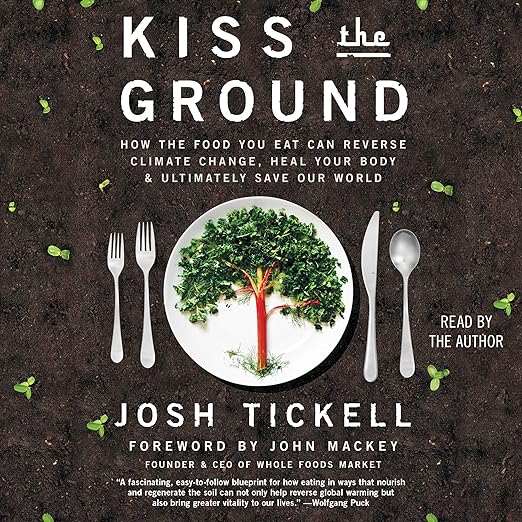
Wolfgang Puck calls this book's blueprint 'fascinating' and 'easy-to-follow,' and that specific praise, from a chef rather than a scientist or an activist, hints at what makes this audiobook different from a typical climate-argument nonfiction title. Josh Tickell, an established documentary filmmaker before he was ever a soil-health advocate, brings that same visual, story-first instinct to Kiss the Ground, building his case for regenerative agriculture around interviews with ranchers, farmers, and top scientists rather than pure argument or statistics.
Built Interview by Interview, Rather Than Argued
The central claim is genuinely ambitious: that changing how we farm and eat, specifically toward soil-nourishing, regenerative agriculture, could meaningfully help reverse global warming while also producing healthier food and eliminating harmful chemical inputs. Tickell doesn't just assert this; he builds it interview by interview, letting ranchers and scientists make the technical case in their own words while he handles the connective narrative between them, a structure that keeps nearly twelve hours from feeling like a lecture.
The book exists alongside a full documentary of the same name, executive produced by Leonardo DiCaprio and narrated by Woody Harrelson, and that pedigree is worth knowing even for listeners who never plan to watch the film. It signals a project with real production resources behind its research, not a self-published pamphlet, and the audiobook draws on that same depth of reporting, interviews and case studies that clearly took real time and access to assemble.
The book also gets genuinely specific in places. Reviewer philip d henderson highlights a detailed section on San Francisco's composting and recycling program as a real-world model of the practices Tickell advocates, the kind of concrete case study that grounds the broader planetary argument in something a listener could actually picture replicating in their own city.
The interview subjects themselves carry real weight beyond their credentials; Tickell doesn't just cite scientists in the abstract, he lets ranchers describe specific, measurable changes on their own land after switching practices, giving listeners concrete before-and-after evidence rather than asking them to take the broader climate claim purely on faith.
The book's emphasis on soil as a genuine climate solution, not just an agricultural efficiency question, represents a meaningfully different framing than most food-systems writing offers; where many books focus on individual dietary choices, Tickell keeps returning to the ground itself as the actual lever worth pulling.
Tickell's Documentary Instincts Carry the Narration
Tickell narrates his own material, and given his background as a documentary storyteller, that's a genuine strength rather than just an economical choice. He knows how to pace a visual argument for an audience that can't see the images, translating what would be sweeping farmland cinematography on screen into language built for the ear, and his own evident conviction about the subject comes through more naturally than a hired narrator's would on such personal, advocacy-driven material.
Reviewer ShreeWoman's description, calling the book 'a simple, practical and poetic blueprint,' captures the balancing act Tickell pulls off: plain enough to act on immediately, but written with enough genuine feeling for the subject that it doesn't read as dry policy advocacy. That combination of practicality and poetry is unusual in climate nonfiction, which tends to land firmly on one side or the other.
Self-narration also means the interview segments carry a genuine sense of presence; Tickell isn't reading a transcript of someone else's conversation with a rancher or scientist, he's recounting exchanges he actually had, and that firsthand quality comes through in small vocal cues, a pause before a striking quote, a note of real enthusiasm when a scientist's finding surprised him, that a professional narrator reading the same words secondhand couldn't fully replicate.
Tickell's own evolution from oil-industry-critical filmmaker, his earlier documentary work focused on the human cost of fossil fuel extraction, to soil-health advocate gives Kiss the Ground a throughline his fans will recognize: a consistent instinct for finding the human and environmental story underneath a large abstract systemic problem.
Twelve Hours Versus a Ninety-Minute Documentary
At nearly twelve hours, this runs considerably longer than the roughly ninety-minute documentary covering similar ground, and listeners should know upfront they're committing to a much deeper, more granular version of the argument, not just an audio version of the film. Reviewer tree's description of the book as essential for 'anyone who cares about the survival of life on earth' signals the urgent, occasionally sweeping tone Tickell adopts throughout; listeners who prefer climate writing that stays measured and hedged should know the register here leans toward advocacy.
The 4.8 average across 437 ratings is unusually high for a nonfiction title in this crowded climate-and-agriculture space, which is worth noting both as a positive signal and as a reason to check whether your own priors about regenerative agriculture already align with Tickell's before committing nearly twelve hours to a book built around persuading you they're correct.
Some listeners coming from a more skeptical, data-first orientation toward climate science may find Tickell's storytelling-first approach less persuasive than a book built primarily around peer-reviewed citation; that's a legitimate difference in rhetorical strategy worth knowing upfront, since the book's genuine goal is inspiring behavior change as much as winning an academic argument.
The 4.8 rating is genuinely rare for nonfiction in this space, and it's worth noting the review pool skews toward listeners already sympathetic to the book's environmental premise; a curious skeptic approaching the material fresh may weigh the arguments somewhat differently than the enthusiastic five-star consensus suggests.
One more practical consideration: because the book's argument builds cumulatively across interviews and case studies, it rewards a relatively continuous listen over a stop-and-start approach; listeners squeezing it into short fragmented sessions across many weeks may find the connective thread between chapters harder to hold onto than a listener who commits to longer, more continuous sessions.
Sustainable-Food Listeners, and Echoes of Michael Pollan
This suits listeners already interested in sustainable food systems, climate solutions, or regenerative agriculture specifically, plus anyone who found the documentary compelling and wants the fuller, more detailed case behind it. Home gardeners and anyone rethinking their own food sourcing will find plenty of genuinely actionable material, not just abstract argument.
Listeners who found Michael Pollan's food-systems writing compelling will recognize a similar instinct here toward connecting individual food choices to much larger systemic consequences, though Tickell's register runs more overtly activist than Pollan's typically does.
Skip it if you want a strictly scientific, citation-heavy treatment of soil science without the advocacy framing, or if nearly twelve hours feels like more commitment than you want for a subject the documentary covers in under two. Listeners skeptical of celebrity-adjacent environmental projects should know the DiCaprio and Harrelson connections upfront, even though the book's actual content stands on its own research.
The Short Version
- Performance: Josh Tickell's self-narration lends genuine firsthand presence to interview segments a hired reader couldn't fully replicate.
- What it covers: Regenerative agriculture, reversing climate change through soil health, food systems and personal action.
- Feel: Urgent but grounded, practical advocacy rather than abstract alarm.
- Our call: An ambitious, well-sourced case for regenerative agriculture, best for listeners already curious about sustainable food systems and willing to commit nearly twelve hours.
Do I need to have seen the Kiss the Ground documentary before listening to this audiobook?
No. The audiobook stands on its own and goes considerably deeper than the roughly ninety-minute film, executive produced by Leonardo DiCaprio and narrated by Woody Harrelson. Listeners who enjoyed the documentary will find a fuller, more detailed version of the same argument here.
Is Josh Tickell's self-narration a strength or a limitation for this audiobook?
It's a real strength. As a documentary filmmaker recounting interviews he personally conducted with ranchers and scientists, Tickell brings a firsthand presence and genuine conviction to the material that a hired narrator reading the same words secondhand would struggle to match.
Does this audiobook require any prior science background to follow?
No. Tickell builds his case through accessible interviews and storytelling rather than technical jargon, keeping the science approachable for listeners without a background in soil science or climate research.