- Voice: Pip Torrens, who played Tommy Lascelles in The Crown, narrates these diaries with an intimacy that borders on uncanny: he has already inhabited this voice on screen, and the audio version benefits from that prior embodiment in ways that are difficult to overstate.
- Big ideas: monarchy and duty, insider diplomacy, twentieth-century British history
- Atmosphere: Measured and revealing, with dry wit running through the historical weight
- Worth it?: One of the most unusual audiobook casting choices in recent memory: Torrens narrating the actual words of the man he played on television creates a listening experience that serious students of the period will not want to miss.
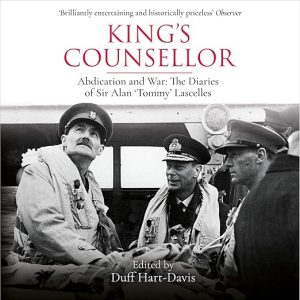
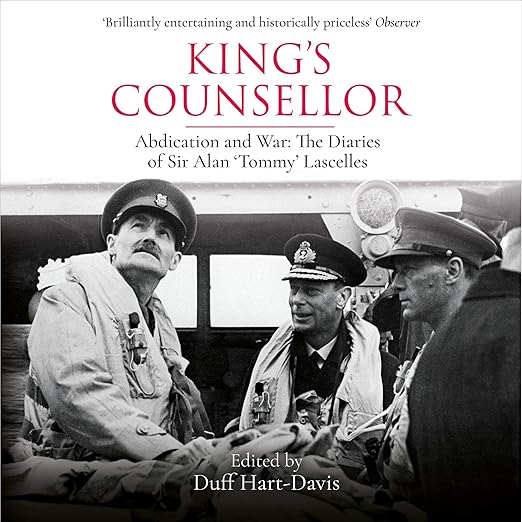
Tommy Lascelles served as private secretary to four British monarchs across a career that spanned Edward VIII's abdication crisis through Elizabeth II's coronation: and he took notes throughout. King's Counsellor collects the diaries of Sir Alan Lascelles, edited by Duff Hart-Davis, and in audio form it arrives with a casting decision that transforms the listening experience in ways that are genuinely unusual in audiobook history. Pip Torrens, who portrayed Lascelles in The Crown, narrates these actual historical documents. This audiobook runs approximately fourteen hours, and that runtime allows the diaries to accumulate the weight of years spent at the center of British royal life while the twentieth century was unmaking itself around the institution Lascelles served.
Torrens Already Spent Time Inhabiting This Man
The casting of Torrens is not a gimmick, and it doesn't function as one. He spent significant time researching and inhabiting Lascelles for television, and the audiobook narration reflects that prior immersion at every level. Lascelles wrote with a dry, precise wit that could turn on a single subordinate clause, and Torrens delivers those moments with the same understated quality that marked his screen performance: he never announces when something is funny or when something is devastating. He trusts the prose, and the prose rewards that trust throughout. The result is a narration that feels authored rather than performed, which is the highest compliment you can give to this kind of literary historical audio.
The diaries themselves are remarkable primary documents. Lascelles was present during some of the most consequential moments of British royal and political history in the middle of the twentieth century, and his accounts of those events have an insider texture that official histories and authorized biographies can't replicate. His portrait of Edward VIII is particularly sharp: affectionate enough to establish that Lascelles once genuinely admired the man, precise enough to document exactly when and how that admiration hardened into something closer to contempt. He writes about George VI with evident respect and restrained grief, and his early observations of the young Elizabeth are among the most interesting documents of the future queen's formation available in English.
The diary format's episodic rhythm suits audio listening particularly well. Each entry is contained, and the accumulation of entries over years builds a portrait of an institutional world that longer narrative histories sometimes flatten into summary.
Writing Without the Sanitizing Instinct of Courtiers
Primary source documents from the inner circle of the British monarchy in this period are rare by nature. Most of what we know about the private machinery of royal life in the 1930s through 1950s comes through memoirs, biographies, and authorized accounts that have passed through multiple editorial and political filters. Lascelles wrote for himself: with an awareness, perhaps, that these notes might eventually be read, but without the sanitizing instinct that most courtiers brought to their public-facing writing. The result is a degree of candor about personalities, decisions, and the operational reality of constitutional monarchy that official sources don't provide and that scholars of the period have found genuinely valuable.
Torrens sustains the necessary consistency across the full fourteen hours, which is a significant achievement. Longer audiobooks frequently show narrator drift: subtle shifts in register or energy that accumulate into something audible by the final chapters. Torrens maintains Lascelles's particular vocal quality throughout, in part because he knows this character well enough to sustain it without conscious effort. The late sections covering George VI's decline and Elizabeth II's early years are among the most affecting, and Torrens delivers them with the appropriate weight.
For listeners who came to this history through The Crown, the audiobook offers a corrective specificity that the dramatization, however excellent, couldn't provide. The real Lascelles is more nuanced than any television portrayal could capture, and hearing his actual words: in Torrens's voice: is an experience that fans of the period have described as revelatory.
This Predates Netflix's Most Recent Crown Seasons
Listeners who come primarily as Crown fans seeking behind-the-scenes detail will find the material richly relevant, but they should expect a document that covers a period substantially earlier than Netflix's most recent seasons. The diaries concentrate on the 1930s through early 1950s, which aligns most closely with the early Crown seasons. Those unfamiliar with the broader sweep of mid-century British history may find some entries require more context than the diaries themselves provide: Lascelles writes for himself, not for a general audience, and assumes familiarity with figures and events he considers obvious.
Hart-Davis's editing shapes what survives in this volume, and as with all edited diary collections, King's Counsellor reflects decisions about what was worth preserving. Lascelles's full diaries presumably contain more material than appears here. This is worth noting for historians seeking comprehensive coverage, though for general listeners the curation is appropriate and does justice to the originals without overwhelming them.
Torrens's Dual Presence, on Screen and in Audio
This audiobook is for listeners with genuine interest in twentieth-century British royal and political history, either as primary-source history or as the real-world context behind dramatizations like The Crown. The combination of Torrens's performance history and the quality of Lascelles's own prose: dry, precise, occasionally cutting: makes this one of the more distinctive biography audiobooks of recent years in the genre. Fourteen hours is a real commitment, but for listeners who have been waiting for an insider account of this period with actual literary quality, the investment is entirely justified.
Crown viewers who want to understand how the show's version of Lascelles was constructed, or how faithfully the drama engaged with the historical record, will find this audiobook provides answers on both counts with unusual directness. Torrens's dual presence: as screen character and audiobook narrator: makes the comparison between dramatization and history unusually immediate and unusually rewarding as a listening experience.