Before You Press Play
- Performance: David Lee Huynh gives Kai Young's contained, precise voice convincing weight, though the heat between him and Isabella reads cooler on audio than the text promises.
- What it covers: opposites-attract tension, billionaire forbidden romance, identity and family legacy
- Feel: Slow-burn with banter, emotionally engaging but lighter on explicit heat than the series opener.
- Our call: Readers already invested in the Kings of Sin world will find Kai and Isabella a compelling if somewhat cooler pairing than book one.
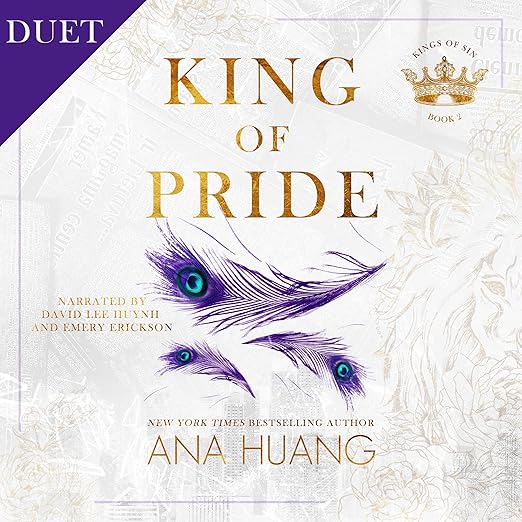
Kai Young is a man who translates Latin classics for pleasure and schedules his silences as carefully as his meetings. Ana Huang's audiobook King of Pride, the second entry in her Kings of Sin series narrated by David Lee Huynh, opens on that contradiction and never quite lets it go. The premise is exact in its geometry: reserved billionaire heir on the verge of a critical CEO vote meets Isabella Valencia, a purple-haired bartender whose warmth and impulsiveness cut through every one of Kai's defenses. Huang knows what she's doing with the opposites-attract structure, and the audiobook lets that tension breathe across eleven hours and eighteen minutes.
What the reviews surface quickly is that King of Pride is not the same animal as the first Kings of Sin installment. Listeners who arrived expecting the same heat level will find themselves in territory that is warmer in emotional texture than in explicit scenes. One reviewer put it plainly: four spicy scenes of moderate intensity, which ranks lower than the series average. This is worth naming upfront, because Huang's writing earns its rating through character architecture rather than through accumulation of heat. The question is whether you can let that be enough.
Isabella Shines While Huynh's Restraint Wavers
Huang's great gift here is Isabella. Multiple reviewers single her out as one of the best-drawn characters they've encountered in the genre in years, which is a genuinely strong endorsement in a space crowded with engaging heroines. She is impulsive, magnetic, and shaped by a backstory that the synopsis deliberately withholds. When the secret surfaces mid-book, readers describe feeling blindsided in the best possible way. Kai, for his part, is the more architecturally conventional of the two leads - the emotionally armored high-achiever who learns, through contact with chaos, that control is not the same as living. His arc is familiar but executed cleanly, and Huynh finds the quiet authority in him without flattening him into a type.
The banter is one of the audiobook's genuine pleasures. Reviewers consistently mention laughing aloud during the verbal sparring sequences, which is its own achievement in a format where timing is everything. Huynh handles the rhythm of these exchanges well, landing the comic beats without overselling them. Where the narration loses some ground is in the scenes that require full emotional release - the moments of confrontation and vulnerability where Huang's prose wants to crack open. Huynh's restraint, well-suited to Kai's character, occasionally works against the emotional temperature the scene needs. This is a recurring challenge when a narrator's natural register fits one protagonist so precisely: the voice becomes a liability in the passages where the other character's emotional volatility needs to dominate.
Banter Carries This Standalone Entry
The standalone construction is real and functional. King of Pride identifies enough of the world's architecture and key characters that a listener arriving without having read or heard book one will not feel lost. Characters from adjacent books make appearances, and there are threads that clearly belong to a larger tapestry, but the central arc of Kai and Isabella is fully contained and fully resolved. For listeners who prefer to dip into a series rather than commit to it from the beginning, this is a reasonable entry point.
What makes the audio format work specifically for this book is the banter. Prose on a page renders comedic timing as an inference; a narrator performs it as a fact. Huynh's control of pace makes Isabella's irreverence land differently than it would in silent reading. The jokes that make reviewers put down their books to laugh work because the delivery has committed to the joke fully. For the opposites-attract formula to succeed, you need to believe that this precise, Latin-translating man would find the chaos genuinely irresistible rather than merely tolerable. Huang's writing makes that case across the full arc of the book, and the audio production gives each comedic exchange the space it needs to register before moving on to the next complication. The eleven-hour runtime is well-paced for the emotional shape of the story.
Real Stakes at the Club, Familiar Missteps
Huang structures her romantic tension around the CEO vote subplot, which creates a functional external pressure on the romance without overwhelming it. Watch for how Huang uses the club setting where Isabella bartends: the power imbalance of Kai as a member and Isabella as staff is handled with more care than the genre average, and the forbidden dimension of that dynamic adds a layer that operates independently of the explicit content question. The class difference between Kai's world and Isabella's is not resolved through fantasy wealth redistribution but through Kai genuinely reckoning with what it costs Isabella to be in that space, which is a more honest accounting than this type of story usually manages.
One reviewer noted frustration with the characters' miscommunication patterns - the deliberate withholding of information that drives conflict in ways that sometimes feel preventable. This is a standard romance architecture, but in King of Pride it runs hot enough to produce real reader irritation rather than just pleasurable suspense. Listeners who find contrived misunderstandings particularly aggravating should know that this book leans into them. The payoff, when it comes, is earned, but the path through involves patience with the structure.
Chemistry Carries This One, Not Heat
Listeners who responded to the emotional intelligence and banter of Ana Huang's other work, particularly in the Twisted series, will feel at home here. Those specifically chasing explicit heat as the primary reason to listen should know they are getting a slower burn with less payoff on that dimension than comparable series entries. Kai and Isabella work as a pairing because of their character depth and verbal chemistry, not because the physical scenes are particularly intense. If you value character psychology over heat level, King of Pride delivers consistently. If the opposites-attract formula in a billionaire setting feels already exhausted to you, Huang's execution is strong enough to merit a chance, but it won't fundamentally reframe the genre for you.
Before You Listen
Does King of Pride work as a standalone audiobook, or do I need to listen to book one first?
The audiobook functions as a standalone. Kai and Isabella's arc is fully contained within this volume, and the story provides enough context about the Kings of Sin world that new listeners won't feel lost. Characters from other books appear, but their presence is flavor rather than essential backstory.
Is Isabella Valencia's backstory resolved within this audiobook?
Yes. The secret that the synopsis withholds is revealed mid-story and fully addressed before the ending. Multiple reviewers describe the reveal as genuinely surprising and emotionally affecting, and the resolution is not deferred to future volumes.